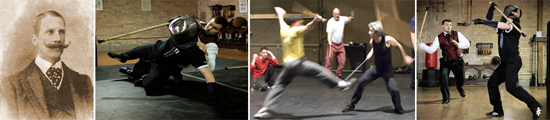
The aim of this sparring match was to faithfully reproduce the techniques presented in the treatises of Charlemont, Leboucher and other savate masters who taught the French art of unarmed combat from the beginning of the 19th century through the middle of the 20th.
For comparison, see this 1896 film of savate practitioners in action:
Note that this type of stylised, light-contact sparring reflects the desire of some professional instructors during the late 19th century to separate French kickboxing from its rowdy, back-alley origins. Instructors such as the Charlemonts wished to promote French kickboxing as a relatively genteel combat game and as a method of physical culture, suitable for middle-class patrons of commercial salles de savate. Inevitably, that rather academic and courteous style drew criticism from other quarters, especially from self defence-oriented instructors and from would-be professional athletes, who advocated for a hard-hitting version of the sport influenced by the no-nonsense ethos of English and American boxing.
Light-contact, academic sparring persists as the “savate assaut” option in modern Boxe Française – Savate, contrasted with the full-contact “savate combat”.
Posted inSavate, Sparring, Video|Comments Off on Boxe Française Historique: a Reconstruction of Classical Savate Sparring
Originally published on the Bartitsu.org site on Saturday, 19th May 2018
In common with most athlete/showmen of his time and place, John Clempert (1878-1940) was not averse to spinning some tall tales about his past exploits. He claimed, among other things, to have served as an enforcer in the Russian Army and to have escaped three times from the confines of a transportation van after having been exiled to Siberia for a political infraction.
Clempert arrived in England circa 1899 and quickly began to establish a reputation as an itinerant strongman, escape artist and wrestler on the music hall circuit. Inevitably his trajectory crossed that of E.W. Barton-Wright and his jiujitsu champions, Tani and Uyenishi, who were likewise gaining fame in the music halls.
At that time, Clempert’s signature feat was as “The Man They Cannot Hang”; a stunt which apparently involved hanging by his knees beneath a trapeze suspended over the stage, only then to release his hold on the trapeze and drop some 15 feet, his descent halted by a noose looped around his neck. Whether or not there was some showbiz trickery associated with this stunt, photographs clearly show that Clempert’s neck muscles were, in fact, unusually well-developed.
Swiss grappler Armand Cherpillod was, along with Tani and Uyenishi, employed by Barton-Wright as a challenge wrestler and instructor on behalf of the Bartitsu School of Arms. In his 1933 autobiography, Cherpillod – who seems to have had consistent difficulty in recalling personal names – offered an exciting account of “Klemsky’s” bout with “Yanichi” (Sadakazu Uyenishi):
As quick as a flash, the Japanese leaped onto the Russian and seized him by the collar of the jacket, one hand on each side of his neck, by crossing the wrists, and learnedly exerted the famous pressure on the carotid arteries, which brings choking, and even unconsciousness. The hold did not seem to have any effect on the Russian, who simply smiled at the audience.
Astonished by this resistance, the Japanese wrestler’s eyes gleamed with malice. He rolled across the ground past the Russian while preserving his hold and, to increase the force of the pressure on the neck, planted his two feet in the pit of Klemsky’s stomach. This tightened the grip so extremely that a net of blood escaped from the mouth of Klemsky and sprinkled his face. It was only then that Yanichi [Uyenishi] released his hold and let fall beside him the apparently lifeless body of the Russian.
The public believed that Klemsky had died. They howled their anger and their disapproval of Yanichi. This latter, triumphant, appeared to be insensitive to the hostile remonstrations of the public. He went to sit down on the sidelines, beside his compatriot, in the manner of the tailors at work, by crossing his legs beneath him.
While the spectators redoubled their cries, our two Japanese entered into an animated conversation and even laughed together, contemplating the victim who did not give any sign of life. Suddenly, one of them rose, as if driven by a spring, and approached Klemsky. He leaned on the body of the Russian and gave some sort of vibration or massage to the cardiac area, which revived the victim gradually.
Then, to the great astonishment of the audience who were now gasping, Klemsky opened his eyes and asked where he was. This seemed magical, and even more than before, Jiu-jitsu appeared to be a most mysterious form of fighting.
When someone asked Klemsky for his impression of the event, he said that while losing consciousness, he had heard the sound of bells.
This account is especially interesting in that it’s one of the few records of a Bartitsu Club champion actually rendering a wrestling opponent unconscious, and one of the very first records of kuatsu (Japanese manual resuscitation techniques) in any non-Japanese media.
Clempert himself later recalled his encounter with Uyenishi in a letter published in the October 17th issue of The Encore:
The first time I ever met anybody under 12 stone was when I took on one of Mr. Barton-Wright’s Japs at the Empire. Beat him in the first five seconds in Greco-Roman style, putting him fairly on his back. He felt as though he was a baby. After that he put me to sleep – not from his strength, but by some sort of magnetism he used. I did not feel any pain. I do not know exactly understand what sort of wrestlers they are. According to my idea, they are not wrestlers but magicians.
I challenge them on the following conditions; Greco-Roman, catch-as-catch-can style or Straps. I put down five pounds if I don’t beat one of them within 10 minutes. But if they want to wrestle in their own way, which is called “self-defence”, I will undertake to defend myself in my own way. This means I shall try to disable my opponent before he can disable me. Some money must be staked, as it is their own style of wrestling. I will not take any responsibility about accidents. Of course, this kind of contest would have to take place where there are no ladies, such as at Wonderland or a sporting club.
Yours truly, John Clempert
Despite this bold challenge, there seems to be no further record of John Clempert taking on a jiujitsu-trained opponent.
In February of 1903, Clempert suffered a serious injury while performing his hanging stunt and was taken to hospital suffering from a “concussion of the spinal cord”. He recovered, but seems to have retired that stunt from his repertoire, thereafter continuing his career as a wrestler and an escape artist in the manner of Harry Houdini. Circa 1909, he also produced a pitchbook, the gloriously-titled Thrilling Episodes of John Clempert, The Shining Star of the Realms of Mystery.
Houdini, however, did not suffer imitators gladly and put legal pressure on Clempert to stop performing several escapes that were a little too directly inspired by Houdini’s own. Clempert apologised and promised to desist, although he did briefly come out of retirement after Houdini’s untimely death in 1926.
Originally published on the Bartitsu.org site on Tuesday, 12th February 2013
Announcing the third international Bartitsu symposium, to take place at Beamish Museum near Newcastle, UK, between September 14th and 15th, 2013.
Update: the Google Groups email list for the School of Arms event is now live at this website.
Instructors and participants who have booked their tickets should now have received an automatic subscription notice allowing full access to the list, delivered to the email address they gave when making their bookings. You may need to check your spam folders, etc.
If you are booked to attend the event but have not received an automatic subscription or invitation, please apply for membership via the webpage link above.
Premise
Training
Schedule
Location and venue
Museum visit
Saturday night buffet and forum at the Sun Inn
Antagonisticathlon
Prerequisites
Please bring:
Local accommodation options
Registration
Premise
To preserve and extend the pioneering martial arts cross-training experiments begun by E. W. Barton-Wright at the original Bartitsu School of Arms and Physical Culture, circa 1901:
Under Bartitsu is included boxing, or the use of the fist as a hitting medium, the use of the feet both in an offensive and defensive sense, the use of the walking stick as a means of self-defence. Judo and jujitsu, which are secret styles of Japanese wrestling, I would call close play as applied to self-defence.
In order to ensure, as far as it is possible, immunity against injury in cowardly attacks or quarrels, one must understand boxing in order to thoroughly appreciate the danger and rapidity of a well-directed blow, and the particular parts of the body which are scientifically attacked. The same, of course, applies to the use of the foot or the stick.
Judo and jujitsu were not designed as primary means of attack and defence against a boxer or a man who kicks you, but are only to be used after coming to close quarters, and in order to get to close quarters it is absolutely necessary to understand boxing and the use of the foot.
– E.W. Barton-Wright, lecture for the Japan Society of London, 1902
Training
School of Arms participants will meet each morning at the Beamish Museum main entrance and then board an authentic early 20th-century electric tram for a five-minute trip back in time to “Beamish Town”, circa 1901.
The event includes an intense and immersive two days of cross-training and circuit training with fellow enthusiasts, guided by a team of Bartitsu instructors and inspired by the ideal of Barton-Wright’s School of Arms:
In one corner is M. Vigny, the World’s Champion with the single-stick: the Champion who is the acknowledged master of savate trains his pupils in another … he leads you gently on with gloves and single-stick, through the mazes of the arts, until, at last, with your trained eye and supple muscles, no unskilled brute force can put you out, literally or metaphorically.
In another part of the Club are more Champions, this time from far Japan, who will teach you once more of how little you know of the muscles that keep you perpendicular, and of the startling effects of sudden leverage properly applied …
… when you have mastered the various branches of the work done at the Club, which includes a system of physical drill taught by another Champion, this time from Switzerland, the world is before you, even though a “Hooligan” may be behind you …
– “S.L.B.” in the article “Defence Against ‘Hooligans’: Bartitsu Methods in London”, from The Sketch, April 10, 1901
Following the successful model of the previous events in London and Chicago, our days will include whole-group training sessions as well as skills-based circuit training and breakout groups concentrating on particular areas of interest. Some cross-training sessions will be team-taught by instructors and others will involve peer-to-peer work.
Instructors and class themes will include:
Tony Wolf (New Zealand/USA) will be running sessions in combat tactics/biomechanics across each of the Bartitsu skill-sets of boxing, low kicking, jujitsu and stick fighting, as well as neo-Bartitsu “combat improv” drills, building upon the stylised canonical sequences through progressive levels of improvisation and resistance as a bridge between set-plays and free-sparring.
Allen Reed (USA) will concentrate on canonical jujitsu sequences and counters to those sequences arising from resistance by the opponent.- UPDATE Sept. 6– sadly, due to his wife suddenly being taken ill, Allen will not longer be able to join us at the School of Arms. The canonical jujitsu sessions will be distributed amongst the other instructors.
James Marwood (UK) will focus on practical applications of Bartitsu principles, specifically the use of boxing/pugilism and jujitsu atemi-waza and grappling to deal with assaults. Working from the premise that such an assault will be a surprise, James will show that the base arts and principles of Bartitsu can be applied to vastly increase one’s chance of a successful outcome.
Mark P. Donnelly (USA) will cover advanced tactics and techniques for employing walking stick, cane, umbrella or parasol at all ranges; using the reach advantage to best effect at long range, holding your own at medium range against a pugilist and exploiting the mechanical advantage of grappling with a cane at close range.
Schedule
Friday, September 13th: 12.00 – 5.00: optional (but highly recommended) visit to Beamish Museum, including a 1/2 hour Bartitsu demonstration to be held in either the Beamish bandstand or the Masonic Hall (see below for details).
Saturday, September 14th: Bartitsu training at the School of Arms venue 10.00 a.m. – 12.30 p.m., 1/2 hour lunch break (we recommend that you bring a packed lunch); training 1.00 p.m. – 5.00 p.m.; Antagonisticathlon (weather permitting – see below); 6.00-9.00, reconvene for buffet dinner, discussions and socialising at the Sun Inn, just down the street from the School of Arms venue.
Sunday, September 15th: Bartitsu training at the School of Arms venue 10.00 a.m. – 12.30 p.m., 1/2 hour lunch break (we recommend that you bring a packed lunch); training 1.00 p.m. – 4.15 p.m.; closing, presentation of participation certificates, group photos and farewells.
The 2012 School of Arms venue is Beamish Museum which is located near the town of Stanley in County Durham, UK.
Established in 1972, Beamish is a multi-award winning open-air “living history” museum spread over 300 acres, with extensive exhibitions representing transportation, engineering, agriculture, coal mining and town life during the Victorian and Edwardian eras. The museum houses some 300,000 historical artifacts, ranging from thimbles to vehicles and buildings, and is staffed by costumed interpreters. Beamish has also been used as a location for TV series, including dramas based on the works of novelist Catherine Cookson.
The Bartitsu School of Arms will be established on the second floor of the historic Barclays Bank building, which is situated along the main street of “Beamish Town”:
Please click here to view a fully interactive map of the local area, plus detailed directions. You can also use this map to check routes to and from the venue and accommodation/entertainment options, etc.
Museum visit
School of Arms participants are invited to join a special day visit to Beamish Museum on Friday, September 13th. We will also present a half-hour Bartitsu demonstration for museum visitors, which will take place in the Beamish bandstand or in the historic Masonic Hall, depending on the weather.
Your School of Arms registration fee covers your ticket to take part in the Friday tour.
Saturday night buffet and forum at the Sun Inn
Our after-hours venue on Saturday night will be the Sun Inn, an authentic Edwardian-era pub translocated from the village of Bishop Auckland and now sited just down the road from the School of Arms.
We will enjoy a hot buffet meal of traditional Northeastern English fare at the Sun Inn, followed by drinks and discussion of matters Bartitsuvian.
Antagonisticathlon
https://youtu.be/GFVSc8pBSYs
Participants in the Antagonisticathlon represent Victorian-era adventurers fighting their way through a gauntlet of obstacles and “assassins”, inspired by Sherlock Holmes fending off Professor Moriarty’s henchmen in The Adventure of the Final Problem. Although the antagonisticathlon is not a competition, “style points” may be awarded at the judges’ discretion.
By special arrangement with Beamish Museum, and if the weather allows, we will be holding the Antagonisticathlon “after hours” on Saturday afternoon.
Prerequisites
The School of Arms is intended to benefit the Bartitsu revival as a whole by encouraging cross-training and fellowship. In order to ensure good progress for the whole group throughout the seminars, certain technical skills are required as prerequisites of participation. These include:
basic ukemi (breakfalling) – you must be able to comfortably and safely fall backwards and/or sideways to the left and right from a standing start
basic boxing – you must be able to comfortably and safely punch a hand-held, padded striking target with either fist
fitness – this will be a physically intense event and you should be in good general physical condition. We will be active all day, each day. People with significant physical challenges should contact the organisers for advice before committing to attending the event.
Though not a formal prerequisite, it is recommended that participants should also have some familiarity with the canonical armed and unarmed combat sequences recorded by E.W. Barton-Wright in his articles The New Art of Self Defence and Self Defence with a Walking Stick. These set-plays will be the basis of some drills and exercises during the School of Arms.
Please bring:
A large water or sports drink bottle
A packed lunch for each day you will be attending (note that Beamish is a popular tourist destination and that there are often long lines at lunchtime)
Exercise clothing resembling 19th century physical culture kit (typically, a plain, form-fitting t-shirt or tanktop/singlet and either yoga pants, fencing pants or gi pants in any combination of the colours black, white, navy blue, maroon or grey)
A pair of exercise shoes to be worn during training; please note that outdoor shoes cannot be worn on the School of Arms floor
A sturdy crook-handled walking stick and/or rattan rod approximately 36″ in length, with any sharp or rough edges smoothed away, or a rubber-tipped Bartitsu training cane
Participants in the antagonisticathlon are encouraged to wear clothing evocative of the Victorian/Edwardian periods, if practical.
Fencing masks, gi jackets and sashes, boxing gloves, hand protection for stick fighting, mouth guards, striking pads, additional body protection (knee/shin pads, groin guards, etc.) are not required, but will be welcome if you can bring them. A limited number of rattan canes, fencing masks and other items of protective equipment will be available for training and sparring purposes.
We suggest that you bring a light jacket or sweater as well as a raincoat and/or umbrella. Average temperatures in the Northeast of England during early September range from 63-48° Fahrenheit (17-9° celcius). The risk of rainfall is moderate.
Local accommodation options
This webpage details numerous accommodation options in the vicinity of the Bartitsu School of Arms venue. Please note that participants are responsible for arranging their own accommodation; this expense is not included in the 2012 School of Arms registration fee.
Update: A limited number of local billets (homestay options) will be available on a first come/first served basis, thanks to members of the Bartitsu Amateur Forum which is based close to the School of Arms location. Car-pooling to and from the Beamish Museum site may also be available. These details will be arranged via an email list for registrants.
Registration
The 2013 Bartitsu School of Arms is a boutique symposium and the event is strictly limited to 24 participants aged 18 years and older.
The registration fee for the event is £80.00 (€93.00, US$125.00). You can register and pay online (Visa, MasterCard, Discover, American Express and PayPal) via this link:
Registrations will be on a first-come, first-served basis and will left open until September 6th or until the event is fully booked.
Please register as soon as possible, ensuring that your registration includes an email address at which we may reliably contact you, so that we can keep you informed of any updates, etc.
If you wish to register for a single day, or for the Friday museum tour and demonstration plus only one other day, please send £40.00 (€47.00, US$63.00) via PayPal to tonywolf@gmail.com, clearly noting which day you wish to attend.
Please note that your registration fee goes towards operational expenses associated with running the School of Arms. Participants are responsible for arranging for their own accommodation and buying their own meals and drinks, apart from the Saturday night buffet meal.
Originally published on the Bartitsu.org site on Tuesday, 3rd July 2018
The following article was originally published in the December 2nd, 1906 edition of The Referee, a then-popular sports newspaper. The journalist remarks upon a proposed upcoming contest arranged by a promoter named Lowes, pitting jiujitsu champion Taro Miyake against pugilist “Gunner” Moir.
The proposed match was probably inspired by the “boxing vs. jujitsu” controversy that played out via numerous letters to the editors of sporting journals during 1906/7. Many correspondents argued points of technique and combative theory, while others appealed to notions of nationalism and manliness. The writer of the following article objects on rather vague grounds of “fairness” and seems to make a simple appeal to traditionalism, while exaggerating his position for comic effect. Taken as a whole, the debate closely resembled a modern Internet forum flame war.
Although the consensus was that a contest mixing boxing and jiujitsu would not, in fact, have been strictly legal at that time – they might well have been considered “brawling in a public place” – it’s clear that some such matches had alreadytaken place “behind closed doors”. Those very likely included the doors of the Bartitsu Club. It’s also clear that wrestler and self-defence authority Percy Longhurst had been party to similar experimental match-ups.
Boxing is one of the finest sports in the world, with what seems to many of us the special advantage of being essentially and exclusively English. There is no exercise equal to it, for one thing, and mentally it is as good for the honest, plucky fighter as it is physically; it teaches him quickness of decision, readiness of resource, and, better still, how to control his temper; for the man who loses it is at once handicapped.
Jujitsu is also a capital thing in its way, ingenious in the extreme as showing how a man’s powers may be most effectively utilised.
But the combination of these two sports is not — in my opinion, at any rate — in the least desirable, and it is to be hoped that if Mr. Lowes gets on his projected match with Moir we shall not have a succession of such tests. Mr. Lowes proposes to introduce a man who will take on the Gunner with 6oz. glove; rounds to be limited to three minutes each with one minute interval, Jujitsu and English boxing to be allowed.
It is not suggested that there should be any savate, or that the men should enter the ring by jumping a bar, the highest jump to win the round, or that they should leave their corners walking on their hands, the first to topple over losing a point; but these little variations would probably follow in course of time if the mixing business were once started.
If a game is worth playing, let us play it; if it is not worth playing, let us find another which is, and play that. It is not fair to British boxing to introduce Japanese details. I do not know whether this new notion is in any way due to the burlesque of golf lately devised by Sir Ralph Payne-Gallwey, who is accustomed to pretend that an arrow is a golf hall, to shoot instead of driving off with the legitimate implement, and to substitute a ball for the arrow when on the green. Why not have another ball a foot or so from the hole, and either pot it or go in off it with a cue? Then you would get a bit of billiards in, too. I feel pretty sure that Refereaders do not approve of mongrel sports.
Originally published on the Bartitsu.org site on Wednesday, 31st January 2018
https://youtu.be/ZGcsIJYiu9Y
Thanks to Rodney Bennett for sourcing and compiling this video, which consists of a series of self-defence postcards featuring French jiujitsu pioneer Ernest Regnier (a.k.a. “Re-Nie”).
The caption of postcard series B, #3 (appearing at 1.52 in the video) is curious in that the Afro-Brazilian martial art of capoeira was almost completely obscure outside of Brazil during the very early 20th century.
Posted inEdwardiana, Jiujitsu|Comments Off on “Sports de Defense” Postcards on Video
Originally published on the Bartitsu.org site on Wednesday, 31st January 2018
In this cartoon from the Penny Illustrated Paper of March 4, 1905, the illustrator imagines a jiujitsu contest between two constables at a police fete held at the famed Crystal Palace amusement centre. Although the cartoon was intended as a joke, within a few years of its publication police constables actually did start performing jiujitsu demonstrations for the general public.
Posted inEdwardiana, Humour, Jiujitsu|Comments Off on “Police Jiujitsu at the Crystal Palace” (1905)
Originally published on the Bartitsu.org site on Wednesday, 31st January 2018
When E.W. Barton-Wright returned to England in 1898, after a three-year sojourn in Japan, he lost little time in starting to promote the then-almost totally unknown martial art of jiujitsu. One of his first major promotions took place via the pages of Pearson’s Magazine, a very popular journal at the time.
Barton-Wright’s two-part article titled “The New Art of Self-Defence” was literally the first detailed, illustrated exposition of Japanese unarmed combat to have appeared in the Western media, and excerpts were widely re-printed in other magazines and newspapers, notably including the American edition of Pearson’s. An extended editorial addendum to the first entry noted that:
It is possible (…) that after a consideration of the explanations which follow, many readers will exclaim, “this is all very well on paper, but in practice it will probably be otherwise.” We must confess that when Mr. Barton-Wright first came into this office with his credentials and claims (a short, good-looking man with no indications of unusual strength) we ourselves were somewhat sceptical, but a few practical tests soon showed that we were in grevious error! Others, too, have scoffed at first – professional strong men, gymnasts, and athletes generally – but not one of these has met Mr. Barton-Wright and put him to the test who has not in the end been bound to admit that his system is irresistible.
The following is excerpted from an essay in the Pearson’s Weekly of September 16, 1909, written by P.W. Everett. Mr. Everett had been the editor responsible for Barton-Wright’s article, and his reminiscence of their first encounter offers a few more details about their “practical tests” of Barton-Wright’s New Art.
Posted inAntagonistics, Reviews, Suffrajitsu|Comments Off on Dr. Emelyne Godfrey Reviews “Her Own Hero: The Origins of the Women’s Self Defense Movement”
Originally published on the Bartitsu.org site on Tuesday, 23rd January 2018
Just a reminder that the 2011 documentary Bartitsu: The Lost Martial Art of Sherlock Holmescannot legally be screened at venues such as public libraries, nor at events such as steampunk conferences, martial arts seminars, etc. without the express permission of the producers.
Here’s the Motion Picture Association of America’s advice:
The Federal Copyright Act (Title 17 of the US Code) governs how copyrighted materials, such as movies, may be used. Neither the rental nor the purchase of a copy of a copyrighted work carries with it the right to publicly exhibit the work. No additional license is required to privately view a movie or other copyrighted work with a few friends and family or in certain narrowly defined face-to-face teaching activities. However, bars, restaurants, private clubs, prisons, lodges, factories, summer camps, public libraries, daycare facilities, parks and recreation departments, churches, and non-classroom use at schools and universities are all examples of situations where a public performance license must be obtained. This legal requirement applies regardless of whether an admission fee is charged, whether the institution or organization is commercial or nonprofit, or whether a federal or state agency is involved.
Willful infringement of these rules is a federal crime carrying a maximum sentence of up to five years in jail and/or a $250,000 fine. Even inadvertent infringement is subject to substantial civil damages.
If you wish to arrange a public screening of Bartitsu: The Lost Martial Art of Sherlock Holmes, please contact Tony Wolf via info(at)tonywolfsystem.com for further details.
Posted inDocumentary|Comments Off on Re: Public Screenings of “Bartitsu: The Lost Martial Art of Sherlock Holmes”
Originally published on the Bartitsu.org site on Monday, 15th January 2018
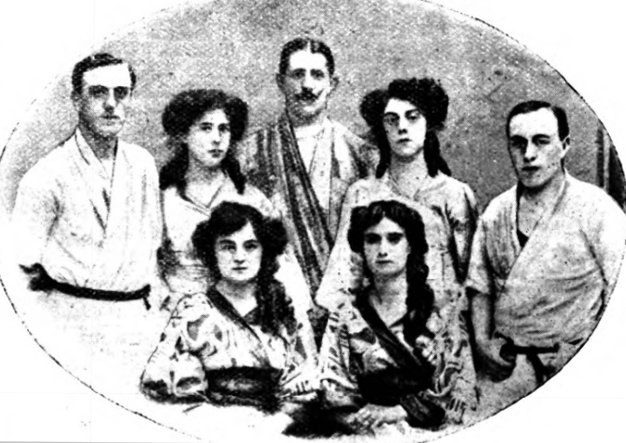
Above: seven of the Eight Olympians.
By 1907 the art of jiujitsu was becoming thoroughly integrated into English popular culture. It had been written into plays and novels and was the subject of greeting cards, jokes and cartoons. It also remained a successful “draw” in the music halls, both in terms of the challenge contests offered by Japanese professionals such as Yukio Tani and Taro Miyake and as a form of performing art in its own right.
The Olympians were an itinerant troupe of music hall athletes who toured their jiujitsu self-defence act between 1907-9. The team of four male and four female performers was led by a Mr. George Mortimer and billed as having appeared “before Royalty”. Notably, their act included explanations of the principles of jiujitsu as well as exhibitions of its practice, recalling E.W. Barton-Wright’s early demonstrations of the art for groups such as the Japan Society.