Originally published on the Bartitsu.org site on Friday, 12th January 2018
Andres Morales (in the fencing mask with white trim) demonstrates the Vigny style in action against an opponent using a more generic style in this recent sparring match:
In this clip Mr. Morales takes on two opponents at once, fighting on uneven terrain and through the obstacle of overhanging tree branches:
Originally published on the Bartitsu.org site on Thursday, 11th January 2018
An academic exhibition of the manly art of pugilism from a 19th century history event in Seattle. Note the use of the milling guard with elbow covers rolling into the “chopper” (back-fist or hammer-fist) punch, which was part of the London Prize Ring style and fell out of favour with the requirement of wearing large gloves under the Queensberry Rules. Likewise, frequent entries into throwing range were very much a part of the LPR style.
Originally published on the Bartitsu.org site on Wednesday, 6th December 2017
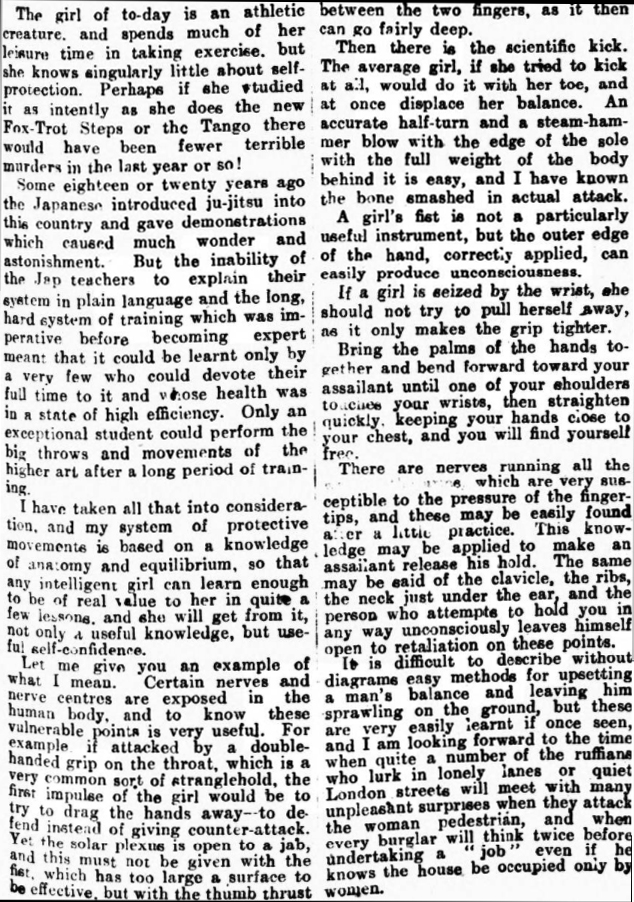
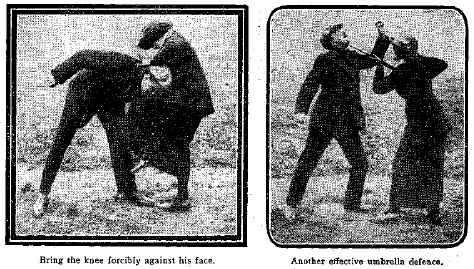
This article from the Pall Mall Gazette of March 17, 1922 offers self-defence advice according to the system of Professor Padian, who is described as “the Master at Arms of Mackenzie’s Dancing Academy”. Archive searches have revealed no further trace of the Professor, nor of his “system of protective movements”, which clearly owed a good deal to jiujitsu atemi-waza.
Originally published on the Bartitsu.org site on Monday, 2nd October 2017
Members of l’Ost du Griffon Noir historical martial arts club in Toulouse, France pose in quasi-Edwardian garb after a recent Bartitsu seminar. The club has been offering periodic Bartitsu training sessions for several years, along with their ongoing courses in historical European longsword and rapier fencing, gladiatorial combat and wrestling.
Posted inAntagonistics|Comments Off on Bartitsu Avec L’Ost du Griffon Noir
Originally published on the Bartitsu.org site on Friday, 9th June 2017
By 1905 the novelty of mixed-style wrestling matches was beginning to wear thin for London music hall audiences, so some creative developments were deemed to be in order. Thus, the invention of “aerial wrestling” by some unknown hero of lateral thinking.
The rules of the new sport were simple enough. Two teams of six female athletes each – at least notionally representing England and the United States, respectively – were to compete in a contest of agility and endurance upon a unique and curious piece of gymnastic equipment. The “Ladies’ Aerial Wrestling Apparatus” consisted of twelve long poles, suspended vertically from a ladder-like arrangement that was secured high above the stage. Each pole was studded with a series of three small round wooden platforms, spaced about 3 feet apart, which could be used as (somewhat precarious) hand- and foot-holds.
At the referee’s signal, there commenced a free-for-all scramble to claim the greatest possible height on a pole, at which point the object of the game was to “wrestle” members of the opposing team off their poles. The favoured and most common technique was to swing one’s legs up and capture the opponent’s head and shoulders in a type of scissor hold, at which stage one could endeavour to force them to slide down and off their pole through sheer body weight. However, the pole-wrestler caught by the scissor grip might be able to break the hold and escape by swinging to an adjacent pole.
Occasionally, two opposing pole-wrestlers would fall together – one hopes that the stage below was well-padded. The most exciting scenario, according to one reporter, occurred when a single, agile wrestler who was the last woman of her team to remain undefeated was pursued by several members of the opposing team and still managed to win the day. Some Aerial Wrestling matches reportedly lasted from fifteen to twenty minutes.
Billed variously as being managed by “Madame Roma”, “Madame Kotka” and “Madame Denny”, the Aerial Wrestling Girls enjoyed a period of success during 1905, touring the various London music halls and then venturing further afield to the Oxford Town Hall and other provincial venues. One of them also made the newspapers for reportedly using her wrestling skills in fending off the attentions of an unwelcome admirer, as recorded in the Derry Journal of 13 September, 1905:
Posted inEdwardiana, Wrestling|Comments Off on The Aerial Wrestling Girls (1905)
Originally published on the Bartitsu.org site on Saturday, 3rd June 2017
Over the past ten years or so, the martial arts of Bartitsu and (especially) Sir Arthur Conan Doyle’s “baritsu” have been incorporated into numerous Sherlock Holmes pastiche stories. Frequently, Holmes’ antagonistic skills are given but a passing mention, but some storytellers have produced tales in which the Great Detective’s fighting prowess is brought front and centre. Most notable among these is the Fight Card series of boxing-themed Holmes stories, now gathered into an omnibus edition for the first time.
Queensberry Justice collects all three extant Fight Card novelettes – “Work Capitol”, “Blood to the Bone” and “A Congression of Pallbearers” – and also includes no less than three new short stories, detailed introductory essays, cover galleries and more besides. Although the gloved and bare-knuckle styles of boxing take precedence, the stories also feature baritsu, cane fighting and even historical fencing via the mysterious Kernoozers Club!
Originally published on the Bartitsu.org site on June 3rd, 2017
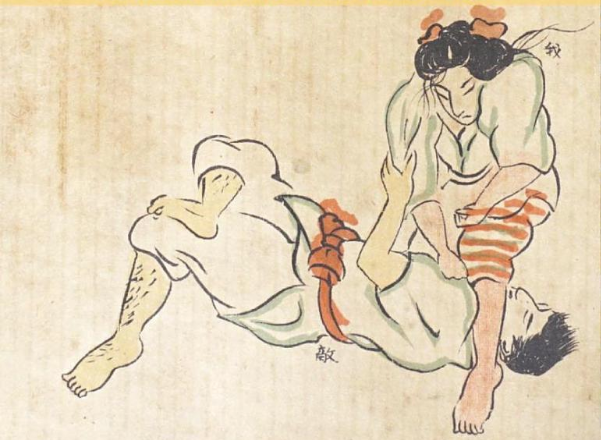
Although Emily Diana Watts’ Fine Art of Jujutsu was first published in 1906, Self Defense for Women (1914) may well have been the first booklet written by a female author to specifically deal with jujutsu as self-defence for women, as distinct from treating it as an athletic accomplishment.
Above: an armlock restraint technique from Self Defence for Women.
Nohata Showa was the pen-name of Nobatake Yaeko. Her booklet is a short compendium of martial arts techniques selected to be of particular use to women who are attacked by men:
The fundamental (principle) of Jujutsu is to use the opponent’s power. You can win by moving nimbly at the right time, without using much power. Should you ingrain these techniques into your body, even a cute weak girl can wrap up a large man and achieve a win!
She also wrote that:
While I was returning to my abode from running an errand just the other night I encountered a frightful situation. I was able to imitate the handful of Jujutsu moves I learned and, despite my slight form, was able to avoid falling prey to a dastardly scoundrel. It was an absolutely thrilling experience.
Additionally, Showa referred to the foundation of a Women’s Self Defence League:
Should any reader of this book have, by chanced toppled, restrained or otherwise through self-defense measures thrown a ruffian or [man] attempting mischief, this organization will award you … a large certificate reading “Meiji Imperial Achievement Award”.
Given the time she was writing, it’s possible that Showa was inspired by the Suffragettes Self Defence Club of London, which was organised by Edith Garrudunder the auspices of the Women’s Freedom League from circa 1909 onwards.
Above: Suffragette jujutsu instructor Edith Garrud demonstrates a restraint hold.
The newly translated, full-colour edition of Self Defence for Women is now available here.
Posted inJiujitsu, Suffrajitsu|Comments Off on “Self Defence for Women” by Nohata Showa (1914) Now Translated and Re-Published
Originally published on the Bartitsu.org site on November 20, 2017
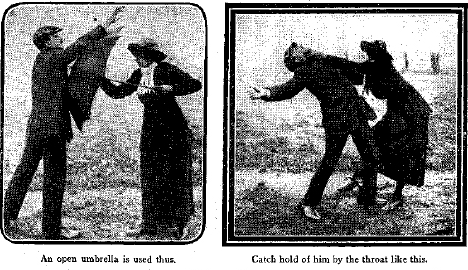
Hetty Beard, the young lady demonstrating umbrella self-defence above, may have been among Pierre and Marguerite Vigny’s students. The Vignys themselves, however, had long departed England for their native Switzerland by the time the Daily Mirror published these photos.
Posted inAntagonistics|Comments Off on “Girl of Whom Footpads Should Beware” (Daily Mirror, January 22, 1914)
Originally published on the Bartitsu.org site on Tuesday, 7th February 2017
The Bartitsu Sparring Video Competition was initiated in November of 2016. The object was to encourage experimentation with a set of sparring guidelines inspired by the styles practiced at the original Bartitsu Club in London, circa 1901.
We are now pleased to be able to announce the winners:
The second prize of US$500 is awarded to the Santiago Stickfighting club based in Santiago, Chile, for the following videos:
The first prize of US$1000 is awarded to the Waterloo Sparring Group based in London, England, for the following compilation video:
The winning videos were judged to have met the conditions imposed by the guidelines and to have best represented both historical/stylistic accuracy and martial intent.
Congratulations to the winners and our thanks to all who entered the competition!
Posted inSparring, Video, Vigny stick fighting|Comments Off on Congratulations to the Winners of the Bartitsu Sparring Video Competition!
Originally published on the Bartitsu.org site on Wednesday, 8th February 2017
From Peter Smallridge of the Waterloo Sparring Group:
“I was immediately excited by the prospect of the contest. I’ve been training (and sometimes teaching) at the Basingstoke Bartitsu Irregulars club for years. I’m also a founding member of Waterloo Sparring Group, which exists to give HEMAists of all stripes a venue for extra sparring. I strongly believe that if you want to be able to develop real skill with an art, then alive training is necessary. That means sparring against fully resisting opponents.
Everyone in the video has, thanks to WSG, had plentiful experience sparring with swords. Many also have experience in “modern” martial arts from MMA to escrima to san shou kickboxing to Dog Brothers Gatherings. In that video you see longsword champions, rapier champions and Ringen champions.
Whatever their backgrounds, they’re fighting “Bartitsu”, some with zero training. How? By handing them the ruleset for the competition! We cut some of the more fumbling efforts, but things which work, work! Giving a handful of smart guys with different martial backgrounds the same weapons and ruleset, and they fought in fairly similar ways.
I’m looking forwards to investing the prize money in some loaner gear to help those new to the hobby, and also to getting another UK Bartitsu Alliance gathering event off the ground before too long!”
From Andrés Pino Morales of the Santiago Stickfighting Club (translated from Spanish):
“Last year we became interested in the Bartitsu stick method (we are stickfighting practitioners and wanted to try something different, without a Filipino martial arts basis), so we started to investigate and experiment. We found your website (Bartitsu.org) and your YouTube videos.
From there we started looking for further material and basically we used H. G. Lang’s book (“The Walking Stick Method of Self Defence”), the articles published on your web site and (Craig) Gemeiner’s instructional videos. Since we do not speak English we made much use of online translators and images. We learned about this contest from a member of your Society who participates in a Facebook Bartitsu group.
We enjoyed taking part in the contest and found that the sparring guidelines allowed us to stay true to the system. We feel that you are doing a very important job to give life to Bartitsu and really prove it as it should be, via sparring.”