Originally published on the Bartitsu.org site on Friday, 12th May 2017
Aside from the curious demonstrations of “baritzu” by Australian soldierscirca 1906, E.W. Barton-Wright’s martial art may have inspired at least one other Aussie enthusiast during the early 20th century – although the latter took pains to deny any such influence.
Above: calisthenics at the Ballarat Amateur Athletic Club (1904)
Starting in May of 1902, members of the then-newly formed Ballarat Amateur Athletic Club began to perform exhibitions of a “new art of self defence” that was claimed to have been devised by the Club president, Mr. John Trekardo. During a packed and diverse athletic display that included gladiatorial tableaux and interludes of song alongside the more standard boxing, fencing and wrestling bouts, Mr. Trekardo and his assistant took the stage to demonstrate:
(…) first, “a new way to cope with a footpad” and, second, “a new art of self-defence.” In the first it was demonstrated how easily the staid citizen, who is accosted by a garrotter or rough on his way home, might by the exercise of a little ingenuity and physical force capsize his would-be assailant before the latter could attack him, while in the second part an entirely new method of stopping the rush of an assailant in the street was cleverly demonstrated.
Mr. Trekardo performed several similar displays throughout the remainder of 1902, always to extravagant praise if the newspaper reviews are to be believed. During a demonstration in August, the Trekardo system was introduced by his student Captain Olden, who claimed that:
(…) the system had been invented by Mr. Trekardo before the introduction of the Barton-Wright system in London.
Records indicate similar self-defence exhibitions in connection with the Ballarat Amateur Athletic Club’s annual displays between 1903-09. There do not, however, appear to be any records of Trekardo actually teaching the “new art”.
The last records of exhibitions of Trekardo’s system are from 1909, during which his associate, a Mr. Lazarus, remarked that Mr. Trekardo had “instituted the teaching of grips in 1899, long before the jiu-jitsu of the Japanese was spoken about here”.
It’s probably true that jiujitsu per se was not known in Australia during 1899; in fact, that word appears in Aussie newsprint for the first time in February of 1904. Granting that it’s possible that Trekardo invented his own system independently, it does, however, seem highly likely that it was inspired by, if not actually copied from, Barton-Wright’s first series of articles for Pearson’s Magazine. Those articles were published in England during March and April of 1899 and were widely available in Australia during that year.
A takedown from Barton-Wright’s second article for Pearson’s.
Notably, Barton-Wright’s articles did not refer to jiujitsu by name, but clearly do describe and illustrate Japanese unarmed combat – under the title “The New Art of Self Defence”.
It should be noted that, during this period, it was quite common for “colonial” entertainers and athletes to jump on the bandwagon of novel, popular trends originating in Europe and the United States. Vaudeville acts and so-on were regularly undertaken by performers who had no actual connection to the “real thing” but whose experience allowed them to pull off a more-or-less convincing imitation.
By 1909, of course, jiujitsu had become internationally famous, and Australians were even able to witness the art performed by an expert in earnest. The jiujitsuka Ryugoro Shima (1885-1958) had arrived in the Land Downunder during 1905, and four years later he was well-established on the wrestling challenge circuit. Possibly Mr. Trekardo took that opportunity to retire his own system; in any case, he went on to some success in local politics, serving as the mayor of Ballarat between 1937-38.
Originally published on the Bartitsu.org site on Friday, 5th May 2017
May 4th of 1891 is recognised as the date of consulting detective Sherlock Holmes’ fateful hand-to-hand battle with the Napoleon of Crime, Professor James Moriarty. Their fight took place at the suitably forboding and dramatic brink of the Reichenbach Falls in Switzerland, described here by Dr. John Watson:
It is, indeed, a fearful place. The torrent, swollen by the melting snow, plunges into a tremendous abyss, from which the spray rolls up like the smoke from a burning house. The shaft into which the river hurls itself is an immense chasm, lined by glistening, coalblack rock, and narrowing into a creaming, boiling pit of incalculable depth, which brims over and shoots the stream onward over its jagged lip. The long sweep of green water roaring for ever down, and the thick flickering curtain of spray hissing for ever upwards, turn a man giddy with their constant whirl and clamour.
Although neither Holmes nor Moriarty appeared to have survived their final encounter, we now know that Holmes had, in fact, defeated his nemesis through his knowledge of what Dr. Watson recorded as “baritsu, or the Japanese system of wrestling“, then took the opportunity to fake his own demise to throw his other enemies off his trail.
The baritsu moment as envisioned by artist Sidney Paget.
In more recent years, the encounter between Holmes and Moriarty has frequently been dramatised in media including the 1979 Russian TV series, The Adventures of Sherlock Holmes and Dr. Watson (click here for a detailed memoir by fight choreographer Nikolay Vaschilin):
… and the classic 1980s Granada Sherlock Holmes series:
… in comic books – most notably Alan Moore’s The League of Extraordinary Gentlemen:
– and in movies such as Sherlock Holmes: A Game of Shadows:
The opening sequence of the 2011 feature documentaryBartitsu: The Lost Martial Art of Sherlock Holmes was shot at the brink of the Reichenbach Falls and in the adjacent Swiss town of Meiringen, which still celebrates its association with the famous fight scene:
Originally published on the Bartitsu.org site on Wednesday, 21st September 2016
By Tony Wolf
The HEMA (Historical European Martial Arts) blogosphere and social media networks have recently caught the edge of the prevailing cultural debates about political correctness, social justice, cultural appropriation, racism and related issues. Inevitably, Bartitsu (as a fringe-of-a-fringe interest) has now been referenced in that context, so I hope you’ll indulge this “editorial” commentary from one who has been, it’s fair to say, closely involved in Bartitsu revivalism from the outset.
Above: Tony Wolf (right) teaches a Bartitsu seminar at the 2006/7 International Sword and Pen workshops in Banff, Canada.
Nearly ten years ago – well before the “Bartitsu boom” generated by the recent Sherlock Holmes craze, at a time when any online reference to Bartitsu by “outsiders” was noteworthy to those very few of us who were paying attention – I came across a discussion on a martial arts message board in which one of the correspondents had described E.W. Barton-Wright as a “racist”. I was curious because I couldn’t recall anything in B-W’s own writings that might justify such a description, so I contacted that person and asked for proof.
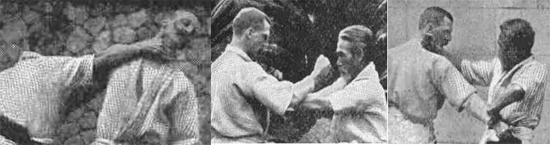
Above: some of the photographs illustrating Barton-Wright’s “New Art of Self Defence” articles.
There was none, as it happened – the writer had simply bought into the modern stereotype of “Victorian Englishmen” as being irredeemably imperialistic and racist, and then assumed that to have been a historical fact in the case of E.W. Barton-Wright. Similar assumptions have occasionally been made by others in subsequent discussions, most recently just a few days ago, when a short mainstream media video item on Bartitsu re-surfaced on a message board and was met with an anonymous comment charging cultural appropriation.
(So far, so much a tiny tempest in a very slightly larger teapot.)
Above: Herman Ten Kate
In fact, the accusation that Barton-Wright had “misappropriated” jiujitsu was first made by one of his close contemporaries. That case is instructive, so here’s the gist of it; Herman Ten Kate was a Dutch anthropologist who had trained at the same Kobe Shinden Fudo-ryu jiujitsu dojo as Barton-Wright and who later came across B-W’s New Art of Self Defence articles, in which B-W first referred to “Bartitsu” by name.
Because Ten Kate apparently had not, however, seen any of Barton-Wright’s other articles, which demonstrated that Bartitsu was a “new” art because it combined jiujitsu with other systems, the anthropologist believed that B-W had simply had the gall to re-name jiujitsu after himself. Thus, lacking crucial context, Ten Kate had jumped to a mistaken and unfair conclusion, which he published in his own article for De Gids, a popular Dutch magazine, during 1905.
Back to the present day and to more immediate concerns; there is an individual who has, periodically over the past several years, offered a series of Bartitsu-related posts on the Stormfront “white power” forum. These posts have obviously been calculated to encourage an interest in Bartitsu among white supremacists, although they have failed in that attempt.
Recently, a screen capture of one of those posts has appeared on a Tumblr page dedicated to exposing racism within the HEMA community. That particular post quotes the introductory text from the Wikipedia page on Bartitsu and then ends with the words “the Bartitsu Society”, the latter taken out of context.
At worst, this juxtaposition may leave casual visitors to the Tumblr page with the impression that the Society somehow endorses a racist point of view. That impression is itself encouraged by the Tumblr author’s comment that “The white supremacists of Storm Front include fans & practitioners of Bartitsu and wider HEMA”, which allows the casual reader to imagine any number of “fans and practitioners” as opposed to the one individual who has, in fact, been responsible for those threads.
In a similar vein, there have been recent “incursions” into Bartitsu-oriented social media by a few proud bigots; people whose religious, racial and cultural prejudices are clear to anyone who bothers to look. And here we must be very careful. Obviously, the fact that someone is, for example, a virulent anti-Semite, or that they may indiscriminately hate and fear members of the Muslim faith, has no intrinsic bearing on their interest in/contributions to martial arts, history nor other subjects. The same person may also be congenial company over dinner.
We who are fortunate enough to live in intellectually free societies regularly navigate these tricky waters – hence the conventions that certain contentious topics are best not broached in “polite company”. But as social media are changing those conventions, at a certain point, it pays to do the contextual homework and, if so moved by one’s own conscience, to draw a line in the ethical sand.
With that in mind:
Bartitsu was originally, and now is again, an ongoing experiment in inter-cultural martial arts cross-training. At least one third of the art is of eclectic Japanese heritage via the jiujitsu styles of Barton-Wright, Yukio Tani and Sadakazu Uyenishi; another third is Swiss/French via Pierre Vigny’s stick fighting system; the remaining pot-pourri of European boxing, kicking and wrestling techniques exist mostly in the “neo” realms of modern revivalism because they weren’t detailed in the canonical sources.
Above: instructors in action at the original Bartitsu Club.
Thus, in the racialist language of the late 19th century, Bartitsu itself could be described as “miscegenated”; it is, incontrovertably, the product of deliberate inter-cultural blending. English boxing and Vigny stick fighting are strengthened by tests against, as well as amalgamation with Japanese jiujitsu, and vice-versa. This is necessary progress towards the utopian ideal of martial arts cross-training pioneered by Barton-Wright and his Japanese and Swiss colleagues at the turn of the 20th century, later taken up by many others (famously including Bruce Lee) and most recently proven in the MMA arena, in Dog Brothers gatherings and in many other venues.
As such, Bartitsu intrinsically refutes both the PC notion of “cultural appropriation” and the segregationist stance beloved of racial supremacists.
Further, although we know precious little about the private life of Edward Barton-Wright, the scattered evidence of his social and political leanings indicate a decidedly progressive direction. The original Bartitsu Club offered classes for women and children at a time when it was extraordinary for “antagonistics” training to be given to anyone other than adult males. All of the politicians who were members and supporters of the Bartitsu Club were affiliated with the Liberal Party. Notably, during a period when it was common for combat sports athletes and promoters to bar challengers on racial grounds, Barton-Wright specifically invited challengers of all races. By his own example and by the ethos of his Club and system, E. W. Barton-Wright encouraged an approach to martial arts training that rewarded curiousity, rational skepticism and a willingness to think (and fight) “outside the box”.
Therefore, far from the “fear of the foreign” sometimes assumed to characterise the people and institutions of Edwardian England, the Bartitsu Club was a melting pot of intensive competition, experimentation and collaboration between wildly diverse individuals and martial arts styles.
For the past fifteen years, the Bartitsu Society has succeeded as an exemplar of individualistic, “open-source”, grass-roots martial arts revivalism within an informal “community of colleagues”. We have consistently resisted the temptation to create a bureaucratic, hierarchical organisation, in favour of offering the fruits of our research to everyone who has an interest in this (still) rather obscure martial art. The result is that there are as many different “Bartitsu” approaches as there are clubs and study groups that have taken up the revivalist challenge – about fifty groups, at present.
Fortunately there is, to date, no evidence of any serious attempt to co-opt Bartitsu by misogynists, racial supremacists, religious bigots nor any other xenophobes on the wrong side of history. I’m very confident that the vast majority of Bartitsu revivalists would be repelled by any such attempt, as history indicates Barton-Wright would have been.
Above: attendees at a Bartitsu seminar by instructor Mark Donnelly (kneeling, second from right), hosted by the Bartitsu Club of New York City.
Originally published on the Bartitsu.org site on Wednesday, 9th October 2013
Highlights from several rounds of recreational medium/hard contact sparring at the Bartitsu Club of Chicago.
The object of this type of sparring is to pressure-test one’s skills while (re-)discovering the most combat-efficient blend of the methods that went into E.W. Barton-Wright’s original Bartitsu system, via experimentation. Thus, the sparring repertoire is deliberately anachronistic; while there is room for spur-of-the-moment improvisation, the techniques are largely restricted to the canonical and lineage material, dating from 1899 into the early 1920s.
Most significantly, these “style points” include:
Predominant use of single and double-handed high guard positions in stick fighting.
Almost exclusive use of “hanging” or “roof”-style parries, in which the weapon-wielding hand is held higher than the point of impact between the two weapons, rather than the orthodox fencing parries in 3 and 4.
Stick fighting tactics are heavily weighted towards invitations (for example, by lowering and/or widening the guard position to tempt an attack to a specific area), pre-emptive striking/feinting and “guards by distance” (simultaneous evasion and counter-attack)
Active integration of armed and unarmed combat
Predominant use of linear punches and linear, low kicks; in strictly unarmed combat, fighters employ the classic erect or backward-leaning fisticuffs stance and the “mill” pattern of vertically rotating fists.
When coming to grips in jacketed unarmed combat, the posture remains erect.
Deliberate exclusion of low-line grappling attacks (double-leg takedowns, etc.)
The minimum protective equipment for this type of sparring consists of fencing masks, hockey or lacrosse gloves and groin cups. The weapons shown are 3/4″ diameter, 36+” rattan sparring canes made by Purpleheart Armory, tipped with standard rubber cane ferrules at one end and with solid rubber “ball” handles at the other, simulating the steel ball handles of classic fighting canes. The asymmetrical balance of the cane is a key factor in this style of stick fighting.
Fighters offer a simple salute with the stick or touch gloves to indicate the commencement and conclusion of a match.
Fighters may acknowledge points verbally and/or gesturally but the emphasis is on continual action. A bout that goes to the ground may feature a successful submission hold/tapout but that does not necessarily represent the end of the match; by mutual accord, the fighters may simply recommence from a standing start if they wish.
Originally published on the Bartitsu.org site on Friday, 7th December 2012
The famous Bath Club features significantly in the history of Bartitsu. Founded at #34 Dover Street in 1894, the Club was named for its large indoor swimming pool, which was a great novelty at the time. The pool featured several diving boards and a “Newman’s water-chute” for sliding, as well as a flying trapeze and a set of “travelling rings” suspended from the ceiling, challenging the most athletic Club members to traverse the length of the pool without getting wet.
The Club building was also equipped with a fencing salon and a gymnasium as well as steam-rooms, showers, an opulent dining room and “overnight rooms”. A comparatively progressive institution, membership was available to both men and women; the latter had their own dedicated entrance, a gesture which might be read either as condescension or as extravagant courtesy, or possibly both at once.
In March of 1899 the Bath Club was the venue for one of E.W. Barton-Wright’s jiujitsu demonstrations. He later noted that he had been awarded a membership in the Club due to his feat of defeating seven larger men within three minutes at a previous display. The Bath Club demonstration was, notably, the first time Barton-Wright had collaborated with the famed historical fencing revivalist, Captain Alfred Hutton, who later joined the teaching staff at Barton-Wright’s own Bartitsu Club.
This event may well also have been Barton-Wright’s introduction to Hutton’s rapier-and-dagger fencing partner, William Grenfell, the 1st Baron Desborough. A notable athlete and a prolific public servant, Grenfell was the president of the Bath Club and he was to go on to become the president of the Bartitsu Club. Sir Cosmo Duff Gordon was another famous Bath Club member who subsequently also joined the Bartitsu Club.
The Bath Club was the venue for several other unusual sporting displays, including a peculiar spectacle organised by Alfred Hutton two months after the Bartitsu display. “Water tilting” was a one-off revival of a type of aquatic jousting, which had apparently been amongst Henry VIII’s favourite sports. According to a newspaper report:
A large and gaily dressed assemblage watched the pair of old-fashioned-looking warriors tilt at one another in the waters of the bath, one of them holding a long spear (with padded point) and a stout leather buckler, the other paddling behind him in the cranky craft, which only just held both when both were evenly balanced. The two shallow boats put out from their respective ends at the word ‘Go,’ and one pair were soon struggling in the water, amidst the merriment of the audience.
The new sport of water polo was also a great attraction:
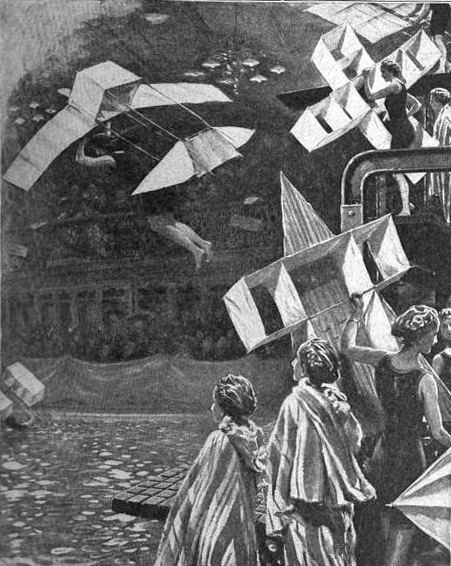
In 1910, the Club hosted an exhibition of a “novel and exciting aero-swimming game” in which competitors equipped with elaborate kite-like gliders leaped off one of the diving platforms, endeavouring to soar a short distance before their flight came to an inevitably wet end:
Posted inEdwardiana|Comments Off on Fun and Games at the London Bath Club
Editorial note: several years ago I had the privilege of traveling with my adult son and my teenage nephew to a boxing gym in the Bronx, NYC and meeting with Daniel Marks, who had, over the previous decade, done much to popularise the hitherto little-known fighting art of the 52 Blocks. Mr. Marks had produced documentaries on the 52s and also spearheaded an initiative to use the art to turn young men away from drugs and gang culture.
The 52s include all the hallmarks of sophisticated body mechanics and fighting tactics associated with more formal, mainstream methods, applied with an almost uniquely personal, improvisational flavor. The method is also characterised by its range of “destructive defence” techniques – blocks that don’t simply redirect or stop an opponent’s punches, but are designed to do damage.
Although the technical details of the “secret style of boxing” developed for Bartitsu by E.W. Barton-Wright and Pierre Vigny remain frustratingly vague, their style also emphasised the principle of destructive defence. Barton-Wright wrote that the guards of “Bartitsu boxing” were “much more numerous” than those of the orthodox style then being taught in London gyms, and that those guards would “make the assailant hurt his own hand and arm very seriously”, as demonstrated here by Pierre Vigny:
In this video series, Bartitsu instructor Tommy Joe Moore teaches a number of 52 Hand Blocks techniques that are – probably – as close as we’ll get to Barton-Wright and Vigny’s “secret style”.
Originally published on the Bartitsu.org site on Monday, 16th December 2013
From The World’s News, Saturday 15 October 1904:
Some little time ago an illustrated article was published in “The World’s News” giving some valuable hints on the use of a walking stick as a means of defending oneself against street attacks by one or more assailants. The perfecter and teacher of this particular system was Professor Pierre Vigny, who has a school of self-defence in Berners-street, London.
Now the professor puts forward an equally excellent system of self-defence against every form of street ruffianism, and which he claims to have thoroughly tested in the most practical manner.
One of the sketches herewith shows the pose that ought to be assumed in the event of being attacked by a man armed with a knife or a belt.
Should you be well practiced in assuming the pose there shown, it is easy to step aside when your assailant stabs, clutch his wrist, and throw him to the ground by a well known wrestling device. Should that fail, however, the foot can be brought into play, and your adversary prostrated.
The defence against a belt is somewhat different. You raise your arm, with the hand open, to meet the belt when your opponent strikes, taking care to let the belt meet your arm near the end which is being held. The result is that the belt coils round your arm, without hurting you in the slightest; and its user is amazed to find his wrist firmly grasped, and that he is unable to resist being thrown on his back, or to protect his face from terrible punishment from the fist.
Should he have a companion, a well-known la savate movement will dispose of him, and the attacked citizen may then contentedly await the arrival of the police to give his assailants into custody.
The movements depicted require a good deal of practice, but in course of time they will become, as in ordinary boxing and fencing, so rapid as to be almost instinctive.
It is interesting to note that, according to the “Pictorial Magazine,” from which our sketches are taken, the professor makes a point of spending his holidays in the dangerous quarters of some large city in order to gain practical experience of any new devices adopted by the larrikins as well as to put into practice his system of self-defence when the occasion arises.
Posted inAntagonistics|Comments Off on “Self-Defence as a Fine Art” (1904)
Originally published on the Bartitsu.org site on Wednesday, 11th December 2013
From The Northern Star newspaper, 25 November, 1910:
Although boxing is called “the noble art of self-defence,” there are forms of attack against which it would require the co-operation of other defensive arts. Man is a fighting animal, not because there is anything innately savage in his composition, but because he has to fight in order to hold his own in the struggle for existence. We may be the most peaceably inclined nation in the world, but because our neighbours are aggressive as the result of either ambitiousness or envy, we have to make warlike preparations against possible attack. As with the nation, so with the individual.
Mr. Citizen might be a most amiable gentleman. He may be strolling along, full of the utmost benignity and charity towards all mankind, when, from behind the shadow of a temporary lurking place, a murderous footpad rudely disturbs his peaceful meditations, by rushing out upon him, on robbery and violence bent. Much as he may, in the abstract, dislike inflicting injury upon a fellow being, our worthy burgher must disable his assailant or be left battered and plundered on the roadside. The fittest of the two will survive. Our citizen may have a stout walking stick, and, thanks to a military training, may be able to use it dexterously, so that on recovering from the first shock that the footpad’s rush has occasioned, he may elude an attempt to sandbag him, and then bring his weighty stick down heavily upon the unguarded head of the would-be robber, and thus render him hors de combat.
Or the footpad may be trusting to his fistic and garrotting powers, and Mr. Citizen may have no walking-stick. So then it would be a case of a contest with nature’s weapons.
Footpads are notoriously what are known in the parlance of the ring as “foul” fighters. That is to say, they kick as well as hit, and are not particular about hitting only above the belt. Consequently, the citizen who finds himself set upon by one of this gang of criminals requires something more than, a knowledge of the hits and guards that a rudimentary knowledge of boxing gives. Many a good boxer who suddenly found himself in holds with a wrestler would be at a disadvantage unless he had also a smattering of the science of wrestling, and, therefore, the art of self-defence to be thorough should take in not only a knowledge of how to hit, but also how to grapple and throw. While a Britisher has a leaning for boxing as a defensive art more than for wrestling, the fact is patent that not only does he want to know how to wrestle, should occasion require it, but he should know how to wield a walking stick or an umbrella for defensive purposes.
Maybe the most effective way of escaping or warding off threatened danger would be to “run for it,” if the opposing forces are too numerous, but we are taking the case where this discretion that is said to be the better part of valour cannot be resorted to, and a man has to stand and fight it out in a corner, with one or two assailants. A stroke across the shins is a most effective way of disabling an assailant, and a good single-stick player could effectively deal with any aggressor by such a means in very short order.
Footpads are not generally courteous and chivalrous Claude Duvals, and a favorite mode of attack with them is the use of the boot. Opposed to the citizen possessing a knowledge of the art of the Japanese Ju-jitsu or the French method of fighting with the feet, the thief wildly letting fly his boots would promptly be stood on his head. Such methods of attack are practised in ju-jitsu, the science of Ju-jitsu being in brief how to defend oneself from attack when deprived of any weapon. Once a Britisher gets a man on the ground his instinct is to let him up again, but with the Japanese that is just the stage of the combat at which the fun really begins. The Japanese practise so that, even though they may be underneath in the fall, they contrive to turn the table on the “top dog.” We Britishers are apt to decry Ju-Jitsu because of the severity of some of the holds and methods invoked, forgetful that it is intended for defensive purposes in mortal combat. The fact that the London police have been instructed in Ju-Jitsu holds shows that there is a lot in it for the man who would know how to take care of himself in an emergency where his life may be hanging the balance.
The garotte, or the grip of the Indian thug, is the ordinary stranglihg-hold, for which there are several effective stops, and these apparently deadly modes of attack upon citizens can be guarded against in a fairly simple way if the citizen, in his youth, will only set about learning how. But our fancy runs so much with the direction of our national pastime that the very essential sport of wrestling is relegated to the background. Wrestling does not rank second to boxing as a defensive art, and as such it deserves every encouragement. The reason for the unimportant position it occupies in public estimation lies, to some extent, in the fact that wrestling matches are easily “faked” and several big matches have occurred in which the public felt that the combatants were not triers. But, quite apart from wrestling as a method of entertaining sporting patrons, its value as an exercise and one likely to stand a man in good stead at some time in his life, cannot be gainsaid.
Originally published on the Bartitsu.org site on Wednesday, 24th August 2011
WRESTLING OR JU-JITSU?
On the whole, catch-as-catch-can wrestling is not a sport to be recommended to amateur athletes. It is true that a knowledge of the chief holds and the appropriate counters and checks would be useful to a person engaged in an all-in street scrummage, though a more profitable investment of time and trouble against that emergency would be found in a study of the rudiments of la savate, with its bone-shattering kicks, all of which can be easily acquired by a football player.
Here it should be pointed out that a smattering of ju-jitsu, which is still a fashionable accomplishment, might be worse than useless against an able-bodied rough. Japanese wrestling, which is based on yielding a point in order to gain a greater advantage, must be thoroughly acquired — so thoroughly, indeed, that the well-balanced non-European physique of the Japanese athlete becomes your own private possession — if a knowledge of its subtleties is to be practically useful in an emergency. Instead of wasting time and energy on ground-wrestling, ju-jitsu, and the like, the able-bodied, able-minded person who is interested in the art of self-defence will be well advised to acquire the rudiments of wrestling in the Cumberland and Westmorland style, which, added to a fair knowledge of boxing, will enable him to hold his own against any type of street ruffian.
Posted inJiujitsu, Wrestling|Comments Off on “Wrestling or Ju-jitsu?” (E. B. Osborn, T.P.’s Weekly, 1914)
Originally published on the Bartitsu.org site on Monday, 22nd August 2011
Longtime Bartitsu aficionados are well aware of Marcus Tindal’s eccentric 1901 article Self Protection on a Cycle, which appears to have been inspired both by E.W. Barton-Wright’s articles on self defence with walking sticks and by this 1900 letter published in the London Bicycle Club Gazette. Tindal’s article included several ingenious techniques involving the use of bicycle pumps, water pistols and bikes themselves as weapons of self defence:
In this video, Canadian stunt team Riot A.C.T. offers an updated take on the same idea …
Posted inAntagonistics, Video|Comments Off on “Self Protection on a Cycle”, Courtesy of Riot A.C.T.