“To Conquer by Yielding”; Lafcadio Hearn on Jiujitsu

  • Originally published on the Bartitsu.org site on Monday, 18th October 2010

An excerpt from Lafcadio Hearn’s “Out of the East: Reveries and Studies in New Japan”, 1895.

Man at his birth is supple and weak; at his death, firm and strong. So is it with all things. . . . Firmness and strength are the concomitants of death; softness and weakness, the concomitants of life. Hence he who relies on his own strength shall not conquer.

– Tao-te-king

Kazo and Iwao, Hearn’s eldest children, at jiujitsu practice.

There is one building in the grounds of the Government College quite different in structure from the other edifices. Except that it is furnished with horizontally sliding glass windows instead of paper ones, it might be called a purely Japanese building. It is long, broad, and of one story; and it contains but a single huge room, of which the elevated floor is thickly cushioned with one hundred mats. It has a Japanese name, too, — Zuihokwan, — signifying The Hall of Our Holy Country; and the Chinese characters which form that name were painted upon the small tablet above its entrance by the hand of a Prince of the Imperial blood. Within there is no furniture; nothing but another tablet and two pictures hanging upon the wall. One of the pictures represents the famous White-Tiger Band of seventeen brave boys who voluntarily sought death for loyalty’s sake in the civil war. The other is a portrait in oil of the aged and much beloved Professor of Chinese, Akizuki of Aidzu, a noted warrior in his youth, when it required much more to make a soldier and a gentleman than it does to-day. And the tablet bears Chinese characters written by the hand of Count Katsu, which signify: Profound knowledge is the best of possessions.

But what is the knowledge taught in this huge unfurnished apartment? It is something called jiujutsu. And what is jiujutsu ?

Here I must premise that I know practically nothing of jiujutsu. One must begin to study it in early youth, and must continue the study a very long time in order to learn it even tolerably well. To become an expert requires seven years of constant practice, even presupposing natural aptitudes of an uncommon order. I can give no detailed account of jiujutsu, but merely venture some general remarks about its principle.

Jiujutsu is the old samurai art of fighting without weapons. To the uninitiated it looks like wrestling. Should you happen to enter the Zuihokwan while jiujutsu is being practiced, you would see a crowd of students watching ten or twelve lithe young comrades, barefooted and barelimbed, throwing each other about on the matting. The dead silence might seem to you very strange. No word is spoken, no sign of approbation or of amusement is given, no face even smiles. Absolute impassiveness is rigidly exacted by the rules of the school of jiujutsu. But probably only this impassibility of all, this hush of numbers, would impress you as remarkable.

A professional wrestler would observe more. He would see that those young men are very cautious about putting forth their strength, and that the grips, holds, and flings are both peculiar and risky. In spite of the care exercised, he would judge the whole performance to be dangerous play, and would be tempted, perhaps, to advise the adoption of Western “scientific” rules.

The real thing, however, — not the play, — is much more dangerous than a Western wrestler could guess at sight. The teacher there, slender and light as he seems, could probably disable an ordinary wrestler in two minutes. Jiujutsu is not an art of display at all: it is not a training for that sort of skill exhibited to public audiences; it is an art of self-defense in the most exact sense of the term; it is an art of war. The master of that art is able, in one moment, to put an untrained antagonist completely hors de combat. By some terrible legerdemain he suddenly dislocates a shoulder, unhinges a joint, bursts a tendon, or snaps a bone, — without any apparent effort. He is much more than an athlete: he is an anatomist. And he knows also touches that kill — as by lightning. But this fatal knowledge he is under oath never to communicate except under such conditions as would render its abuse almost impossible. Tradition exacts that it be given only to men of perfect self-command and of unimpeachable moral character.

The fact, however, to which I want to call attention is that the master of jiujutsu never relies upon his own strength. He scarcely uses his own strength in the greatest emergency. Then what does he use ? Simply the strength of his antagonist. The force of the enemy is the only means by which that enemy is overcome. The art of jiujutsu teaches you to rely for victory solely upon the strength of your opponent; and the greater his strength, the worse for him and the better for you. I remember that I was not a little astonished when one of the greatest teachers of jiujutsu (1) told me that he found it extremely difficult to teach a certain very strong pupil, whom I had innocently imagined to be the best in the class. On asking why, I was answered: “Because he relies upon his enormous muscular strength, and uses it.” The very name jiujutsu means to conquer by yielding.

I fear I cannot explain at all; I can only suggest. Every one knows what a “counter” in boxing means. I cannot use it for an exact simile, because the boxer who counters opposes his whole force to the impetus of the other; while a jiujutsu expert does precisely the contrary. Still there remains this resemblance between a counter in boxing and a yielding in jiujutsu, — that the suffering is in both cases due to the uncontrollable forward impetus of the man who receives it. I may venture then to say, loosely, that in jiujutsu there is a sort of counter for every twist, wrench, pull, push, or bend: only, the jiujutsu expert does not oppose such movements at all. No: he yields to them. But he does much more than yield to them. He aids them with a wicked sleight that causes the assailant to put out his own shoulder, to fracture his own arm, or, in a desperate case, even to break his own neck or back.

With even this vaguest of explanations, you will already have been able to perceive that the real wonder of jiujutsu is not in the highest possible skill of its best professor, but in the uniquely Oriental idea which the whole art expresses. What Western brain could have elaborated this strange teaching,— never to oppose force to force, but only to direct and utilize the power of attack; to overthrow the enemy solely by his own strength, — to vanquish him solely by his own effort? Surely none! The Occidental mind appears to work in straight lines; the Oriental, in wonderful curves and circles. Yet how fine a symbolism of Intelligence as a means to foil brute force! Much more than a science of defense is this jiujutsu: it is a philosophical system; it is an economical system; it is an ethical system (indeed, I had forgotten to say that a very large part of jiujutsu training is purely moral); and it is, above all, the expression of a racial genius as yet but faintly perceived by those Powers who dream of further aggrandizement in the East.

(1) Kano Jigoro. Mr. Kano contributed some years ago to the Transactions of the Asiatic Society a very interesting paper on the history of Jiujutsu.

The remainder of Hearns’ essay considers jiujitsu as a metaphor in ethical, political and other spheres.

Posted in Jiujitsu | Comments Off on “To Conquer by Yielding”; Lafcadio Hearn on Jiujitsu

“The Mystery of Baritsu” (1958)

  • Originally published on the Bartitsu.org site on Friday, 15th October 2010

In early 1902, and under circumstances that remain a historical mystery, the Bartitsu Club closed its doors for the last time. Jiujitsu went on to experience a boom lasting even through the First World War, firmly establishing the mystique of the Japanese martial arts in Western pop culture. The popularity of boxing and wrestling continued unabated. Some individuals, notably Pierre Vigny, Percy Longhurst and Jean Joseph Renaud, perpetuated and expanded upon Barton-Wright’s practice of mixing Asian and European “antagonistics”. For almost all intents and purposes, however, Bartitsu itself was forgotten throughout the 20th century.

During this period, Sherlock Holmes aficionados continued to puzzle over Sir Arthur Conan Doyle’s reference to “baritsu, or the Japanese system of wrestling”, with which Sherlock Holmes had simultaneously saved his own life and defeated his arch-nemesis, Professor Moriarty, at the brink of Reichenbach Falls. Meanwhile, E.W. Barton-Wright was occasionally referenced in the introductory paragraphs of English judo manuals – as the famous Yukio Tani’s manager. Bartitsu, when it was mentioned at all, was typically described simply as “an English version of jiujitsu”.

And so the situation remained until the mid-1950s research of Ralph Judson, whose work has recently been re-discovered by Andy Stott.

Judson had studied jiujitsu under Japanese instructors for eight years in his capacity as the Commandant of the Manchester Sub-District Physical Training and Close Combat School during the Second World War. A longtime Sherlockian, he had quizzed his Japanese colleagues about Holmes’ “baritsu”, but was consistently told that no such term existed in the Japanese language:

For a long time I tried to discover the origins of the word baritsu, and the precise methods of this form of wrestling. Somebody must have invented it, some time.

After his retirement in 1955, Judson began the task of cataloging his collection of some 6,500 books, which included a number of antique 19th century periodicals. Leafing through the contents of the seventh volume of Pearson’s Magazine, dating to 1899, he was intrigued to find a series of two articles entitled The New Art of Self Defence, by one E.W. Barton-Wright:

In the second installment (Barton-Wright) wrote, “Readers of the March number will remember that I described therein a few of the three hundred methods of attack and counter-attack that comprise the New Art of Self Defence, to which I have given the name of BARTITSU.

(emphasis in original text).

Thrilled to have finally tracked down the origins of Holmes’ mysterious art of “Japanese wrestling”, Judson learned what he could about Barton-Wright, Tani and the Bartitsu Club and offered his ground-breaking research in the form of an article. The Mystery of Baritsu: a Sidelight Upon Sherlock Holmes’s Accomplishments was published in the Christmas 1958 edition of the Baker Street Journal.

Judson’s summary of the Bartitsu story was largely accurate, although, like many prior and subsequent writers, he apparently missed the significance of Bartitsu as an eclectic self defence art, describing it as “a number of selected methods of ju-jutsu, adapted to European needs and costume”. It’s entirely possible that Judson simply didn’t read, or failed to connect Barton-Wright’s second series of Pearson’s articles (on walking stick defence) to his first, and so did not realise that Bartitsu actually encompassed four different methods of “antagonistics”.

Shifting gears into the Sherlockian “Great Game” of pretending that Holmes and Watson had been real people, Judson pointed out that Holmes could not possibly have studied Bartitsu, because the events described in The Adventure of the Empty House took place on May 4th, 1891. Since Bartitsu was not introduced until 1899, he reasoned, Holmes must in fact have referred to jiujitsu, and Watson (writing in 1903) must have simply confused jiujitsu with the then-popular Bartitsu, further confounding future generations of scholars by misspelling the word. (1)

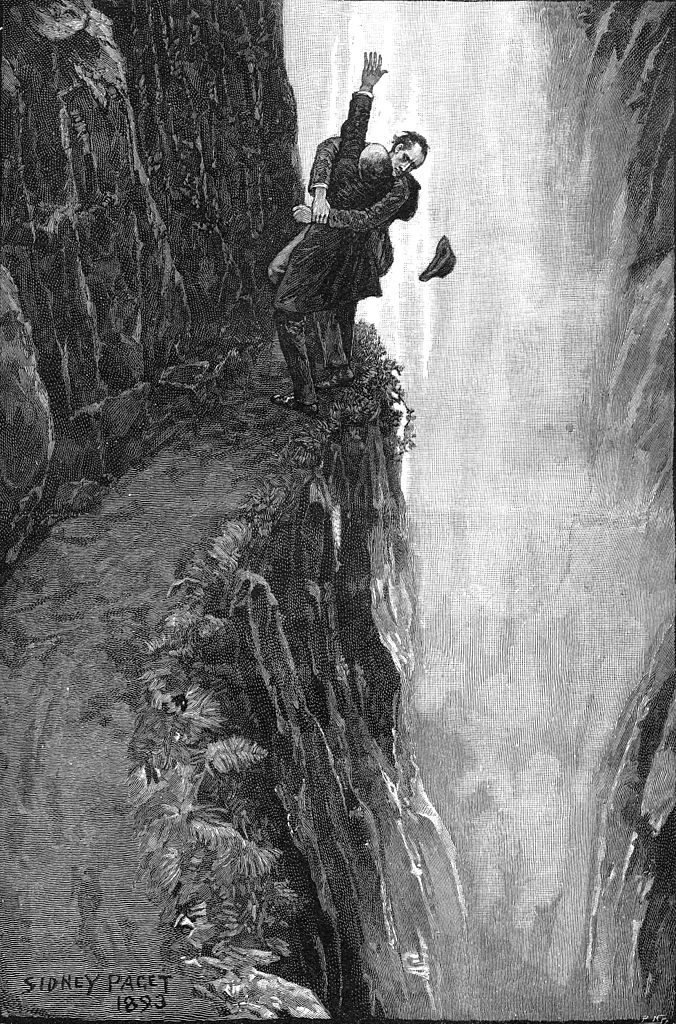
Ralph Judson finished his article by offering an ingenious technical explanation as to how Holmes had defeated Moriarty at Reichenbach Falls. Noting that the observation path where they battled is only three feet wide, with a sheer wall of rock to one side and a sheer drop on the other, Judson suggested that:

Holmes and Moriarty fighting over the Reichenbach Falls. Art by Sidney Paget.

Just before Professor Moriarty locked his grip, pinning the detective’s arms to his sides, Sherlock Holmes, having inflated to the full extent his chest and his biceps, swiftly deflated himself, and, as he said, “I slipped through his grip”. In one fast and smooth movement, dropping on one knee, he gripped with one hand Moriarty’s heel, which was closer to the abyss, and lifting the heel and with it the foot, diagonally, away from himself, he pushed hard, at the same time, with his other hand, into the groin of the captured leg, applying terrific leverage …

This caused Moriarty to lose completely his balance and gave him no time to clutch at his opponent. When Holmes let go, Moriarty “with a horrible scream, kicked madly for a few seconds and clawed the air with both his hands.”

But, for all these efforts, Moriarty could not regain his balance, and over he went – while his opponent was still crouching on the narrow path.

This is the complete picture of this unforgettable conflict – and “Baritsu” is no longer a mystery.

Ironically, though, Judson’s Mystery of Baritsu article was, itself, largely forgotten over time …

(1) A more recent theory is that the art known as baritsu was in fact founded by Holmes himself, based on his documented study of Japanese wrestling, fencing, boxing and stick fighting, and that he later gave permission to his top student, E.W. Barton-Wright, to go public with a modified version of the art.

By far the most detailed version of these events, though, is discussed here.

Posted in Baritsu, Reviews, Sherlock Holmes | Comments Off on “The Mystery of Baritsu” (1958)

An Edwardian Jiujitsu Exposition

  • Originally published on the Bartitsu.org site on Friday, 15th October 2010

(From Womanhood Magazine, 1904)

A VERY INTERESTED GATHERING assembled at Caxton Hall, Westminster, on December 20, at the invitation of Mr. Granger, Agent General for Australia, to witness a demonstration of the Japanese School of Ju Jitsu. Mr. Granger’s talented son, whom his friends were pleased to see happily restored after a dangerous illness, explained the various points in the system, which, he said, was recognised as long ago as the fourteenth century. In the sixteenth century there was a Chinese priest who was a very great expert. Gradually the system was adopted by the Japanese Government, and is now regularly taught in the schools.

Ju Jitsu may in truth be termed the “gentle art of self-defence,” and its basis is to act upon a knowledge of the most tender spots in the human body, so that a person skilled in the art, though apparently weak, can protect himself or herself against the biggest bully that exists. In Ju Jitsu no strength must be put forth into the defence, and it is for this reason that ladies learn it more quickly than men, because men want to put strength into it, whereas women use finesse. The principle is to defeat the opponent by utilising his strength and playing upon his most vulnerable point. In Japanese school and university training the system has much the same position as established games have in England. The Japanese woman is educated in it, and it enters into the training of soldier, sailor, and policeman.

A most interesting part of the demonstration was that in which two English ladies, Mrs. Watts and Miss Roberts, took part. Mrs. Watts gave a demonstration of throws with Mr. Eida, and she and Miss Roberts also gave a demonstration of practice. The points illustrated by Mr. Miyake and Mr. Tani were various ways of falling without inconvenience, illustrations of the balance of the human body, and how to throw one’s antagonist; also what is called “the locks”— as for example, the arm lock, in which the arm of the person who attacks, however strong he be, must be broken either at the elbow or shoulder; the leg lock, where excruciating pain can be caused by pressure at a point at the bottom of the calf, or the foot may be injured; and the neck lock, in which a person becomes unconscious owing to pressure on the arteries. Mr. Granger incidentally remarked that the Japanese have no less than three ways to rapidly restore consciousness which are unknown to European medical men, but these are not made known.

Among others who took part in the demonstration were Mr. Kanaya and Mr. Uyenishi. As Mr. Granger humorously remarked, Ju Jitsu is a triumph of knowledge and skill against mere brute strength, and any lady who knows the game is more than a match for any husband who does not.

Posted in Exhibitions, Jiujitsu | Comments Off on An Edwardian Jiujitsu Exposition

Edwardian Walking Stick Defence Seminar (Edinburgh)

  • Originally published on the Bartitsu.org site on Thursday, 14th October 2010

Edinburgh: on the 16th of October, beginning at midday and ending at 5pm, there will be a workshop in Walking Stick Defence given by Phil Crawley. The venue will be the Kirk o’Field church hall.

Although based on the Vigny/Lang system(s), the seminar will include aspects of the AndreRenaud and Cunningham methods for comparison. The workshop will look at using the walking stick at three different ranges – long, medium and close – in order to defend with a number of different, and often surprising, techniques, and how the stick may be combined with other contemporary arts and objects in order to provide an all-round self-defence against ruffians.

Participants will require a fencing mask, stout gloves and a fencing jacket or gambeson. Forearm protection is advised.

Sticks, and other specialist equipment, will be provided.

Cost will be the small sum of £12 for the day.

Posted in Antagonistics, Seminars | Comments Off on Edwardian Walking Stick Defence Seminar (Edinburgh)

Neo-Bartitsu Event in Pfarrkirchen, Germany

  • Originally published on the Bartitsu.org site on Wednesday, 13th October 2010

On October 9th and 10th the Pfarrkirchen branch of the Ochs historical fencing association hosted a “challenge tournament” followed by a neo-Bartitsu seminar.

Opening the neo-Bartitsu session, Andy Damms gave a lesson on English pugilism, covering history, basic punches with an emphasis on straight punching and the falling step, followed by simple defenses and then the throws typical of bare-knuckle pugilism.

After the lunch break the seminar continued with savate low line kicks and their respective evasive motions, then basic wrist locks and defence in special situations. The latter included the defender being punched while leaning against a wall, the defender being on the ground while the opponent is standing and drills for facing multiple opponents, taught by Alex Kiermeyer.

Posted in Antagonistics, Boxing, Savate, Seminars | Comments Off on Neo-Bartitsu Event in Pfarrkirchen, Germany

More Images from “Bartitsu: the Lost Martial Art of Sherlock Holmes”

  • Originally published on the Bartitsu.org site on Tuesday, 12th October 2010
Posted in Documentary | Comments Off on More Images from “Bartitsu: the Lost Martial Art of Sherlock Holmes”

“Father Frank’s Trick”

  • Originally published on the Bartitsu.org site on Sunday, 26th September 2010

Text from “The French Scotland Yard: About the Paris Detective and his Work” by Alder Anderson and H. de Noussanne; The London Magazine, Volume 9, 1903.

Has the reader ever heard of “the trick of Father Francis?” Or as it is in its French dress, “le coup du Pere Francois”? Whether he has or not, let him offer up a devout prayer that it may never be practically demonstrated to him on his own person. To the industrious antiquarian must be left the task of discovering exactly who “Father Francis” was; the trick to which he stands sponsor will, nonetheless, remain one of the most effectual methods known to he Paris representative of the London “hooligan”, of disabling a belated bourgeois, who looks as if he might be the temporary custodian of a heavy purse, a well-lined pocket book, a gold watch or any of the hundred and one trifles for which the soul of the hooligan of every country hungers.

Properly executed, the “trick of Father Francis” is not inartistic, and though painful to the victim, seldom proves fatal. Any person whose steps lead him Pariswards may see the interesting youth of the French metropolis who select the dry moat of the fortifications as their playground, practicing this trick and others in sheer wantonness among themselves. All that is required for the purpose is a large silk handkerchief.

A former professor of the art has been good enough to describe for the readers of the London Magazine his modus operandi. It would be a pity to attempt to improve on the naive precision of his style. Here, then, is a faithful transcription, in English, of his lesson.

“Take a strong silk muffler (scarf), which you should wear very loosely round the neck. You should have (at least) one accomplice, who follows you at a distance of about a dozen paces. Select a belated wayfarer of substantial appearance, and walk in the same direction as he is going, and, as nearly as you can, on a level with him without arousing his suspicions. Should the street be well lighted or you have reason to suspect that anyone may be observing you, be particularly careful to appear utterly indifferent, both to the man you are following and to your accomplice.

Sooner or later, you will traverse some dark, deserted thoroughfare. Here you must arrange to be a few steps in advance. You stop in an unconcerned manner, as if to light a cigarette, and your man comes up level, and finally passes you.

You then quickly drop the match, take a firm grip of each end of the muffler and swing it over your own head and over the head of your man, so that it goes under his chin. At the same instant you half turn round, bend slightly forward, and by so doing lift the bourgeois off the ground by the neck. He is half suffocated and has no time to utter the least exclamation. Your accomplice, meanwhile, has run up, and while you keep a firm hold of the muffler, at once explores all the pockets of the choking and helpless victim. If necessary, he can give the bourgeois a blow on the head to keep him quiet. The whole operation is over in a few seconds. It is rarely necessary to kill the victim, who may be just left senseless on the ground where he falls.”

In spite of all their precautions, Father Francis tricksters are occasionally caught red-handed by the guardians of the law. They then, commonly, resort to the “head trick,” which consists in charging at the policeman with lowered head. A blow thus delivered in the pit of the stomach is usually all but fatal. The police are carefully instructed how to parry this form of attack by stepping quickly aside at the last moment, felling the aggressor by a heavy blow on the nape of the neck as he passes. An alternative is for the policeman to stand on one leg and check the rush of the oncoming “ram” with the raised knee of the other leg, giving a heavy blow on the head with the fist at the same time.

Posted in Edwardiana, Hooliganism | Comments Off on “Father Frank’s Trick”

In Memoriam: E.W. Barton-Wright (8 Nov. 1860 – 13 Sept. 1951)

  • Originally published on the Bartitsu.org site on Monday, 13th September 2010

Today marks the 59th anniversary of the death of Bartitsu founder Edward William Barton-Wright.

Born in Bangalore, India, he was the third of six children of railway engineer William Barton Wright and his wife, Janet. Edward travelled widely as a youth, matriculating in France and Germany and then operating mining concessions in Spain, Egypt and Portugal. After studying jiujitsu in Japan for approximately three years, he returned to London and opened his Bartitsu School of Arms and Physical Culture in 1899.

The Bartitsu Club era was a relatively prosperous and happy time for Barton-Wright, but it was short-lived. By 1902, for reasons that are still unknown to us, the Club had ceased operating as a martial arts school. The instructors that Barton-Wright had gathered dispersed, and he himself spent the rest of his career working as a physical therapist.

Barton-Wright’s life was punctuated by genuine innovations and bold plans, but plagued by financial and legal problems. A bankruptcy suit brought by a disgruntled former employee in 1910 seems to have dealt his professional life a crippling blow. From 1938 onwards, his therapeutic clinic was in his own home, a small flat in the London suburb of Surbiton.

Despite having quite literally pioneered the teaching of the Japanese martial arts in the West, E.W. Barton-Wright died in obscurity and in virtual poverty; a forgotten eccentric. To the very last, though, he remained proud of his art of Bartitsu. In a 1950 interview with Gunji Koizumi, the founder of the London Budokwai judo club, Barton-Wright recalled:

I have always been interested in the arts of self-defence. And I learned various methods, including boxing, wrestling, fencing, savate, the use of the stiletto under recognised masters, and by engaging regular ‘roughs’ I trained myself until I was satisfied in practical application. Then when I went to Japan, during my three years’ sojourn there, I studied Ju-jutsu under a local teacher in Kobe who specialised in the Kata form of instruction. I then met Prof. J. Kano, who gave me some lessons. On my return to England I founded an institution at which one could learn under specialised instructors all forms of sports and combative arts. For Ju-jutsu teachers, I asked my friends in Japan and Prof. Kano to select and to send … I then worked out a system of self-defence by combining the best of all the arts I learned and called it Bartitsu.

It was not until the 1990s that scholars began to realise E. W. Barton-Wright’s historical significance in the martial arts, not least being his radical innovation of Bartitsu as a method of cross-training between Asian and European fighting styles. The influence of Bruce Lee’s Jeet Kune Do and the massive popularity of Mixed Martial Arts clearly vindicate Barton-Wright’s vision. Sadly, he was simply eighty years ahead of his time.

Barton-Wright was interred at Kingston Cemetery in Surbiton. For those who may wish to pay their respects, the relevant details are:

Section E (Consecrated), Grave no. 3012A

Note that, due to his having died in poverty, he was buried in a communal grave. A local ordinance forbids the placing of individual grave markers (gravestones) on these sites, because it is impossible to determine exactly where an individual is buried. Flowers may be left at the base of a tree growing from the grave.

Posted in E. W. Barton-Wright, In Memoriam | Comments Off on In Memoriam: E.W. Barton-Wright (8 Nov. 1860 – 13 Sept. 1951)

“One Man, One Suffragette”

  • Originally published on the Bartitsu.org site on Saturday, 11th September 2010

A 1907 Punch Magazine cartoon offers a satirical training suggestion to those London bobbies whose duties brought them into conflict with radical Suffragettes. The following year, under the tutelage of Edith Garrud, the Suffragettes themselves began training in jiujitsu …

Posted in Antagonistics, Edwardiana, Humour | Comments Off on “One Man, One Suffragette”

ISMAC Bartitsu 2010

  • Originally published on the Bartitsu.org site on Wednesday, 8th September 2010

It is quite unnecessary to try and get your opponent in any particular position, as the system embraces every possible eventuality, and your defence and counter attack must be entirely based upon the tactics of your opponent. – E.W. Barton-Wright, 1899

Barton-Wright’s precept of adaptability was the central theme of the Bartitsu intensive held at the 2010 International Swordfighting and Martial Arts Convention between September 3-6. The Bartitsu course comprised three two-hour long classes, commencing at 9.00 each morning of the event, and was taught by Tony Wolf.

Day 1 began with a precis of Bartitsu history and then moved into biomechanics exercises, concentrating on the image of the standing human body as an isosceles triangle and exploring the limits of triangular stability. Participants started with solo movements and then experimented with various pushing and pulling techniques to de-stabilise their partners, following Barton-Wright’s first and second principles; “to disturb the equilibrium of your assailant” and “to surprise him before he has a chance to use his strength”.

These exercises were then extended into a basic boxing sequence (parry left lead off, counter with left and straight right combination) in which slow “pressing” contact was made, then adding in a low chopping kick to either the lead or rear ankle/shin. To this sequence was then added the third principle of “straining joints” via leverage against the head and neck, elbows etc., with the choice of joint lock or de-stabilising hold depending on the partner’s physical position following the punches and the kick.

Day 2 commenced with a recap of the (kick)boxing work and then segued into a selection of the canonical Bartitsu stickfighting sequences. Again, the emphasis was on freely applying Barton-Wright’s “three principles” in response to the opponent’s spontaneous defensive and/or counter-offensive actions, as a “bridge” between set-plays and free sparring.

Day 3 also began with a brief (kick)boxing based review, followed by a close examination of two of the canonical jiujitsu paired kata from the tactical and dynamic points of view. The classical set-plays were then “twisted” on the assumption that the opponent muscled through or otherwise interrupted the set sequence of events, the defender’s challenge being to ride with the interruption and spontaneously apply the imbalancing, surprise and joint-locking principles to regain the initiative. There was a digression at one point into a specific newaza (ground grappling) submission lock as an example of maintaining control should the thrown opponent pull the defender down with them.

Posted in Canonical Bartitsu, Reviews, Seminars | Comments Off on ISMAC Bartitsu 2010