Originally published on the Bartitsu.org site on Monday, 30th August 2010
From “The Foolish Almanack for the Year 1906 A.D.”
By observing the following six rules any boy of twelve can easily protect himself from the attacks of a full-grown man:
I. As your opponent makes for you, step quickly under his arm, and, stooping, grasp his left ankle with both hands, fingers interlocked. Rise smartly, and with a circular motion throw him over your right shoulder.
II. Enraged, your adversary will reach for you with his right hand. Step lightly aside, and, as his arm passes you, strike it sharply with your fist. This will break his wrist.
III. Your antagonist will now reach for you with his left hand. Take two rapid steps backward and kick his open palm, at the base of the thumb, upwards. This will dislocate his shoulder and cause a compound fracture of his left floating rib.
IV. Your mortified foe will attempt to kick you. Catch his foot in your left hand and twist his leg off at the knee.
V. Your enemy will make an effort to kick you with his other foot . Step quickly behind him and butt him in the small of the back with your head. Properly administered, this blow should break and dislocate every vertebra in his spinal column.
VI. The last attempt your adversary will make will be to bite you. As he opens his mouth place your open left hand on his forehead, and, thrusting your right down his throat, take a good hold, and with a long, strong pull, turn him inside out. This trick is somewhat dangerous and should only be tried by an expert, as otherwise your opponent may be painfully injured.
Originally published on the Bartitsu.org site on Saturday, 28th August 2010
E.W. Barton-Wright (left) and Sherlock Holmes (seated, right).
Bartitsu.org is pleased to present this illustrated essay in three parts by Michael Bertram Wooster. Drawing from his grandfather’s memoirs and from the archives of the Vernet Foundation (Paris), amongst other sources, Mr. Wooster’s essay details the hitherto mysterious collaboration between famed consulting detective Sherlock Holmes and E.W. Barton-Wright in devising the latter’s “New Art of Self Defence”, Bartitsu.
Part One details Holmes’ enthusiasm for physical culture, his growing fascination with Asian martial arts and association with judo founder Jigoro Kano.
Part Two offers insight into Holmes’ meeting and subsequent friendship with E.W. Barton-Wright and the genesis of the Bartitsu Club in Soho.
Part Three outlines the eventual downfall of the Bartitsu Club, the further activities of both Holmes and Barton-Wright and finally resolves the mystery of Holmes’ “baritsu” as recorded by his colleague, Dr. John Watson.
Significantly, the first article is an interview with William Henry Grenfell, the 1st Baron Desborough, who was apparently the President of the Club. We had previously known of Grenfell’s involvement as a promoter and member, but not that he held an official position.
Also of note; the Club at least planned to include classes for children, and to teach “the use of the dagger” in addition to fencing, boxing, wrestling, kicking, stick fighting and jiujitsu. Although Barton-Wright said that he had trained in the use of the stiletto “with recognised masters”, we have no further evidence to suggest that dagger-play was actually taught at the Club, except possibly in the context of defending against dagger attacks:
Originally published on the Bartitsu.org site on Tuesday, 24th August 2010
From Popular Mechanics Magazine, Vol. 10 Issues 1-12:
In one of the women’s fencing schools of Paris instruction in the art of attack and defense with foils has been discontinued and umbrellas instituted.
The first lesson the pupils learn in this up-to-date means of defense from attack on the streets is to baffle the watchfulness of the aggressor by skillful blows. The most simple and at the same time most effective, consists in applying a flat stroke of the umbrella upon his headgear. Surprised by this stroke and perhaps blinded by the rim of the hat, he has not the time nor the presence of mind to seize the umbrella. The lunges which follow such a blow are not only effective, but dangerous. The first is known as the “Hors de Combat” blow. Seizing her umbrella near the handle with one hand and near the point with the other and advancing a step with the body well forward, the point if well directed against the center of the aggressor’s neck will drop him to the ground senseless and probably badly hurt. The same blow aimed at the pit of the stomach will probably send the recipient to the hospital and perhaps cripple him for life.
Posted inAntagonistics, Edwardiana|Comments Off on “The Umbrella as a Weapon of Defence” (1908)
Originally published on the Bartitsu.org site on Monday, 16th August 2010
Stefan Dieke announces a new, ongoing Bartitsu course to commence in September at the Alte Kampfkunst, his full-time Western martial arts academy in Wuppertal, Germany.
Bartitsu classes will be held every Wednesday from 6.30 to 8.00 pm.
The new course will initially focus on the cane and boxing aspects of E.W. Barton-Wright’s “New Art of Self Defence” and will then extend into the kicking and grappling elements. The course details, etc. are available in German here.
On the 9th and 10th of October Stefan will be teaching a ten-hour, two day introductory seminar on Bartitsu, addressing all four main elements of the art.
Wuppertal, which is world famous for its Edwardian-era sky train, is located between Cologne, Düsseldorf and the Ruhr area.
Posted inCanonical Bartitsu, Seminars|Comments Off on New Ongoing Bartitsu Course at the Alte Kampfkunst (Wuppertal, Germany)
Unfortunately, few biographical details are available, and those that are offer a scattershot impression of William Steers. We know that he was born circa 1857. Contemporary sources noted him as having been an auditor for the British Ministry of Munitions; he was also an “extraordinary scholar” and a member of the Society of Arts. By the age of forty he had evidently travelled widely in various capacities throughout the British Empire, possibly as far away as New Zealand.
In 1903 Steers set sail for Japan, where he befriended E.J. Harrison and began training in jiujitsu. Returning to London the following year, Steers joined the Golden Square dojo of former Bartitsu Club instructor Sadakazu Uyenishi. There he made the acquaintance of Gunji Koizumi, who had recently arrived from Liverpool where he had been briefly affiliated with the highly dubious Kara Ashikaga School of Jiujitsu. During this period Steers may also have studied with Mitsuyo Maeda, a prominent competitor on the professional wrestling circuit.
Circa 1909, Steers commissioned the design and construction of an extraordinary house in the Surrey Downs. As it was built atop one of the highest hills in the Tandridge district, near the town of Caterham, Steers named his new home “Hilltop”.
Created by the architectural firm of Parker and Unwin, Hilltop featured a unique blending of Japanese aesthetics with those of the then-burgeoning English Arts and Crafts movement. According to an article in The Craftsman journal of 1910:
By a life spent in close study of the characters and customs of many nations, perhaps more especially of the Japanese, he has gained that breadth of outlook which much travel alone can give, and has come to feel that we have much to learn from the older civilizations of the East, civilizations which on the other hand, we of the West are beginning to mar.
It’s likely that the gi-wearing figure standing in the doorway in the following picture is Steers himself:
The interior of the house featured a graceful combination of Asian and European motifs:
However, by far the most unusual feature of Hilltop was its gymnasium, which melded the typical features of an Edwardian physical culture studio with those of a Japanese martial arts dojo.
Quoting the architect:
… when Mr. Steers came to settle in England it was his wish to do this in a home and among surroundings which would make it possible for him to practice and demonstrate to others what he had come to believe in. His position being as follows:—that it is everyone’s first duty to society and to himself or herself to be always in the most perfect health possible. He even goes so far as to say that few of us are justified in being ill, and would put no duty before that of keeping in perfect health, claiming that only when this has been accomplished are we capable of our best in any sphere, and that it is our duty never to give anything short of our best.
Believing in the physical and perhaps even greater mental alertness and agility resulting from the practice of the Japanese art of self-defense, jiujitsu, he would have it taught in our schools and colleges, to our military, naval and police forces. He holds that its practice gives a physical, mental and moral self-reliance which nothing else can.
One of the principal rooms of his house had therefore to be so planned as to give ample facilities for the practice of this art, while at the same time it was not to be spoiled for the many other uses to which it might be put. On the accompanying plans this room is called the gymnasium. It is worthy of careful study from both decorator and athlete.
It was not possible to secure quite as much sunshine in this room as could have been wished, partly owing to considerations for its privacy and partly to the necessary position for the living room. The gymnasium, however, gets all the northeast, east and southeast sun there may be, that is the morning sun, and its use as a gymnasium is almost entirely in the morning. The front of this room being composed of rolling shutters and large opening windows through which one enters onto an exercising lawn, terminating in an open-air swimming bath, necessitated extreme privacy and therefore an aspect away from the road which runs by the south end of the house. The room is carried to the full height of the house—that is, two stories—so, when the rolling shutters, together with the French windows on either side of them and the row of windows above are all open, as is almost always the case, the room is a very high one with practically one side open; in fact, it becomes a three-walled room. This sense of openness and airiness may be experienced which would be unobtainable in a less lofty room, even though as open in front. The floor, like a dancing floor, is carried on springs, and is covered with Japanese reed mats two inches thick. A dressing room and bath are connected with the gymnasium.
In summer, with mattresses thrown down at night upon the reed mats and the front thrown open, this room becomes one of the most delightful sleeping apartments imaginable. The Japanese custom of having no apartments set aside exclusively for sleeping in is one that Mr. Steers holds we might well adopt. Is it not possible that in some of our smaller houses we could frequently with advantage so adapt the furniture in some of the rooms in which part of our daily occupations are performed, that by simply throwing down mattresses and bedclothes when night comes we could sleep quite comfortably? Some claim that it is unhealthy to sleep at night in a room used in the daytime; surely this idea belongs to the days when it was customary to keep all windows closed. In these days when we all appreciate the hygienic value of fresh air and no longer open windows merely to “air the room,” but live with the windows open day and night, this claim can have no significance.
The decoration of the gymnasium was undertaken by Mr. Hugh Wallis of Altrincham. He was asked to go to Caterham, to stand in the middle of the room and imagine he was standing in a green glade or clearing in a forest, then to paint on the rough plaster of the walls the vistas among the trees, their foliage, boles, stems and branches, glimpses of sky and distant landscape, and in the foreground, characteristic woodland flowers in the grass. When the artist reached Caterham, however, the spirit of the delightful Surrey scenery surrounding him took so great a hold of the imagination that he had perforce to reproduce it in his delightfully decorative style. The vistas between the trees widened out and became filled with glimpses of distant country, broadening finally into wide peaceful scenes in the luxuriant Surrey countryside.
According to British judo historian Richard Bowen, Steers shared Hilltop with fellow jujitsuka E. H. Nelson, who had helped to organise their teacher Sadakazu Uyenishi’s “Text-Book of Ju-Jitsu”. Strangely, however, Steers was only to occupy Hilltop for a few years. In 1911 he sold the property and the following year he returned to Japan, where he enrolled at the Kodokan in Tokyo and became a student of Jigoro Kano’s. Kano later described Steers as having been the most earnest foreign student he had ever taught. At the age of fifty-five Steers was awarded the black belt rank in Kodokan judo, being only the second Westerner ever to achieve that rank.
Re-settling in London, Steers continued to display an almost evangelical zeal for judo, most especially for its emphasis on both moral and physical fitness. In 1918, at the age of sixty-one, he gave a speech entitled “A Perfect Manhood, or, Judo of the Kodokwan”. During the lecture he advocated free tuition in judo for almost every English citizen and performed a demonstration of “hand-throws, waist-throws, leg-throws, and lateral and frontal sutemi – a sacrifice for a gain.” This event aroused huge enthusiasm within the newly-founded London Budokwai, whose members sent copies of the text to many hundreds of politicians and educational institutions. Unfortunately, nothing came of their efforts.
Steers became Budokwai member number 52 and went on to become the clubs’ first honourary secretary. He was responsible for introducing his friend E.J. Harrison to the club, and later, the prominent American martial artist and scholar Robert W. Smith.
Steers’ most historically significant accomplishment, though, was that he was instrumental in forging ties between the London Budokwai and the Kodokan. In 1920 the Budokwai hosted a visit by Professor Kano and 4th-dan instructor Aida Hikochi, and thereafter the club officially took up the study of judo. Both former Bartitsu Club instructor Yukio Tani and Gunji Koizumi were accredited Kodokan 2nd-dan black belts, with Tani becoming the Budokwai’s first professional teacher. This shift marked the end of the era of eclectic “British jiujitsu” begun in 1898 by E.W. Barton-Wright, and the beginning of the formal development of judo in the UK.
William E. Steers died in his early 70s during the year 1930.
Originally published on the Bartitsu.org site on Tuesday, 27th July 2010
A British Pathe newsreel from 1937, including a brief shot (0:25-27) that may be the only surviving film footage of the then 56 year old former Bartitsu Club instructor Yukio Tani. Tani suffered a stroke in this same year, but continued to coach from the sidelines of the Budokwai until his death on January 24, 1950.
Posted inJiujitsu, Video|Comments Off on Yukio Tani (?) at a Budokwai Demonstration (1937)
For full enjoyment of the story, please note that the term Jap was not used pejoratively during the Victorian or Edwardian periods, being rather in the nature of a simple abbreviation (q.v. “Brit” for British, “Aussie” for Australian, etc.) The modern pejorative use dates to the Second World War.
Posted inEdwardiana, Fiction, Jiujitsu|Comments Off on “The Secret Lock: A Splendid Yarn of Jiu-Jitsu” (1911)
Originally published on the Bartitsu.org site on Friday, 23rd July 2010
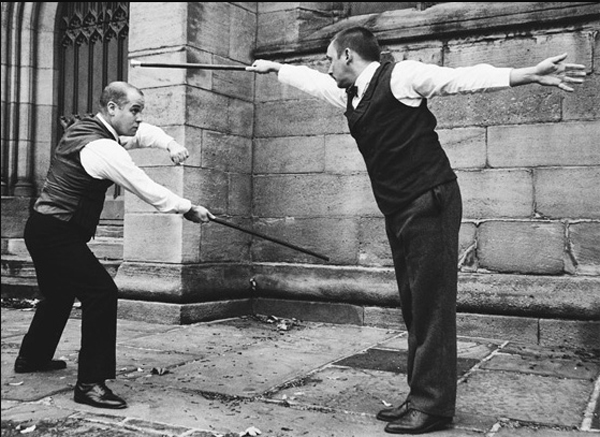
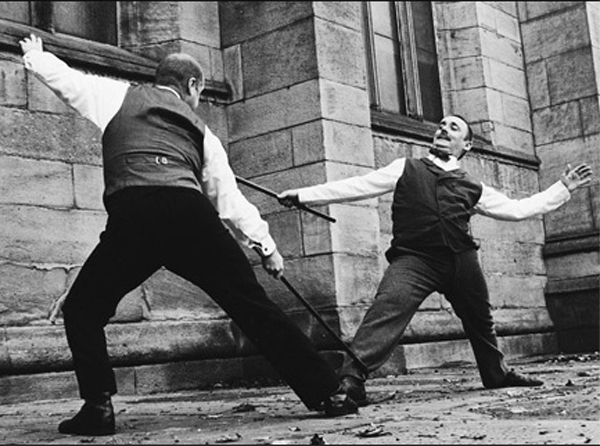
Royal Armouries fight interpreters Rob Temple (as Dr. John Watson, right) and Keith Ducklin (as Sherlock Holmes, left) demonstrate Bartitsu cane fighting poses during their 2001 presentation “Bartitsu, the martial art of Sherlock Holmes”. Inspired by the online publication of E.W. Barton-Wright’s articles at the Electronic Journals of Martial Arts and Sciences Journal of Manly Arts, this was the first known public demonstration of Bartitsu since 1902.