- Originally published on the Bartitsu.org site on Saturday, 26th July 2014

Some simple self defence tricks from the San Francisco Morning Call of February 10, 1895.
Some simple self defence tricks from the San Francisco Morning Call of February 10, 1895.
A Morning Post report on one of Bartitsu founder E.W. Barton-Wright’s earliest jiujitsu demonstrations, which took place at St. James’s Hall in London on October 26, 1898.
The journalist was evidently very intrigued by Barton-Wright’s demonstrations of sutemi (sacrifice throws), which – being outside the scope of most European wrestling styles – were an extraordinary novelty.


A very rare colour version of artist Percy Macquoid’s Exercise With The Double-Handed Sword, part of his Types of Old Swordsmanship series for The Graphic newspaper, dating to 1894.
The swordsmen who posed for these pictures were members of the historical fencing club established by Captain Alfred Hutton at the London Rifle Brigade’s School of Arms. In 1900 Hutton became both an instructor at, and a Committee Member of E.W. Barton-Wright’s Bartitsu Club and several of his senior students became members of the Club.
For more on this subject, see Ancient Swordplay: The Revival of Elizabethan Fencing in Victorian London.
Originally published on the Bartitsu.org site on Wednesday, 14th January 2015
The Suffrajitsu graphic novel trilogy, written by Bartitsu instructor Tony Wolf, is now available for pre-order on Amazon.com:
In the year 1914, with Europe on the brink or war, the leaders of the radical women’s rights movement are fugitives from the law. Their last line of defence is the secret society of Amazons; women trained in the martial art of Bartitsu and sworn to protect their leaders from arrest and assault …
(And yes, that is the Bartitsu Club shown at 00:25 in the video!)

As shown in this spectacular illustration for The Graphic of May 28, 1910, the use of the naginata was demonstrated alongside jiujitsu at the famous Japan-British Exhibition.
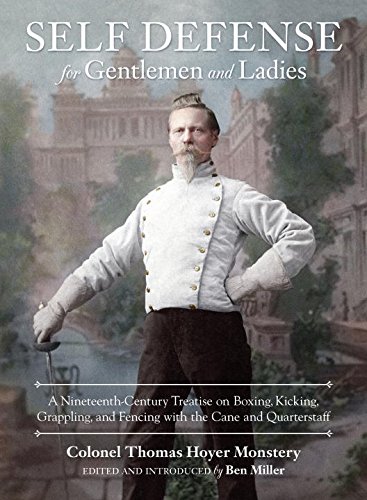
Advance notice that this book – a compilation of self-defence articles written by famed duelist, mercenary and raconteur Col. Thomas Hoyer Monstery – will be published in April of 2015.
According to the synopsis:
Self-Defense for Gentlemen and Ladies is the treatise of Colonel Thomas Hoyer Monstery, a master swordsman who participated in more than fifty duels, fought under twelve flags, battled gangsters, and was constantly involved in the great conflicts and upheavals of his time. Monstery’s treatise—originally published in the 1870s as a series of newspaper articles and collected here for the first time—is his magnum opus, a highly detailed dissertation on the art and science of defense. Filled with profound insight as well as practical advice based upon personal combative experience, it proposes a holistic approach to self-defense, including both unarmed and armed methods for use against a wide variety of fighting styles and weapons, as well as touching upon issues of health, exercise, diet and longevity.
Self-Defense for Gentlemen and Ladies presents a unique look into the Victorian fighting world, describing styles of the era such as British “purring” (shin-kicking), Welsh jump-kicking, and Danish head-fighting. Additionally, the book’s section on the quarterstaff is the only American source on this weapon prior to the 20th century. Aside from its historical value, however, Monstery’s teachings on unarmed self-defense, cane fighting, and responding to unpredictable situations are still useful today, especially for those martial artists focused on “real world” self-defense. Fifty rare drawings and photographs from the period provide a fascinating glimpse into Monstery’s world and training, while an extensive glossary of terms and an introductory biography of Colonel Monstery–including fascinating details of his many duels as well as his groundbreaking devotion to teaching fencing and self-defense skills to women–update Monstery’s text to make it accessible to a broad and modern audience.
CONTENTS
Colonel Thomas Hoyer Monstery: The Unknown American Martial Arts Master
I. Introduction.
II. The Logic of Boxing.
III. Standing and Striking.
IV. Advancing to Strike and Feinting.
V. Simple Parries in Boxing.
VI. Parries with Returns.
VII. Effective or Counter Parries in Boxing.
VIII. Offence and Defense by Evasions.
IX. Trips, Grips, and Back-Falls.
X. Rules for a Set-to with Gloves.
XI. Observations on Natural Weapons.
XII. The Use of the Cane.
XIII. The Use of the Staff.
Appendix: Monstery’s Rules for Contests of Sparring and Fencing
Glossary

This Illustrated London News article describes some of the unusual Japanese martial arts displayed at the Aeolian Hall on May 31, 1919. As well as jujitsu, the visiting kendo master Sonobe Masatada demonstrated aspects of kendo as well as combat with the kusarigama (chain and sickle), nito (pair of swords) and nabebuta (saucepan lids). Madame Hino Yoshiko also took part in the display, demonstrating naginatajutsu (fencing with the halberd).
A series of promotional photographs, subjects unknown, dating to the first decade of the 20th century.


The graphic novel trilogy Suffrajitsu: Mrs. Pankhurst’s Amazons, written by Tony Wolf with art by Joao Vieira, will be published by Jet City Comics in early 2015:
London, 1914: with Europe on the brink of war, the leaders of the radical women’s rights movement are fugitives from the law. Their last line of defence is the elite secret society of Amazons; women trained in the martial art of Bartitsu and sworn to protect their leaders from arrest and assault.
The stakes dramatically rise when the Amazons find themselves playing a deadly game of cat-and-mouse against an aristocratic, Utopian cult …
Stay tuned for updates!