“A Striking Exhibition” (Grantham Journal, Nov. 1, 1902)

  • Originally published on the Bartitsu.org site on Sunday, 29th September 2013

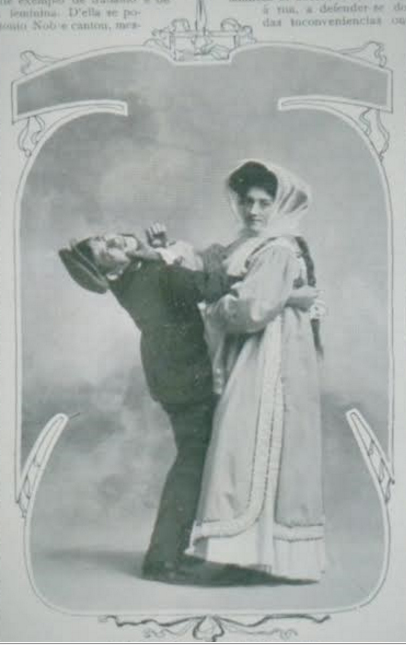
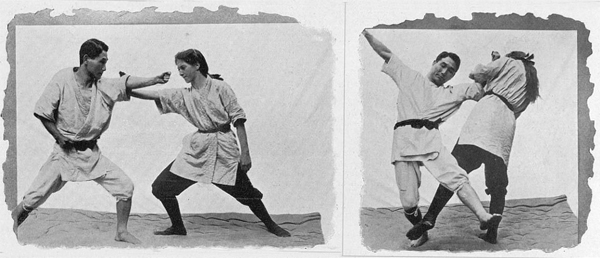
On Tuesday night, in London, Professor Vigny gave a striking exhibition the possibilities of self-defence afforded by simple walking-stick. Holding his malacca cane by one hand at each end, the Professor calmly awaited the onslaught of a skilled opponent armed with a similar stick. The spectators never knew which hand was to deal the blow, the released end moving with lightning speed.

Then came an exhibition of stick swinging by which every part the body was protected on all sides. With perpetual loud hum the cane made circles, front and behind, that no one could reach within the guard without instantly receiving blew that would splinter any bone to pieces.

And then, with the amateur heavy-weight champion, he showed his skill in boxing, and the French system of boxing with both hands and feet, “la savate.”

With a sprinkling of people about who had learned Vigny’s system, remarks our correspondent, the Hooligan would find his occupation gone.

Posted in Vigny stick fighting | Comments Off on “A Striking Exhibition” (Grantham Journal, Nov. 1, 1902)

Bartitsu in “Black Belt Magazine”

  • Originally published on the Bartitsu.org site on Thursday, 19th September 2013
BB cover

Congratulations to Elizabeth Crowens of the Bartitsu Club of New York City, whose article Bartitsu: Reviving the “Mixed” Martial Art of Sherlock Holmes appears in the October/November 2013 issue of Black Belt Magazine.

Posted in Editorial | Comments Off on Bartitsu in “Black Belt Magazine”

“A New School of Self-Defence” (1902)

  • Originally published on the Bartitsu.org site on Saturday, 26th May 2018

From The Referee of 21 September 1902:

I have been asked to notice the New School of Self Defence and Salle D’Escrime, opened at 18, Berners-street, Oxford-street, and the system of umbrella or stick play illustrated by Professor Pierre Vigny and disciples. Though unable to respond in person to the invitation given to be present at an assault held on Thursday of last week, I can do what is asked, for at various times I have assisted—as a spectator—at such displays.

Certainly the school does make good case for the articles’ usefulness, both in offence and self-defence, when expertly handled; but the art is scarcely new, though carrying much variety. Anyone well versed in single-stick can, of course, easily adapt anything in the nature of a stick for purposes of self-defence, which naturally includes carrying the war into the enemy’s quarters; but to my mind better possibilities are contained in being armed with a stout blackthorn, not to mention “my friend Captain Kennedy.”

At the same time, I have seen in street rows some awfully effective play made with a strong umbrella—a truly terrible weapon in the hands of a clever fencer indifferent as to what damage he might inflict. I wouldn’t like to go for anyone that way, save in extremity. Give such a one room to start —say, with his back against wall, and the foe in front, and he can do tremendous execution, almost murderous.

Once in an election riot I saw an old Army man, set upon by roughs, send his assailants down, man after man, at each lunge. Over they went, struck full on the chest, and no one came for a second dose. How much he hurt them goodness knows—seriously, most of them, I expect.

Posted in Vigny stick fighting | Comments Off on “A New School of Self-Defence” (1902)

Dr. Herman Ten Kate Discusses the Shinden Fudo Ryu in 1905 (Part 1)

  • Originally published on the Bartitsu.org site on Monday, 2nd April 2018

Bartitsu founder E.W. Barton-Wright studied jiujitsu between the years 1895-98, while working as a chemical engineer for the E.H. Hunter Company in Kobe, Japan.  Building on a background that included boxing, wrestling, savate and “the use of the stiletto” as well as, by his own account, considerable street fighting experience in far-flung locales, Barton-Wright was almost uniquely well-positioned to appreciate the Japanese art of unarmed combat, which was then almost completely unknown to the Western world.  By the time he returned to England, it’s likely that his practical knowledge of jiujitsu exceeded that of almost literally any other Westerner.

Herman Ten Kate

Barton-Wright did not, however, record much of his Kobe jiujitsu experience, other than referring to training with a sensei who “specialised in the kata form of instruction”.  For details about that sensei and his school and style, we must refer to the writings of Dr. Herman ten Kate.  Ten Kate was a Dutch medical doctor and anthropologist who had met Barton-Wright on a steam ship sailing from Batavia (present-day Jakarta) to Singapore, en route to Japan, where both men became students at the same Kobe jiujitsu dojo.

In 1905 ten Kate wrote an article titled “Jujutsu, de Zachte Kunst” (“Jujutsu, the Yielding Art”) for the Dutch journal De Gids.  It’s evident that ten Kate had come across Barton-Wright’s own articles on “The New Art of Self-Defence”, which had been published in Pearson’s Magazine several years previously.  It’s also clear that ten Kate mistakenly assumed that Barton-Wright had “mis-appropriated” jiujitsu by re-naming it after himself; this strongly implies that ten Kate was not aware of Barton-Wright’s other writings on Bartitsu, which demonstrated that Bartitsu was a “new art” specifically because it combined jiujitsu with other fighting styles.

Ten Kate’s article was primarily concerned with the history, theory and variety of jiujitsu koryu-ha (traditional styles).  It also included several anecdotes and a number of technical analyses drawn from his personal experience.  The following translated excerpts from “Jujutsu, the Yielding Art” offer the best available insights into the type of training given to Herman ten Kate and E.W. Barton-Wright at their Kobe jiujitsu dojo, and thus offer some clues as to the early origins of Bartitsu.  We have offered some annotations in italics, for clarity and context.

After introducing the theory of victory by yielding to an opponent’s strength, ten Kate states that:

It was by chance, during a conversation with Barton-Wright aboard a steamship between Batavia and Singapore, that, several years ago, I first learned of  Jujutsu. His Japanese teacher, the already elderly Terajima Kunichiro, would also initiate me into the secrets of this art; and so, for fifteen months, I was his pupil in Kobe. I also saw jujutsu performed repeatedly in the exercises of police constables in Nagasaki and by others elsewhere in Japan.

From the literature on jujutsu that is known to me, the study of the Japanese neurologist Miura the most comprehensive and most scientific. Therefore, I want to follow him  particularly when describing the essence of Jujutsu.

This art is essentially based on the following principles:

1. Attempts to reduce the opponent’s strength by pulling them off-balance;

2. Attempts to divert the attacks of the opponent;

3. One tries to put the opponent in a weaker position, while also maintaining one’s own (stronger) position;

4. One focusses one’s attack upon the opponent’s weakest point;

5. Leverage is primarily used to effect the overthrow of the opponent – “knowledge of balance and leverage” as Barton-Wright calls it;

6. To pin (lock) the fallen adversary, as well as to free oneself from an opponent’s grip, use joint rotations and pressure applied to sensitive areas;

7. When the enemy attempts to attack, strikes to certain highly sensitive areas of the body will cause them to fall unconscious;

8. An enemy thus downed can, however, be revived again, according to certain methods.

In studying such modes of attack and defense, as well as the method of imparting them, one might think that they had been developed by a physician, especially with regards to their anatomical and physiological invention. I believe, however, that there is much less theoretical than empirical scientific knowledge in Jujitsu. At the time in which the art originated, the level of scientific knowledge of the human body was extremely low. Certainly very few practitioners have heard of the median nerve or the gastrocnemius muscle, and yet all know how to put unbearable pressure on those points.

Further, when a Japanese man inflicts a blow upon some points of the chest and makes his foe fall unconscious, he need not know that he repeats the experiments of Meola, Riedinger and others, but still the blood vessels of the lungs are widened, blood flow to the left ventricle is obstructed and general blood pressure lowers. Likewise, (he need not know) that he brings into use, by certain thrusts under the ribs and below the navel, the ‘Klopfversuch’ by Goltz.

This refers to anatomical experiments by Friedrich Goltz (1834-1902) which demonstrated the effects of nerve stimulation.

One can, in general, distinguish four main divisions of jujutsu:

I. Randori, i.e. (free) wrestling, where one throws his opponent to the ground and holds him there. The 1st-6th principles enumerated above are then put into application.

II. Kata, i.e. engaging in a particular (pre-arranged) way.

III. Atemi or Sappo, i.e. the way to strike a blow to weaken or kill if necessary.

IV. Kwata or kwappo, i.e. the way to render a man unconscious.

We can not dwell within each division, because going into detail would fill a volume. As in European swordsmanship, but regardless of weapon, lessons in the various divisions are made according to a certain order; also, all techniques, within randori, kata and atemi, may be combined in various ways. In the school of my teacher Terajima there were over seventy (such methods). This combination between them also happens in “man to man” practice, which are mimic (mirror) combats, and also in actual combat. In addition, the attack and counterattack depend entirely on the circumstances of the moment. Perhaps more than in any other conceivable fight, of any kind, is lightning fast reflex speed a prerequisite to jujutsu.

Part 2 of this article will continue Dr. ten Kate’s analysis of jiujitsu techniques and principles.

Posted in Canonical Bartitsu, E. W. Barton-Wright, Jiujitsu | Comments Off on Dr. Herman Ten Kate Discusses the Shinden Fudo Ryu in 1905 (Part 1)

“… the misspelled wrestle Doyle called baritsu”

  • Originally published on the Bartitsu.org site on May 1st, 2017

In response to the newest and most action-packed Sherlock adventure, The Six Thatchers, TV critic Ralph Jones wrote an opinion piece titled “Sherlock is slowly and perversely morphing into Bond. This cannot stand.” Here is series writer Mark Gatiss’ retort, in Doylean verse no less:

Here is a critic who says with low blow
Sherlock’s no brain-box but become double-O.
Says the Baker St boy is no man of action –
whilst ignoring the stories that could have put him in traction.

The Solitary Cyclist sees boxing on show,
The Gloria Scott and The Sign of the Fo’
The Empty House too sees a mention, in time, of Mathews,
who knocked out poor Sherlock’s canine.

Would you mess with this man?

As for arts martial, there’s surely a clue
in the misspelled wrestle Doyle called baritsu.
In hurling Moriarty over the torrent
did Sherlock find violence strange and abhorrent?

In shooting down pygmies and Hounds from hell
Did Sherlock on Victorian niceties dwell?
When Gruner’s men got him was Holmes quite compliant
Or did he give good account for The Illustrious Client?

There’s no need to invoke in yarns that still thrill,
Her Majesty’s Secret Servant with licence to kill
From Rathbone through Brett to Cumberbatch dandy
With his fists Mr Holmes has always been handy.
Mark Gatiss
London

Posted in Baritsu, Humour, Sherlock Holmes | Comments Off on “… the misspelled wrestle Doyle called baritsu”

Sadakazu Uyenishi Trains the Crew of the “Buzzard” (1905)

  • Originally published on the Bartitsu.org site on Sunday, 1st January 2017

Bartitsu Club instructor Sadakazu Uyenishi was appointed the jiujitsu instructor of the British Army and also gave unarmed combat lessons to sailors in the Navy. In this photo from the Penny Illustrated Paper of December 23, 1905, he instructs crewmen of the HMS Buzzard.

Posted in Jiujitsu | Comments Off on Sadakazu Uyenishi Trains the Crew of the “Buzzard” (1905)

“A New Weapon: The Torpedo Umbrella” (New York Times, 1876)

  • Originally published on the Bartitsu.org site on Monday, 5th May 2014
Torpedo Umbrella

A fanciful suggestion from the New York Times, proposing one way in which the humble brolly might be augmented for use as an implement of self-defence:

It is a reproach to the inventive genius of the age that hitherto no improvements have been made in that familiar weapon, the umbrella. The present generation has seen the smooth-bore musket succeeded by the breechloading rifle, and the old-fashoned 32-pounder made obsolete by the introduction of the 15-inch Rodman gun. The revolver and the bowie-knife, the percussion shell and the naval torpedo have all been invented during the present century, but the umbrella remains precisely the same uncertain and inefficient weapon that it was when first adopted as a substitute for the rapier.

Whether it is used for purposes of offence or defence, it is equally unsatisfactory. Occasionally an irascible old gentleman attempts to strike a blow with a furled umbrella, but there is not on record a single case in which a serious wound has been thus inflicted, and it is now generally recognized that the umbrella cannot be effectually used either as a club or a cutting weapon. Tacticians are agreed that when an attack is made with an umbrella, the attacking party must use it exclusively as a thrusting weapon.

Even when thus used, it is far inferior to the bayonet or the pike. If thrust violently into an adversary’s stomach, or inserted carefully in his eye, a wound may be inflicted which will temporarily disable him. It is seldom, however, that a man will hold his eye sufficiently still to enable another to hit it with an umbrella, and the inability of the weapon to pierce through several thicknesses of cloth renders the modern stomach comparatively safe from an umbrella-thrust.

In the hands of determined women, the umbrella is sometimes effectively employed in order to attract the attention of a car conductor, or to prepare a careless young man smoking a cigar on the car platform, to receive a tract on the sin of profane swearing. In such cases, however, the umbrella is intended merely to stimulate the mind through the medium of the ribs, and not as an offensive weapon.

When used for defensive purposes, an open umbrella will sometimes ward off the attack of an infuriated poodle, and it is asserted that it has occasionally sheltered a cautious husband from a sudden shower of crockery, resulting from a depressed state of feminine hopes concerning a new bonnet and the sudden appearance of a domestic storm-centre in the area of the breakfast-room. Still, when all has been said in behalf of the umbrella that its advocates can possibly claim, the facts of its miserable inefficiency both for attack and defence must be conceded.

The recent invention of the torpedo-umbrella, by an ingenious citizen of Chicago, can be compared in value only to the invention of gunpowder, and the new weapon is as much superior to the old-fashioned umbrella as the musket was to the bow and arrow.

The torpedo-umbrella resembles in its outward appearance the ordinary silk or cotton side-arm, but its stock is somewhat larger in diameter, and consists of two pieces, a hollow metallic tube and a wooden piston, the latter forming the handle of the weapon.

Within that part of the tube which projects beyond the frame of the umbrella, and forms what is commonly called its point, is enclosed a cartridge containing a heavy charge of dynamite. This cartridge can be pushed forward and exploded simply by pressing the handle of the piston-rod, and as the force of the explosion is exerted on a line with the tube, the cartridge can be fired without danger to the operator, especially if he first spreads the umbrella and thus interposes a shield against any possible splinters or flying fragments of an enemy.

It can easily be perceived that this simple weapon may be made extremely formidable in the hands of a cool and courageous man. If such a man were to be accosted in a lonely street at midnight by a suspicious-looking stranger, who should express a wish for his money or his life, without evincing any particular preference for either, he would instantly open his umbrella, bring the point in contact with the stranger’s waistcoat, and smartly drive down the piston. There would be a sharp explosion, and the stranger would vanish. No trace of the tragedy would be left in the neighborhood for the edification of the possible policeman who might bend his slow footsteps in the direction of the explosion during the following day, but minute and widely dispersed materials for a hundred inquests would afterwards be collected by expert coroners, who would enjoy a prolonged carnival of fees.

No such satisfactory results could be achieved by any other known weapon. Unlike the revolver, the torpedo-umbrella never misses its aim; neither does it burden the operator with a useless corpse. Its work is done instantaneously, thoroughly, and with absolute certainty, and the Chicago inventor claims that by its aid an enterprising wife, who modestly shrinks from the trouble and cost of divorce suits, can prepare herself for a fresh husband, even in the most crowded thoroughfare, without danger of impertinent interference. So instantaneous is the effect produced by the explosion of the umbrella-torpedo, that had Mrs. Laura Fair used it in connection with the late Mr. Crittenden, all that the bystanders would have noticed would have been a violent report and the inexplicable disappearance of Mr. Crittenden — phenomena which no one would have dreamed of associating with a pretty woman and a seemingly harmless umbrella.

Hereafter the privacy of men with umbrellas will be strictly respected, and the travelling Briton who visits this country with his inevitable umbrella in his hand, can roam over the entire continent without finding a single representative of the traditional Yankee whose thirst for information has been recorded by every foreign book-making tourist.

Posted in Antagonistics, Fiction, Humour | Comments Off on “A New Weapon: The Torpedo Umbrella” (New York Times, 1876)

The Bartitsu School of Arms: Chicago, 2012

  • Originally published on the Bartitsu.org site on Wednesday, 25th April 2012

Announcing the second international Bartitsu symposium, to take place in the great city of Chicago, USA between September 8th and 9th, 2012. The event is hosted by the Bartitsu Club of Chicago.

  1. Premise
  2. Training
  3. Schedule
  4. Location and venue
  5. Field trip to the Hegeler Carus Mansion
  6. “Susan Swayne and the Bewildered Bride”
  7. Antagonisticathlon
  8. Prerequisites
  9. Please bring:
  10. Local accommodation options
  11. Registration

Premise
To preserve and extend the pioneering martial arts cross-training experiments begun by E. W. Barton-Wright at the original Bartitsu School of Arms and Physical Culture, circa 1901:

Under Bartitsu is included boxing, or the use of the fist as a hitting medium, the use of the feet both in an offensive and defensive sense, the use of the walking stick as a means of self-defence. Judo and jujitsu, which are secret styles of Japanese wrestling, I would call close play as applied to self-defence.

In order to ensure, as far as it is possible, immunity against injury in cowardly attacks or quarrels, one must understand boxing in order to thoroughly appreciate the danger and rapidity of a well-directed blow, and the particular parts of the body which are scientifically attacked. The same, of course, applies to the use of the foot or the stick.

Judo and jujitsu were not designed as primary means of attack and defence against a boxer or a man who kicks you, but are only to be used after coming to close quarters, and in order to get to close quarters it is absolutely necessary to understand boxing and the use of the foot.

– E.W. Barton-Wright, lecture for the Japan Society of London, 1902

Training

Participants will experience an intense and immersive two days of cross-training and circuit training with fellow enthusiasts, guided by a team of Bartitsu instructors and inspired by the ideal of Barton-Wright’s School of Arms:

In one corner is M. Vigny, the World’s Champion with the single-stick: the Champion who is the acknowledged master of savate trains his pupils in another … he leads you gently on with gloves and single-stick, through the mazes of the arts, until, at last, with your trained eye and supple muscles, no unskilled brute force can put you out, literally or metaphorically.

In another part of the Club are more Champions, this time from far Japan, who will teach you once more of how little you know of the muscles that keep you perpendicular, and of the startling effects of sudden leverage properly applied …

… when you have mastered the various branches of the work done at the Club, which includes a system of physical drill taught by another Champion, this time from Switzerland, the world is before you, even though a “Hooligan” may be behind you …

– “S.L.B.” in the article “Defence Against ‘Hooligans’: Bartitsu Methods in London”, from The Sketch, April 10, 1901

Following the successful model of the inaugural event in London, the 2012 School of Arms will be a “combat laboratory” with participants collaborating as martial athletes, historical scholars and research analysts. Our days will include whole-group training sessions as well as skills-based circuit training and breakout groups concentrating on particular areas of interest. Some cross-training sessions will be team-taught by instructors and others will involve peer-to-peer work.

Instructors and class themes to date (April 22nd – list may be subject to additions and change) include:

Tony Wolf (New Zealand/USA) will be running sessions in combat tactics/biomechanics across each of the Bartitsu skill-sets; twist and segue drills (building upon the stylised canonical Bartitsu sequences through progressive levels of improvisation and resistance as a bridge between set-plays and free-sparring) and c1900 physical culture conditioning exercises.

Keith Jennings will teach aspects of 19th century pugilism (the predecessor of modern boxing) and catch-as-catch-can wrestling, the folk-style which quickly blended with the eclectic jujitsu introduced to the Western world by Barton-Wright, Yukio Tani and Sadakazu Uyenishi at the Bartitsu Club.

Allen Reed (USA) will concentrate on canonical jujitsu sequences and counters to those sequences arising from resistance by the opponent.

Mark Donnelly (UK/USA) will focus on the principles of Bartitsu as outlined in all of the canonical material.  His sessions will demonstrate how canonical Bartitsu outlines tactical approaches to combat at different ranges based on the nature of the threat and the weapons (real or improvised) which are available at that moment.

Schedule

Friday, September 7th: Optional (but highly recommended) field trip to the Hegeler Carus mansion, including historic gymnasium, in LaSalle, Illinois (see details below).  Departing from Forteza Fitness at approximately 12.00 mid-day, mansion tour from approximately 2.00-3.30 pm, returning to Forteza by approximately 6.00 pm. Also optional and recommended on Friday night; a meal in Chicago’s Lincoln Square neighborhood, followed by the play “Susan Swayne and the Bewildered Bride” (see below) at 8.00 pm

Saturday, September 8th: Bartitsu training at the School of Arms venue 9.00 a.m. – 12.30 p.m., 1 hour lunch break, training 1.30 p.m. – 6.00 p.m.; reconvene for dinner, discussions and socialising at O’Shaughnessy’s Public House (4557 N Ravenswood Ave, Chicago, IL 60640 – a three-minute walk from the School of Arms venue) from 7.00 p.m. onwards

Sunday, September 9th: Bartitsu training at the School of Arms venue 9.00 a.m. – 12.30 p.m., 1 hour lunch break, training 1.30 p.m. – 4.15 p.m., antagonisticathlon (see below) from 4.30 – 5.45 p.m.; closing, presentation of participation certificates, group photos and farewells.

Please visit the Events.com website for information on other sporting and cultural events taking place in Chicago during September and TripAdvisor.com for details on the Windy City’s many tourist attractions.

Location and venue

… a huge subterranean hall, all glittering, white-tiled walls, and electric light, with ‘champions’ prowling around it like tigers …

– journalist Mary Nugent, describing the original Bartitsu Club in her January, 1901 article for Sandow’s Magazine of Physical Culture.

The 2012 School of Arms venue is the Forteza Fitness, Physical Culture and Martial Arts studio in Chicago’s popular Ravenswood district.

Specifically inspired by E.W. Barton-Wright’s original Bartitsu School of Arms and Physical Culture, Forteza is one of the very few full-time, dedicated Western martial arts facilities in North America. Old-school brick walls and a soaring exposed-beam timber ceiling enclose a 5000 square foot studio in a c1900 building, which also includes the Gymuseum, a “living museum” of functional antique physical culture equipment.

Please click here to view a fully interactive map of the local area, with the School of Arms venue highlighted. You can also use this map to check routes to and from the venue and accommodation/entertainment options, etc.  Note that the Forteza studio is a three minute walk from the Montrose Brown Line train station.

Free, all day street parking is typically available all along Ravenswood Avenue.  Please do not park in the small parking lot immediately outside the studio door, as the spaces there are reserved for the adjacent businesses.

Field trip to the Hegeler Carus Mansion

Built in the year 1876, the Hegeler Carus mansion is located in LaSalle, a two-hour journey from downtown Chicago. The 57-room mansion is considered to be one of the finest examples of Second Empire architecture in the American Midwest.  It has been the site of numerous historic accomplishments in industry, philosophy, publishing and religion.  For eleven years during the late 19th century, the mansion was the base of Japanese scholar D. T. Suzuki’s efforts to communicate Zen Buddhism to the Western world.

Of particular interest to practitioners of Bartitsu and c1900 physical culture, the Hegeler Carus mansion houses what is believed to be the world’s oldest private gymnasium.  The turnhall (German, “gymnastics room”) still contains its original equipment, including wooden Indian clubs and dumbbells, “Roman rings” suspended from the ceiling, gymnastics poles, climbing ladders and an extremely rare “teeter ladder” device.  D.T. Suzuki himself exercised there.

School of Arms participants are invited to accompany Tony Wolf, a member of the Hegeler Carus Foundation’s advisory board, in a fascinating guided tour of the mansion and historic gym.

Susan Swayne and the Bewildered Bride

After returning from LaSalle, School of Arms participants will be welcome to join us for a meal and a show! The play Susan Swayne and the Bewildered Bride concerns the adventures of the “Society of Lady Detectives” in late-Victorian London, and has been described as “Mary Poppins meets the League of Extraordinary Gentlemen”. They’ve been getting great reviews and the fight choreography includes fencing, knife fighting and, yes, Bartitsu!

The theatre is in Lincoln Square, a five minute drive or easy 12 minute train trip from Forteza.

Your School of Arms registration fee covers your ticket to see “Susan Swayne”. Please let us know whether you will be attending the show, towards our making an accurate group booking.

Antagonisticathlon

Combining fun with challenge, the antagonisticathlon is a fitting final event for the 2012 Bartitsu School of Arms. Participants represent Victorian-era adventurers fighting their way through a gauntlet of obstacles and “assassins”, inspired by Sherlock Holmes fending off Professor Moriarty’s henchmen in The Adventure of the Final Problem. Although the antagonisticathlon is not a competition, “style points” may be awarded at the judges’ discretion …

Prerequisites

In order to ensure good progress for the whole group throughout the School of Arms, certain technical skills are required as prerequisites of participation. These include:

  • basic ukemi (breakfalling) – you must be able to comfortably and safely fall backwards and/or sideways to the left and right from a standing start
  • basic boxing – you must be able to comfortably and safely punch a hand-held, padded striking target with either fist
  • fitness – this will be a physically intense event and you should be in good general physical condition. We will be active all day, each day. People with significant physical challenges should contact the organisers for advice before committing to attending the event

Please bring:

  • A large water or sports drink bottle
  • Exercise clothing resembling 19th century physical culture kit (typically, a plain, form-fitting t-shirt or tanktop/singlet and either yoga pants, fencing pants or gi pants in any combination of the colours black, white, navy blue, maroon or grey)
  • A pair of exercise shoes to be worn during training; please note that outdoor shoes are not permitted on the Forteza studio floor
  • A sturdy crook-handled walking stick and/or rattan rod approximately 36″ in length, with any sharp or rough edges smoothed away

Participants in the antagonisticathlon are encouraged to wear clothing evocative of the Victorian period, if practical.

Fencing masks, gi jackets and sashes, boxing gloves, hand protection for stick fighting, mouth guards, additional body protection (knee/shin pads, groin guards, etc.) are not required, but will be welcome if you can bring them.  A limited number of rattan canes, fencing masks and other items of protective equipment will be available for training and sparring purposes.

We suggest that you bring a light jacket or sweater.  Average temperatures in Chicago during early September are pleasant, ranging from a high of 74°F (23°C) to a low of 55°F (13°C).  The risk of rainfall is low.

Local accommodation options

This map details numerous accommodation options in the vicinity of the Bartitsu School of Arms venue.  Please note that participants are responsible for arranging their own accommodation; this expense is not included in the 2012 School of Arms registration fee.  In selecting accommodation, please note again that Forteza Fitness is very close to the Montrose Brown Line train station.

Update: members of the Bartitsu Club of Chicago are able to offer free homestay accommodation to School of Arms participants on a first-come, first serve basis. Please contact tonywolf@gmail.com to discuss the homestay option.

Registration

The 2012 Bartitsu School of Arms is a boutique symposium hosted by the Bartitsu Club of Chicago. The event is strictly limited to 30 participants aged 18 years and older.

The registration fee for the event is US$120.00 (€91.00, £74.00). You can register and pay online (Visa, MasterCard, Discover, American Express and PayPal) via this link:

If you wish to register for a single day, please send US$60.00 via PayPal to tonywolf@gmail.com , clearly noting whether you are booking for Saturday or Sunday training.

Payment may also be made in cash or by credit card on the day, but it is crucial in these cases to make advance contact via tonywolf@gmail.com to ensure that there will be a free space.

Please note that your registration fee goes towards operational expenses associated with running the School of Arms. Participants are responsible for arranging for their own accommodation and buying their own meals and drinks.

We hope to see you soon in Chicago!

Posted in Antagonistics, Bartitsu School of Arms, Boxing, Canonical Bartitsu, Instruction, Jiujitsu, Physical Culture, Savate, Vigny stick fighting | Comments Off on The Bartitsu School of Arms: Chicago, 2012

The Bartitsu School of Arms: London 2011

  • Originally published on the Bartitsu.org site on Wednesday, 25th May 2011

Announcing the first international Bartitsu symposium, to take place in the great city of London, England, U.K. between August 26 and 28, 2011.

The 2011 Bartitsu School of Arms is a boutique symposium sponsored by the Linacre School of Defence. The event is strictly limited to 25 participants aged 18 years and older.

  1. Premise
  2. Training
  3. Schedule
  4. Location and venue
  5. Nights at the Sherlock Holmes
  6. Prerequisites
  7. Please bring:
  8. Local accommodation options
  9. Certificates of participation
  10. Registration

Premise

To preserve and extend the pioneering martial arts cross-training experiments begun by E. W. Barton-Wright at the original Bartitsu School of Arms and Physical Culture, circa 1901:

Under Bartitsu is included boxing, or the use of the fist as a hitting medium, the use of the feet both in an offensive and defensive sense, the use of the walking stick as a means of self-defence. Judo and jujitsu, which were secret styles of Japanese wrestling, he would call close play as applied to self-defence.

In order to ensure as far as it was possible immunity against injury in cowardly attacks or quarrels, they must understand boxing in order to thoroughly appreciate the danger and rapidity of a well-directed blow, and the particular parts of the body which were scientifically attacked. The same, of course, applied to the use of the foot or the stick.

Judo and jujitsu were not designed as primary means of attack and defence against a boxer or a man who kicks you, but were only to be used after coming to close quarters, and in order to get to close quarters it was absolutely necessary to understand boxing and the use of the foot.

– E.W. Barton-Wright, lecture for the Japan Society of London, 1902

Training

Participants will experience an intense and immersive two days of training with fellow enthusiasts, guided by a team of Bartitsu instructors and inspired by the cross-training/circuit training model of Barton-Wright’s School of Arms:

In one corner is M. Vigny, the World’s Champion with the single-stick: the Champion who is the acknowledged master of savate trains his pupils in another … he leads you gently on with gloves and single-stick, through the mazes of the arts, until, at last, with your trained eye and supple muscles, no unskilled brute force can put you out, literally or metaphorically.

In another part of the Club are more Champions, this time from far Japan (who) will teach you once more of how little you know of the muscles that keep you perpendicular, and of the startling effects of sudden leverage properly applied …

… when you have mastered the various branches of the work done at the Club, which includes a system of physical drill taught by another Champion, this time from Switzerland, the world is before you, even though a “Hooligan” may be behind you …

– “S.L.B.” in the article “Defence Against ‘Hooligans’: Bartitsu Methods in London”, from The Sketch, April 10, 1901

The 2011 School of Arms will be a “combat laboratory” with participants collaborating as martial athletes, historical scholars and research analysts. Our days will include whole-group training sessions as well as skills-based circuit training and breakout groups concentrating on particular areas of interest. Some cross-training sessions will be team-taught by instructors and others will involve peer-to-peer work.

Confirmed instructors and subjects to date (August 4th) include:

Tony Wolf (New Zealand/USA) will be running sessions in combat tactics/biomechanics across each of the skill-sets; twist and segue drills (building upon the stylised canonical Bartitsu sequences through progressive levels of improvisation and resistance as a bridge between set-plays and free-sparring) and c1900 physical culture conditioning exercises.

James Marwood (UK) will focus on practical applications of Bartitsu principles, specifically the use of boxing/pugilism and jujitsu atemi-waza and grappling to deal with assaults. Working from the premise that such an assault will be a surprise, James will show that the base arts and principles of Bartitsu can be applied to vastly increase one’s chance of a successful outcome.

Allen Reed (USA) will concentrate on canonical jujitsu sequences and counters to those sequences arising from resistance by the opponent.

George Stokoe (UK) will teach a special class in tactical low kicking techniques.

Stefan Dieke (Germany) will teach “La Canne Vigny through the eyes of a swordsman: another look at ‘Self defence with a walking stick’”. Structured along swordfighting tactics, this class will revisit a number of key sequences and their variations from Barton-Wright’s Self Defence with a Walking Stick article, paying special attention to distance and time according to fencing theory.

Friday, August 26: dinner, orientation and socialising from 7.00 p.m. onwards in the back bar of the Salisbury pub (90 Saint Martin’s Lane). Built in 1892, the Salisbury is about a six minute walk from the Shaftesbury Avenue site of the original Bartitsu Club. Who knows, perhaps Barton-Wright and his colleagues used to frequent it …

Saturday, August 27: training at the School of Arms venue 9.00 a.m.-12.30 p.m., 1 1/4 hour lunch break, training 1.45 p.m. – 6.00 p.m.; reconvene for dinner, discussions and socialising at the Sherlock Holmes pub and restaurant (10-11 Northumberland Street, Westminster, London WC2N 5DB – see further info. below) from 7.00 p.m. onwards

Sunday, August 28: training at the School of Arms venue 9.00 a.m.-12.30 p.m., 1 1/4 hour lunch break, training 1.45 p.m. – 6.00 p.m.; closing, presentation of certificates, group photos and farewells; another night at the Sherlock Holmes for participants whose schedules allow it.

Note that the following day, Monday August 29th, is the Summer Bank Holiday in the U.K. School of Arms participants may wish to stay in London to enjoy the local festivities, including the world-famous Notting Hill Carnival. For other events and attractions in London during August please see this website.

Location and venue

… a huge subterranean hall, all glittering, white-tiled walls, and electric light, with ‘champions’ prowling around it like tigers …

 journalist Mary Nugent, describing the original Bartitsu Club in her article “Barton-Wright and his Japanese Wrestlers” for Sandow’s Magazine of Physical Culture, January 1901.

The 2011 School of Arms venue is a historic and atmospheric Victorian-era building on the South Bank of the River Thames:

This unique facility is adjacent to the Guy’s Hospital complex, which hosted one of E.W. Barton-Wright’s Bartitsu exhibitions in the year 1900.

Please click here to view a fully interactive map of the local area, with the School of Arms venue highlighted. You can also use this map to check routes to and from the venue and accommodation/entertainment options, etc.

Nights at the Sherlock Holmes

I have some knowledge, however, of baritsu …

– Sherlock Holmes on his defeat of Professor Moriarty at Reichenbach Falls

After a challenging day of cross-training in Victorian-era martial arts and combat sports, what better way to relax than at the Sherlock Holmes pub and restaurant?

The Sherlock Holmes is a short trip by tube from the School of Arms venue. Here you will enjoy traditional English meals, socialising and discussing matters Bartitsuvian with your colleagues.

We suggest that you budget for £15.00 (€17.00, US$25.00) per main course and dessert at the Sherlock Holmes restaurant. The average price of a glass of beer in a London pub is £2.24 (€2.05, US$3.06).

Prerequisites

In order to ensure good progress for the whole group throughout the symposium, certain technical skills are required as prerequisites of participation. These include:

* basic ukemi (breakfalling) – you must be able to comfortably and safely fall backwards and/or sideways in both directions from a standing start, as shown here:

* basic boxing – you must be able to comfortably and safely punch a hand-held, padded striking target with either fist

* fitness – this will be a physically intense event and you should be in good general physical condition. We will be active all day, each day. People with significant physical challenges should contact the organisers for advice before committing to attending the event.

* canonical Bartitsu sequences – you will require a working knowledge of the formal unarmed combat and stick fighting sequences detailed by E.W. Barton-Wright in his four-part article series, “The New Art of Self Defence” and “Self Defence with a Walking Stick”. Barton-Wright’s articles are reproduced in Volume 1 of the Bartitsu Compendium and are also available online here. These formal sequences will be used as conceptual platforms for neo-Bartitsu training at the School of Arms.

Please bring:

* A large, full water or sports drink bottle – please note that water is not easily available at the venue
* Comfortable exercise clothing
* A sturdy crook-handled walking stick and/or strong (hardwood) dowel approximately 36″ in length, with any sharp edges smoothed away

Fencing masks, gi jackets, boxing gloves, mouth guards, additional body protection (knee/shin pads, groin guards, etc.) are not required but will be welcome if you can bring them. A limited number of rattan canes will be available for sparring purposes.

Local accommodation options

Note that participants are responsible for booking and paying for their own accommodation; this expense is not included in the 2011 School of Arms registration fee.

St Christopher’s Village Hostel and the nearby St. Christopher’s Inn Hostel are both within a ten-minute walk or three minute car/cab journey from the School of Arms venue. Both hostels offer low-cost, few-frills accommodation with the options of private or dorm-style rooms, plus breakfast.

The 5-star London Bridge Hotel and 4-star London Southwalk Rose Hotel are also within a ten-minute walk of the School of Arms venue.

Numerous other London accommodation options are available via this site.

Certificates of participation

Each participant in the 2011 School of Arms will receive a handsome certificate as a memento of their time at this historic event.

Registration

The registration fee for the event is £80.00 (€90.08, US$129.00). You can register and pay online (Visa, MasterCard, Discover, American Express and PayPal) via this link:

Registration for single days (£40.00) should be sent via PayPal to tonywolf@gmail.com , clearly noting whether you are booking for Saturday or Sunday training. Payments on the day, at the door are possible, but it is crucial in these cases to make advance contact via tonywolf@gmail.com to ensure that there will be a free space.

Please note that your registration fee goes towards operational expenses associated with running the School of Arms. Participants are responsible for booking and paying for their own accommodation and for buying their own meals and drinks.

We hope to see you soon in London!

Posted in Antagonistics, Bartitsu School of Arms, Boxing, Canonical Bartitsu, Instruction, Jiujitsu, Physical Culture, Savate, Vigny stick fighting | Comments Off on The Bartitsu School of Arms: London 2011

The Fighting Arts of Sherlock Holmes, Part 1

  • Originally published on the Bartitsu.org site on Tuesday, 9th February 2010

Bartitsu.org is pleased to present this two-part article series by Bartitsu Society member Mike Ball.

The unusually action-heavy focus of the recently released Sherlock Holmes movie highlights a certain misconception about one of history’s greatest fictional detectives – the idea that he is solely a detective and possesses no physical skills to complement his intellect. Read on, and you will discover, if you were not already aware, that not only was Holmes skilled in fisticuffs and other manly arts [1], but that his creator’s choice of combative methods have roots in a very rich and interesting martial history.

A Master of Antagonistics

It is mentioned by Watson, as the narrator of the first Sherlock Holmes story “A Study in Scarlet”, that Holmes is “an expert singlestick player, boxer, and swordsman”, and there are several references in the canon to Holmes employing the first two of these skills. These references are fairly scant [2], possibly because Conan Doyle did not want his stories compared to those published in the “penny dreadfuls”, which were a sort of British precursor to the pulp novels of the ’30s and ’40s. Their lurid tales were often heavy on the action and the fight scenes tended to be prolonged and detailed.

There is no incidence of Holmes using an actual sword on any of his cases, but one of his other noted athletic pursuits does in fact derive from the usage of the blade. Singlestick, also sometimes referred to as cudgel-play, was a method of fencing that simulated the use of the broadsword and sabre, and was to these weapons somewhat as the foil is to the rapier. Practised as it was with a round wooden rod about forty inches in length, skills acquired in this game could be immediately applied to defending oneself with the gentleman’s walking stick. In “The Adventure of the Illustrious Client”, Holmes goes up against multiple assailants and despite his singlestick expertise, comes off second best:

“I’m a bit of a single-stick expert, as you know. I took most of them on my guard. It was the second man that was too much for me.”

Here is the encounter from “The Adventure of the Illustrious Client” as interpreted by the fight choreographer of the Granada Television series, starring Jeremy Brett. Rather than the sword-derived techniques of singlestick, however, the focus is on two-handed methods which are more suitable for the close range at which the fight scene has been constructed.

https://youtu.be/poUS_sLV-FI

Boxing

“Only a ruffian deals a blow with the back of the hand. A gentleman uses the straight left!”
– Jeremy Brett as Sherlock Holmes

Boxing in the English sporting tradition, which predates many Eastern forms of combat (its origins are several centuries older than aikido, judo, tae kwon do and karate, to name a few), was of great interest to Conan Doyle. He praised the old prize-ring bare-knuckle style of boxing as well as the newer style and thought “better that our sports should be a little too rough than that we should run a risk of effeminacy.”

Boxing during the era of the London Prize Ring (the ruleset utilised before that of modern boxing, which is based on rules known as the Marquess of Queensbury rules) was practised mostly by the lower classes, and pugilists would often be hoping to fight their way out of poverty, just as they would later during the Great Depression. The sport attracted many rich and powerful fans, known as “The Fancy”, who might become the patron of a particular boxer, thus giving him the chance to earn a decent living.

A depiction of one of bare-knuckle champion Daniel Mendoza’s fights, from the 1934 movie The Scarlet Pimpernel.

As social attitudes changed towards the end of the 1800s, however, boxing was modified to make it less bloody and barbaric. Gloves became mandatory, throwing was banned, and the number and duration of rounds was limited. This new, more palatable, form of the sport caused a new amateur or “scientific” boxing scene to spring up that became very much in vogue among the gentlemanly classes, and it was this kind of boxing, as typified by the Oxford and Cambridge Varsity fisticuffs, that would have been studied by Conan Doyle and Holmes.

Holmes was an accomplished amateur boxer, and it is suggested by a former opponent of his that, had he chosen, he could have taken it to a professional level and really “been a contendah”:

“I don’t think you can have forgotten me. Don’t you remember the amateur who fought three rounds with you at Alison’s rooms on the night of your benefit four years back?”

“Not Mr. Sherlock Holmes!” roared the prize-fighter. “God’s truth! how could I have mistook you? If instead o’ standin’ there so quiet you had just stepped up and given me that cross-hit of yours under the jaw, I’d ha’ known you without a question. Ah, you’re one that has wasted your gifts, you have! You might have aimed high, if you had joined the fancy.”

-from “The Sign of the Four”

The other significant reference to boxing can be found in “The Adventure of the Solitary Cyclist”. Holmes related the bar-room brawl thus:

“He had a fine flow of language, and his adjectives were very vigorous. He ended a string of abuse by a vicious backhander, which I failed to entirely avoid. The next few minutes were delicious. It was a straight left against a slogging ruffian. I emerged as you see me. Mr. Woodley went home in a cart.”

Holmes is characteristically terse in describing this encounter, so let’s watch Jeremy Brett go through the pugilistic motions:

The oft-lampooned circular movement of the arms, known as milling, was in fact a real tactic which was used to keep your opponent guessing as to where the next blow would come from. The guard is lower and extended further from the head than in modern boxing. This is a holdover from the old bareknuckle days when it was much more important to keep your opponent at a distance, both because the sport used to incorporate standup grappling and throws and also because un-gloved punches are more apt to seriously damage the face.


Illustration from period amateur boxing manual showing the typical guard position

Skipping a ‘T’ – The Mystery of Baritsu

He drew no weapon, but he rushed at me and threw his long arms around me. He knew that his own game was up, and was only anxious to revenge himself upon me. We tottered together upon the brink of the fall. I have some knowledge, however, of baritsu, or the Japanese system of wrestling, which has more than once been very useful to me. I slipped through his grip, and he with a horrible scream kicked madly for a few seconds and clawed the air with both his hands. But for all his efforts he could not get his balance, and over he went.

– Sherlock Holmes, The Adventure of the Empty House

The most intriguing of all the references to Holmes’ combative skills is also perhaps the most throwaway, serving as little more than a deus ex machina. By 1893 Conan Doyle felt that his true calling as an author was to pen historical novels, and in order to fully dedicate himself to this new literary pursuit he decided that it was time for his creation to retire. The Adventure of the Final Problem ended with Watson discovering that Holmes had plunged to his death down the Reichenbach Falls, taking his arch-nemesis Moriarty with him. Conan Doyle’s hero had, with his final act, done the world a great favour and concluded his career in the most fitting way possible.


Sydney Paget’s famous illustration of the struggle at Reichenbach Falls

But the fans couldn’t let a sleeping detective lie, and public clamour for more Holmes was such that a decade later, death became a revolving door. In 1903 The Adventure of the Empty House was serialised in The Strand magazine, revealing that Holmes had survived his showdown atop the waterfall. Conan Doyle ascribed Holmes’ miraculous survival to the martial art of baritsu, also described as a system of Japanese wrestling.

For much of the next century Holmes aficionados speculated upon exactly what this previously-unknown art was. Was it an on-the-spot fabrication by Conan Doyle? Was it a lost samurai combat art? Was it perhaps a synonym for judo, jiujitsu or sumo? To further compound the mystery, American publishers of Holmes’ adventures replaced “baritsu” with “jiujitsu”, deeming the original too obscure.

The answer lay in the pages of Pearson’s Magazine, a publication for which Conan Doyle was writing at the turn of the century. At this time, a vogue for publications on civilian self-defense had come about, fuelled by increasing panic over violent gang activity in the major cities of Europe. Several such articles had appeared in Pearson’s, authored by a man named Edward William Barton-Wright. He claimed to have created a “New Art of Self-Defense”, and his articles were adorned with pictures of the impressively-moustached Barton-Wright engaging in various methods of self-protection with a partner dressed in traditional Japanese martial arts uniform. The name of his method – a portmanteau of his own name and the recently popularised martial art of jiujitsu – Bartitsu.


A sequence from Barton-Wright’s first article in Pearson’s Magazine

When these articles were unearthed again by Holmes fans and martial arts historians many decades later, the connection became clear. In choosing a fighting art and miracle plot device for Sherlock Holmes, Conan Doyle, for one reason or another, misplaced a “t”.[3]

Some Knowledge of Bartitsu

“…I have introduced a new style of self-defence, which can be very terrible in the hands of a quick and confident exponent.
– E.W. Barton-Wright

Although the actual connection is small, Bartitsu is nevertheless a significant part of the Holmes canon, and if one is “playing the Great Game” as fans do, it can be assumed that the style was a major part of Holmes’ fighting repertoire. Bartitsu’s history is also an interesting and important part of both Eastern and Western martial arts history in general, and for these reasons it is worth providing a brief account.

Edward William Barton-Wright was a British civil engineer and surveyor who lived and worked in Japan for three years during the 1890s. A self-professed lifelong enthusiast of the arts of self-defense, he took the opportunity during his stay there to study judo and jiujitsu. Upon his return, he set about developing a well-rounded system of personal defense that would cover all the major ranges of combat. To the forms of Japanese martial arts he would add British boxing, French savate kickboxing, European wrestling, and a form of fighting with a walking stick developed by a Swiss master of arms [4]. Bartitsu also incorporated some less formal “hooligan” street methods as well as a physical training system.

Probably the first man to teach Japanese martial arts in the West, Edward William Barton-Wright was a great unsung pioneer in the field. His eclectic art, the first known to combine Asian and European fighting styles, was an excellent fit for the character and the existing physical skill-set of Sherlock Holmes. Were it not for the mention in “The Adventure of the Empty House”, the art would most likely still be unknown, or seen as a relic of Edwardian-era eccentricity. Who knows, perhaps if Conan Doyle had utilised the correct spelling and given greater mention to Bartitsu, the publicity might have been enough to keep it alive.[5]

Notes

[1] And why should he not be? One would expect that a man who specialises in applying himself fully to the mastery of his choice areas of study ought to be able to pick up a thing or two about fighting. Just as with another great fictional detective who wears a cape and cowl instead of a deerstalker hat!

[2] It is likely that Holmes would have fought more than a handful of times during the four decades over which the canon takes place, or else he would be out of practice!

[3] One newspaper account also misspelled “Bartitsu” as “Baritsu”, which may account for Conan Doyle’s error. Other theories includes worries over copyright infringement, or that Conan Doyle did not wish to write out something that had the word “tit” in it!

[4] This method would later be incorporated into the combat syllabus of the Jewish paramilitary group in Palestine that later became the Israel Defense Forces.

[5] “Baritsu” occasionally popped up in popular culture – the Shadow and Doc Savage were two other fictional characters who were revealed to have learned it, and in Detective Comics #572 the aged Sherlock Holmes himself employed the art in assisting Batman.

On to Part Two of “The Fighting Arts of Sherlock Holmes”.

Posted in Antagonistics, Baritsu, Boxing, Canonical Bartitsu, E. W. Barton-Wright, Jiujitsu, Pop-culture, Sherlock Holmes, Video | Comments Off on The Fighting Arts of Sherlock Holmes, Part 1