- Originally published on the Bartitsu.org site on Tuesday, 7th February 2017
An advertisement in the Sporting Times, promoting one of the assault-at-arms exhibitions staged at the Bartitsu Club in Shaftesbury Avenue.

An advertisement in the Sporting Times, promoting one of the assault-at-arms exhibitions staged at the Bartitsu Club in Shaftesbury Avenue.

The Friday, 16 October 1903 edition of The Sporting Life included this short description of a self-defence skit performed by Pierre Vigny and “Miss Sanderson”, who was, in her private life, Madame Marguerite Vigny.
SPECIAL MATINEE AT THE ROYAL MUSIC HALL
The first performance of a new and original sketch entitled “Attacked by Hooligans” written by Frank Howard, who is well known in sporting circles, round Professor Vigny’s new art of self defence, proved a great attraction at the Thursday matinee, for the house was well filled in every part.
The sketch opens with lesson in the professor’s academy, in which Mr. Vigny instructs Miss Saunderson. a lady pupil, in his clever art, and an exhibition how to defend one’s self is given. Then follows a “scrap” between a couple of Hooligans introduced by Mr. Howard, which might be considerably curtailed. The third tableau is a scene in the Clare Market, about the hour of the opening of the theatres. The Professor and his lady pupil are set upon by three Hooligans, whose number is afterwards increased. But so ably does the lady wield her umbrella and the Professor his walking-stick that their assailants are defeated in their fell purpose.
The sketch is a strong one, and highly instructive of what can be done with a common or garden walking stick. The Royal programme is especially strong at present, and the hall is well worth visit.
The following article, originally published in The Sporting Life, offers fresh details on the multi-style assault-at-arms staged at the London Bartitsu Club during late November of 1901.
Several references may require clarification. The fact that Barton-Wright’s terms of challenge were open to “black or white” fighters was notable in 1901, when it was common for promoters and fighters to bar challengers based on race.
The Charlemont vs. Driscoll match, which had taken place in Paris during October of 1899, was a mixed savate/boxing contest whose highly controversial outcome in favour of Charlemont was widely held as an example of appalling sportsmanship.
“Trouser wrestling” refers to the Swiss schwingen style, in which athletes gripped each other by their breeches and belts in much the same way that jiujitsuka grip each others’ uwagi jackets.
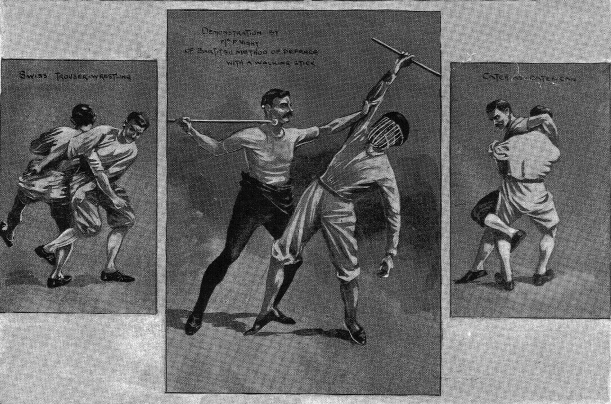
Mr. Barton-Wright has established, at 67b Shaftesbury Avenue, a School of Arms known as Bartitsu, a name given to a method of wrestling demonstrated with success by his school instructors for some time past in the London Music Halls and at the School of Arms aforementioned. Mr. Barton-Wright, in print and from the stage, has also defended this system of wrestling in forcible and expressive language, and no matter what may be urged against it by opposing forces, the fact remains that he, with his money and his men, is prepared to face all comers – big or little, black or white, no-one is barred. His representatives are small in stature, but athletically proportioned, quick, cunning, and trained in the mysteries of all the tricks of the trade.
Last Saturday evening, the founder of the school introduced an assault at arms to his patrons and friends, which will doubtless increase in public favour with repetition. It was a most interesting and instructive entertainment, rendered all the more attractive by the introductory remarks of the chief.
An English boxer of repute, in the person of Jem Barry, measured his strength and ability against Pierre Vigny, instructor in Bartitsu (Savatte – sic) boxing, and as will readily imagined, great curiousity was shown by the spectators in the desire to learn whether the English style would triumph, or vice-versa. Charlemont and Jerry Driscoll’s set-to was called to mind. The remembrance of that memorable passage of arms fired the imagination and predictions of the company, all of whom disregarded nationality, and hoped, not in vain, for fair play. The company was more select than numerous, and included one lady, Colonel Fox, Captain Hill, Captain Hutton, and Mr. Hugh Astley.
At twenty-five minutes past nine Pierre Vigny, the world’s champion, commenced proceedings with stick drill, ambidexterity in the use of the right as well as the left arm being a special feature. With a pupil member (Mr. Noel), he subsequently took part in a mimic combat.
Jem Barry opposed Vigny a la savate and boxing. Barry weighed 11st. His fighting weight is 10st 6lb. Vigny weighs 11st 4lb. Captain Hill was timekeeper. Two minutes per round. Sharp work right and left. Barry knocked Vigny down after nearly getting the right on the jaw with sufficient force. Vigny got up and kicked right and left. Severe business.
Round 2. Sharp and severe work at close quarters. Both on ground twice, and toppled over in an embrace among the people.
Round 3. Barry led. Vigny had a rough time of it, and they frequently clinched. To the end, a splendid encounter. Vigny kicked and boxed hard. Barry punched with might and main. When time was called, honours were to the advantage of Barry on points.
Demonstration of the Bartitsu style of wrestling by the two Light-weight Japanese Champions.—This was very amusing. Dextrous, tricky, and the very acme of agility.
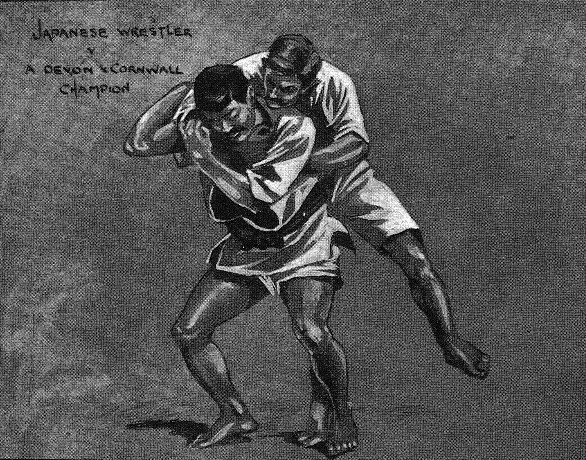
Contest between one of the Japanese Light-weight Champions and a Cornish and Devonshire Heavy-weight.—The Jap won the first fall, the second and the last.
Contest between the Bartitsu Instructor of the Catch-as Catch-Can Style Wrestling versus a Swiss — The instructor won the first fall, and, after a hard struggle, the second, in which he injured his right arm. The third trial of skill ended favour of the instructor.
The entertainment concluded with exhibition of Swiss trouser wrestling.
From the Pall Mall Gazette of Thursday, 04 May 1899:

It is not often that the London people have such an exhibition of fencing and kindred feats of arms put before them as last evening at Bertrand’s Academy in Warwick-street, W. The main object of the gathering was to give the British public an opportunity of seeing Professor Vigny, of the Geneva Boxing Academy, who comes to us with a very high reputation as an expert in the use of foils, single-sticks, duelling swords, and French and English boxing.
During the evening he appeared no less than six times, and consequently wound up greatly fatigued. His knowledge of stick-play was proved to be a most complete one, his prefatory demonstration bringing forth much applause. In a bout with single-sticks against Professor Anastasie, of Paris, he can only be said to have held his own.
M. Felix Bertrand was to have opposed Vigny with duelling swords, but had unfortunately injured his hand and could not appear, his place being taken by Staff-Sergeant Betts, who, however, was no match for his redoubtable opponent. With the foils Vigny had but few equals, and delighted the audience by his spirited bout with Professor Danguy.
In the French mode of boxing Vigny is also a first-class artist and gave a capital display, but had quite 2 st. advantage in the weights. As to his abilities in the English method of boxing, the less said the better, as any of our best men would smother him. On the whole, he must be classed as a performer of rare merit and, indeed, a first-class all-round athlete. His performances were scarcely up to the standard of his great reputation; but it must be borne in mind that, although in the pink of condition, he was decidedly overworked, and consequently suffered in this respect by comparison with his adversaries.
Other incidents of the evening were an extremely skillful bout with the foils between Mr. Egerton Castle and Mr. John Jenkinson, the former of whom is the most graceful exponent we have seen; and an exhibition of club-swinging by Staff-Sergeant Betts.

Here follow two further reviews of the series of self-defence exhibitions organised by Bartitsu founder E.W. Barton-Wright during mid-1899, to benefit Pierre Vigny, who had then recently arrived in London.
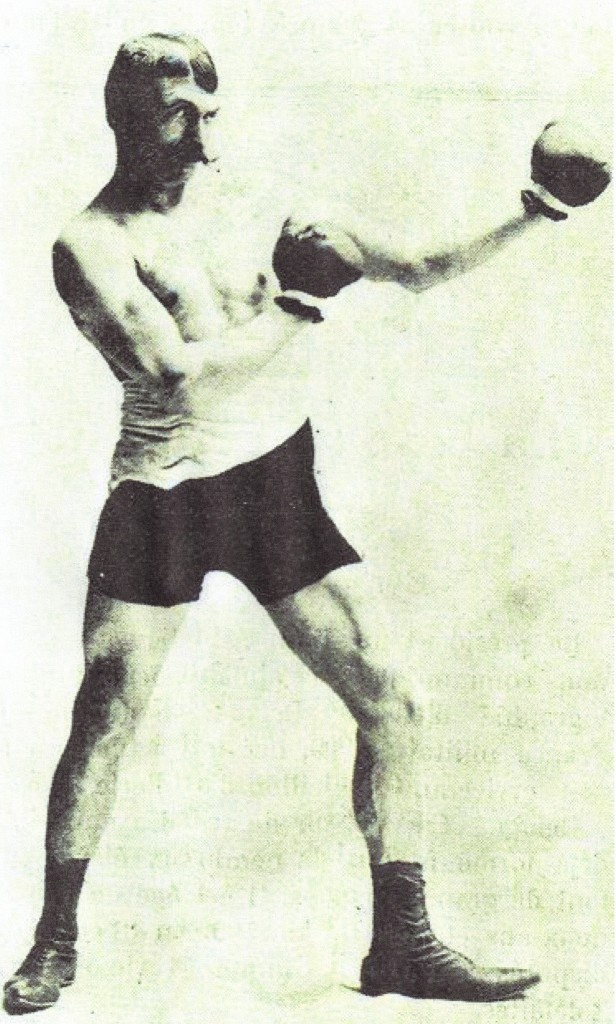
Vigny was noted in related reports to have started his study of English boxing at the age of fifteen and had begun to work as a master-at-arms from the age of twenty-three. He had initially travelled to London, at least in part, to gain further experience in the English style of fisticuffs, and indeed had competed in several bouts with English boxers shortly after arriving in the city during late March of 1899.
Vigny, of course, went on to collaborate with Barton-Wright in the practical development of Bartitsu as a “mixed martial art” and assumed the role of Chief Instructor at the Bartitsu School of Arms between 1900-1902. He later set up his own London school before returning to Switzerland and continuing his work as a self-defence and physical culture instructor.
From the Sporting Life: Tuesday, 27 June, 1899:
“WALKING STICK PLAY: BARTITSU LADIES’ NIGHT”
For the purpose of introducing to the English public Professor Pierre Vigny, the celebrated French swordsman and world champion of walking stick play and la savate, and also as a benefit to that gentleman, Mr. Barton-Wright organized a grand display of various forms of self-defence, which took place on Thursday evening in the Banqueting Hall, St. James’s Restaurant, Regent Street . W., which was well attended by a fashionable and appreciative company, including many of the fair sex, in full evening dress.
Mr. Barton-Wright, the initiator of “Bartitsu”, gave a descriptive lecture and demonstration of walking stick play and la savate with Professor Pierre Vigny, who will instruct in these two subjects at the Bartitsu School of Arms, which will shortly be opened in a central position in the West End.
Without question, Professor Vigny is an undoubted master of these two forms of self-defence, and to which he will devote special attention at the Bartitsu School of Arms, but whether these two forms of self-defense will readily be taken up by Englishmen remains to be seen. Anyhow, to become proficient in these, it will require a vast amount of practice, and in gaining this plenty of beneficial exercise will be necessary, and this alone will commend itself to be rising and present generation of athletes.
The entertainment throughout was of a highly interesting character, and as all concerned in it were adepts in their several styles, everything passed off satisfactorily and in the most efficient manner. The chief events comprising the program were –
Fencing foils
Mr. W. H. Staveley (London Fencing Club) v. Mr. W. P. Gate (London Rifle Brigade) – these able exponents had a grand bout, Mr. Gate gaining last hit.
Walking stick play
After an explanation of the procedure and demonstration with Mr. Barton-Wright, Professor Vigny engaged in a most spirited bout with Professor Anastasie, of Paris, both displaying great aptitude with the walking sticks.
Boxing
Lieutenant Ronald Miers (middleweight amateur champion of the Army) v. Tom Burrows (champion club swinger) – a splendid three rounds in which both showed fine science, which was much appreciated, especially by the ladies.
La Savate
Professor Vigny (champion of the world) v. Professor Anastasie (of Paris) – an interesting bout in which both concerned showed great agility in their feet work, especially Vigny, who gained the last point.
Mr. Barton-Wright, who claims to have put forward a new style of defence, especially in dealing with heavyweights at wrestling and otherwise, gave an exhibition of his system with one of the audience, and fully demonstrated his power, but in actual contest he would have to wait his chance of getting on all his holds against a proficient opponent.
Professor Vigny also engaged in a bout with walking sticks against two professors, and gave a clever exhibition of his undoubted superiority with these weapons. Professor Vigny is also a proficient with the gloves under the Queensberry rules.

From the Sporting Life – Saturday, 22 July, 1899:
“WALKING STICK PLAY and LA SAVATE”
Mr. Pierre Vigny, universally acknowledged as the best exponent of walking stick play, gave a most interesting and novel demonstration of this art of self-defence a few nights ago before a very distinguished and select audience at one of the most fashionable London clubs.
He first proceeded to demonstrate the use of the stick by showing the different attacks and guards, displaying wonderful wrist work, in which great strengths and suppleness were combined. He grasps a stout Malacca cane about six inches from the end, and does all the movements with the wrist only, and not with the fingers. He passes his stick from right hand to left and vice versa without the slightest trouble, using right-hand and left-hand alternately with equal dexterity. He then took a stick in each hand and gave a wonderful display of combined right and left-hand work, showing great activity and science.
After this he engaged in a bout with Mr. Anastasie of Paris, a well-known professional exponent of walking stick play and la savate. The weapons used were thick Malacca canes and it must here be observed that no masks, gloves, nor padded jackets were worn. Both exponents appeared in tights only, and wore no protection of any sort. The stage was small and did not admit of the exponents getting away to avoid punishment, and therefore they had to face the music, which was very lively and real. But, in spite of the pace and the formidable weapons used, it was effectively proved that an able exponent of walking stick play never gets hit upon the fingers and so disabled and disarmed.
Mr. Anastasie, a small, agile man, faced his redoubtable opponent with great courage, and displayed considerable skill, but was outclassed by his bigger and more scientific opponent, and Mr. Vigny conclusively proved that, even at close quarters, it is practically impossible to hit him with a stick.
After a short rest Mr. Vigny and Mr. Anastasie gave a display of la savate, and as they are both especially good exponents the demonstration was exceedingly interesting. Mr. Vigny will give a public demonstration of walking stick play, la savate, boxing, swordplay, fencing, and Indian clubs at an early date at the St. James’s Music Hall and we can confidently recommend our readers to go and see him.
Both walking stick play and la savate are included in Mr. Barton-Wright’s system of self-defense, which he calls Bartitsu, and will be taught at the Bartitsu Club which will shortly be started in some central position in the West End. The following gentlemen will be the first directors of the club – W. H. Grenfell, President; Lord Alwyne Compton, M. P., Chairman; Lord Arthur Cecil, Bertram Astley, W. Moresly Chinnery, Captain Alfred Hutton, St. Clair Stobbart, W. Montague Sweet, and Mr. E. W. Barton-Wright, managing director.

Instructor Jesse Barnick (right) of the Bartitsu Club of New York City demonstrates a Vigny canne attack.

Click the link below to read Liam Hannan’s thesis on Victorian “cultures of violence”, including an analysis of six canonical Bartitsu jiujitsu kata and stick-fighting set-plays:

French music hall star Gaby Deslys – famous for her “Jiujitsu Waltz” – is shown throwing Sorekichi Eida in this 1907 publicity photo.
Note that the term “Jap” held no pejorative meaning in Edwardian English, being more in the nature of a simple abbreviation like “Brit” for British.

Fans of Victorian-era action/adventure are looking forward to the October 23 release of Assassin’s Creed: Syndicate, which will feature “Bartitsu” as a special achievement. The achievement award will be unlocked if players master all of co-lead character Jacob Frye’s fighting skills:
Noting that Jacob’s primary weapon is a sword-cane …