- Originally published on the Bartitsu.org site on November 6th, 2018
The “last hurrah” of the Bartitsu Club as a corporate entity was the ambitious and largely successful “Great Anglo-Japanese Tournament” tour during early-mid 1902. We’ve previously detailed these provincial Bartitsu exhibitions at the Oxford Town Hall, the Shorncliffe Army Camp base in Kent and the Mechanics Institute Hall in Nottingham; the Club is also known to have exhibited at Cambridge University during this period.
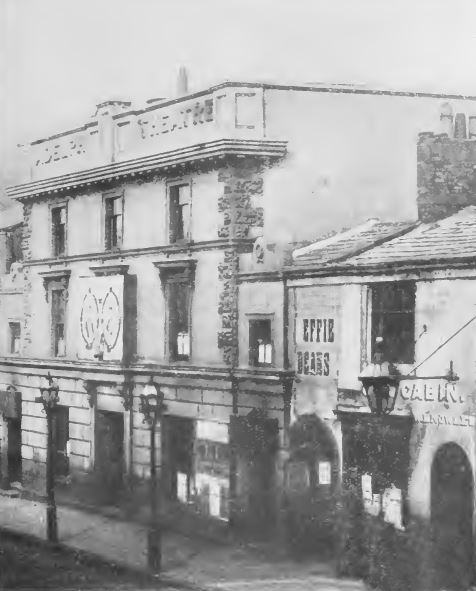
Recent research has confirmed that the 1902 tour extended as far North as Liverpool, where Edward Barton-Wright et al performed a week-long series of tournament contests and displays at the famed Adelphi Theatre in Christian Street.
As usual, the first notice Liverpudlians had of Barton-Wright’s impending visit came in the form of challenge notices printed in their local newspaper. Lancashire was, of course, the birthplace of the renowned catch-as-catch-can style of wrestling, and a Liverpool Echo journalist picked the story up, commenting that although they had heard great things about the “New Art of Self Defence” from London, Lancastrians knew a thing or two about the grappling game and would adopt a “wait and see” approach:
Anglo-Japanese wrestling in Liverpool
The Bartitsu Self-Defence System
An orchid fancier, when he makes an important find or successfully hybridizes, generally perpetuates himself in the nomenclature of the plant. In the field of athletics Mr. Barton Wright seems to have done both, and, applying the first syllable of his own name to the Japanese phrase which is equivalent to our “to the finish”, gives to the world “Bartitsu” as the appropriate name of the system of self-defence for which he claims results that, to those ignorant of anatomy, might seem almost incredible.
Bartitsu in its fullness is described as consisting of a means of self-preservation against hooliganism, which enables a man a very slight build to hold his own against a giant. With the Japanese system of wrestling and its wonderful knowledge of anatomy as a basis, Mr. Barton-Wright has set himself to add to it by calling from other systems of wrestling as well as boxing, singlestick, etc., all that is most applicable to a perfect system of self-defense under all possible circumstances.
We of Liverpool, who in the past decade have seen more of championship wrestling than the rest of the world taken together, aren’t actually inclined to accepting anything regarding matters agonistic on the ipse dixit of any other place. If, however, all that is reported of Bartitsu from the Metropolis is such as we are likely to find it, Liverpool will not be behindhand in its acclamation.
Mr. Barton-Wright’s combination, including two celebrated Japanese wrestlers, who are credited with doing some wonderful things in resistance as well as attack, opens this evening a week’s performance at the Adelphi Theater, Christian Street, which has been very much brightened up for the occasion. These events, which seem to pit the Japanese system of wrestling against our own Lancashire style and to involve other equally interesting considerations, will be awaited with great expectancy.
– Liverpool Echo, 31 March, 1902
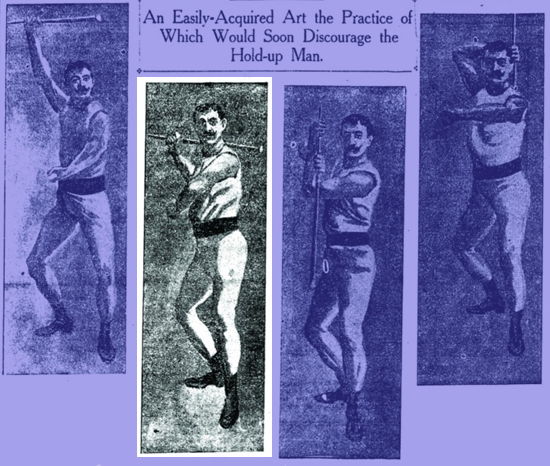
It may be worth noting that “combination”, in this context, implies a team of professional athletes, and that the Echo journalist confused Pierre Vigny’s art of walking stick defence with the sport of singlestick fencing.
Another story appeared in the Echo a few days later (noting, as usual, that the term “Jap” was not pejorative during this period, being rather a simple abbreviation like “Brit” for “British” or “Aussie” for Australian):
Japanese wrestling in Liverpool
Forthcoming visit of the Japanese exponents
If the “Japs”, in their enterprising and praiseworthy search after scientific knowledge, have had to borrow extensively from Britain and other Western nationalities, it appears that they are in a position to return the compliment by showing us some valuable “pins” and how best to take care of ourselves when threatened as individuals with personal hostility.
For quite a decade, Liverpool people have had the advantage over other centers, not excluding even the mighty Metropolis, and seeing by far the larger share of the championship Greco-Roman and catch-as-catch-can wrestling matches. On the other hand, in regards to the Bartitsu method of self-defence , regarding which such wonderful reports have for months been appearing in print, London has had the better of us.
At last, however, Mr. Barton-Wright is coming with his lightweight Japanese wrestlers to show what it what extraordinary results man of slight build, but armed with easily learned scientific knowledge, can obtain against heavyweight hooliganism. Mr. Barton-Wright is to open a week’s entertainment of a varied and attractive program on Monday next, in the Adelphi Theater.
The first exhibition, on the evening of March 31st, was received with great acclaim (although later reports suggested that the attendance on that night was low):
The Wonderful Japanese Wrestlers in Liverpool
The Bartitsu Method of Self-Defence
Last evening, Mr. Barton-Wright and his athletic combination, who have for several months been creating such a furore among sporting circles in London, entered upon a week’s entertainment in the Adelphi Theater, Christian Street. In anticipation of the event, Liverpool people have seen so much of championship wrestling during several years, and are naturally rather chary in giving credence to the wonderful things related of Mr. Barton-Wright’s Japanese wrestlers and his combination generally.
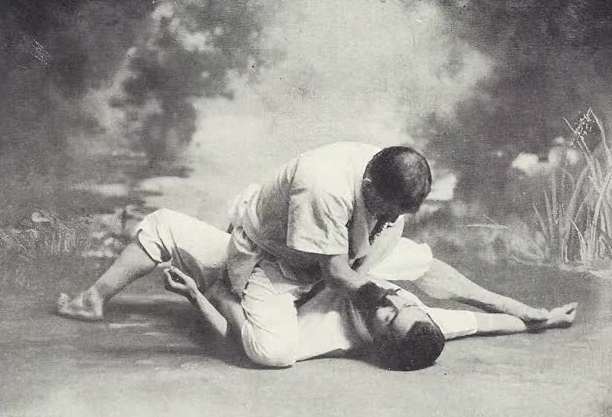
Now that they have had an opportunity of witnessing it for themselves, there is no doubt about the superlative degree with which the verdict would be given. The neatness and lightning quickness with which falls occur in the Japanese practice is something that must be seen to be believed. Their performance consists of three classes of display, commencing with the foiling of sudden attacks by dextrous movement and sudden assumptions of the best wrestling positions with strength momentarily applied in the nick of time.
Following that are several wrestling bouts, in which the falls are obtained with equal dexterity, the feet, which are bare, playing an important and a wonderfully clever part in the struggle. Balance, or rather the sudden deprivation of it, obviously plays a very prominent part in these bouts, which can hardly be called “struggles”, so quickly is the controlling force brought into operation.
They also illustrate how effectually a man lying on his back may defend himself against an aggressor on foot, while giving far more than he receives. Several new counter checks for the cross buttock are also in evidence to the great admiration of the onlooking, and one artiste lying on his back, and held down by a pole across his throat, and kept in the position by the weight of two men on each side, releases himself by sudden exertion, the operation being so deftly performed that the eye can scarcely follow it.
That part of the display would of itself be a very fine entertainment for lovers of really scientific athletics, but several additional turns bear out both the novelty and the excellence of the whole display. The combination comprises a most remarkable exhibition of ball punching by Mr. D. Meier, described as the champion of the world and certainly the best we have seen in Liverpool.
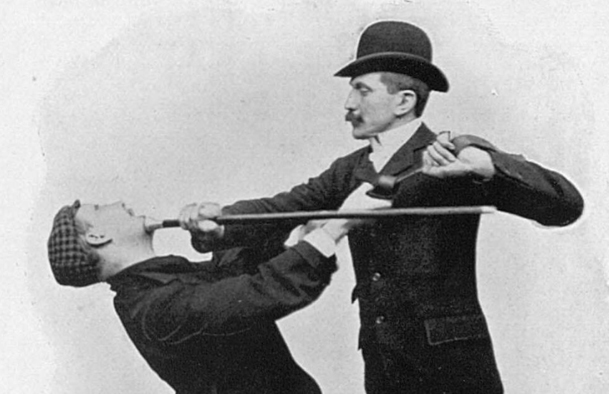
La Savate is a style of boxing very much in evidence in France, but absent from Liverpool for very many years. A very able display of that art of self-defense is given by Pierre Vigny opposed to Wolfe (sic – should read “Woolf”) Bendoff, a well-known heavyweight boxer of decided ability. Monsieur Vigny also gives an able exposition of the most comfortable and effective use of the walking stick in self-defence.
Not the least important item in the program is the catch-as-catch-can wrestling competition contended for each night with Armand Cherpillod, the celebrated Swiss wrestler. Last night the contest was between him and Charles Green, of Wigan, a well-known heavyweight who was pinned down upon his shoulders after fully 40 minutes industrious wrestling, in which the Swiss put in a kind of leg roll which was new to many of the spectators.
Tonight Cherpillod’s opponent will be the famous Joe Caroll, whose long and exciting struggles with the renowned American, Jack Carkeek, two years ago, are still well remembered. Mr. Sam Nixon officiated as referee last evening, and Mr. T. Walsh as timekeeper.
The Cherpillod/Carroll contest on Tuesday night was effectively a rematch of their famous catch-as-catch-can contest at London’s St. James’s Hall a few months prior. After training with Tani and Uyenishi, Cherpillod had won the St. James’s Hall challenge match, and so his struggle with Joe Carroll at the Adelphi was the highlight of that evening’s action:
Japanese and European wrestling in Liverpool
Mr. Barton-Wright’s Wonderful Combination
Cherpillod and Joe Caroll in Catch-as-catch Can
Mr. Barton-Wright’s remarkably clever combination of experts in Japanese and European wrestling, Bartitsu self-defence with a walking stick, boxing, savant, ball punching, etc. was again presented last evening to a highly appreciative Liverpool audience.
The Japanese secret art of wrestling by the two lightweights Japanese champions elicited tokens of unbounded admiration, and occasionally a good deal of laughter, on account of the apparently magical style in which falls were achieved. So suddenly and unexpectedly were they brought about as to elicit the general comment that they were far too quick for the eye to follow them. One noticeable point in regards to either contestant who scored a particular fall was that, however negligently he appears to be standing at the commencement, his attitude at the close of the movement was always the strongest and the most rigid which science could devise for the purpose.
A remarkably interesting item was a catch-as-catch-can contest between Cherpillod, the Swiss champion, and the celebrated Joe Caroll, who, in prospect of a match a month hence with Carkeek, the American heavyweight, found the event a good opportunity for training practice. Seldom have two men apparently more equally matched in skill and the other qualities essential to success been pitted together. Joe Carroll, as candidate for the 10 pounds offered on behalf of the Swiss, was in the position of defender, but he undertook a large share of the attack, and by his phenomenal bridge-making capacity repeatedly escaped from tight corners occurring through Cherpillod’s strong body rolls, half-Nelsons, etc.
Having succeeded in out-staying the 15 minutes, he was hailed as the winner of the 10 pounds offered as a forfeit. As he has accepted a second challenge for this evening, patrons of agonistic prowess may expect to see something in the nature of the object lesson in regard to clever points. Apart from this event, the general program is one which no lover of excellence in athletics should miss the opportunity of seeing them.
The Wednesday night programme ran much the same:
Mr. Barton-Wright’s Japanese Wrestlers
A Local Catch-as-Catch-Can Champion’s Acceptance
A Britisher and a Japanese Wrestler
Last evening’s program in the Liverpool Adelphi Theatre was highly intensified by a second contest between those redoubtable catch-as-catch-can celebrities Joe Carroll of Hindley and Cherpillod, instructor of the Bartitsu School of Arms. The time limit was set at 15 minutes.
Carroll, as the acceptor of the challenge, being nominally on the defensive, was really doing a full share of the aggressive work . In regard to Cherpillod’s body rolls and Carroll’s splendid defense on the bridge, the ballot was pretty much a repetition of that of the previous evening, but with intensified impetuosity and some very fine additional points put in on both sides.
Carroll successfully outstayed the 15 minutes, and, as he is considered a good man to take on upon a similar terms again, the limit for him will be extended to half an hour, with Carroll having the opportunity of earning double forfeit if he can’t obtain a fall within the time.
Mr. Barton-Wright’s general program is one which must really be seen more than once for an intelligent appreciation of Pierre Vigny’s remarkably fine walking stick defence, which leaves no part of the body unprotected for the 10th part of the second; Mr. D. Meier’s magnificent ball punching; M. Vigny’s display of the French savate against an English boxer, and the wonderful exploits of the Japanese wrestlers.
This evening’s bill is fare will not only include a bout between Cherpillod and Charles Green, of Lincoln, but the fulfillment of an acceptance by a local man of a challenge on behalf of one of the Japanese wrestlers. As the opponent in question is Roger Parker, winner of the 11 stone championship and Mr. Cannon’s catch-as-catch-can tournament of two years ago, the event will be of very great interest, as affording the first opportunity we of Liverpool have had of seeing a Britisher opposed to a Jap.
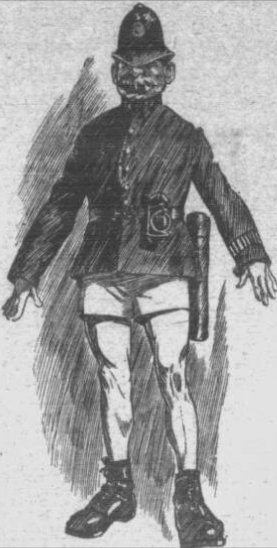
Barton-Wright’s ongoing difficulty in persuading English wrestlers to take on his Japanese grapplers under their own rules seems to have followed the troupe around the country. Kenneth Duffield’s 1945 memoir Savages and Kings includes an amusingly exaggerated account of his own set-to with Yukio Tani at Cambridge University, in which the diminutive Tani was described and illustrated as if he’d been a sumo wrestler.
The Liverpudlian catch wrestler Roger Parker was unusually courageous in accepting Barton-Wright’s challenge, though the subsequent match only lasted 90 seconds before Parker tapped out.
The Japanese Wrestlers in Liverpool
The attendance at the Adelphi theater last evening he gave unequivocal testimony to the remarkably rapid progress which Mr. Barton-Wright’s scientific and attractive entertainment has made in the favor of Liverpool patrons of athletics.
A house filled to repletion presented a remarkable contrast to the miserable gathering of the opening evening, which would probably have caused a less enterprising manager to shake the dust of Liverpool from his feet, but which did not deter Mr. Barton-Wright from persevering, knowing that his entertainment was one deserving well a very important section of the public to delight in patronizing athletics conducted with dignity and respectability, and carried on with the idea of selecting the fittest on their merits, and apart from individual or national considerations.
The customary items of ball punching by Meier, boxing and the Savate by Wolf Bendoff and Pierre Vigny, the wonderful defensive manipulation of the walking stick by M. Vigny and the magical science of the Japanese wrestlers were all applauded to the echo.
The piece de resistance of the evening proved to be a half-hour bout between Cherpillod, the wonderfully strong and clever Swiss catch-as-catch-can wrestler, and the celebrated Joe Carroll. It proved to be one of the nimblest and best conducted struggles as seen in Liverpool for many a day. The Swiss was, as usual, remarkably quick and strong in securing body rolls, but Carol was equally effective in his splendid bridge-making defence, and exceedingly quick and nimble in counteractive moves. Neither secured a fall, so that, according to the agreement, Carroll received 5 pounds for having outlasted the time, though he failed in earning a similar sum offered if he could throw the other man.
Cherpillod afterwards tried conclusions with Leo, the South African giant, who made a good defence in resistance of hammer locks and other moves for 13 minutes, but who was eventually disposed of before his allotted 15 minutes.
The Jap wrestler, who had got the better of Roger Parker on the previous evening in a minute and a half, Japanese-style, appeared on the stage in readiness to wrestle him (Parker) in the catch-as-catch-can style on the undertaking to put him down in 15 minutes. Parker failed to appear, but it was announced on his behalf that he would come forward this evening. It is also expected that Tom McInerney will appear as an opponent of Cherpillod on a half hour time limit, and that Ted Reece will also try for a forfeit against the Swiss in the ordinary quarter of an hour.
There is, therefore, every prospect of a very fine program of wrestling events added to the other admirable structures. Mr. Sam Nixon officiates as referee, and Mr. W. Walker as timekeeper. Mr. Barton-Wright announced that he was willing to back Cherpillod for 25 pounds or upwards in his own style against any man in England.
Unfortunately, although the Echo noted again on Saturday afternoon that Cherpillod was scheduled to take on two local opponents, namely Tom McInerney and Ted Reece, and that Roger Parker intended to compete again with either Yukio Tani or Sadakazu Uyenishi, there seem to be no detailed records of the final night’s exhibitions. Research is ongoing …
By March the troupe had arrived in Liverpool, where local journalists evinced a hard-nosed “wait and see” attitude regarding the announced highlight of the tournament, which would pit jiujitsuka Yukio Tani and Sadakazu Uyenishi against Lancashire-style wrestling challengers. Reacting to the advance publicity notice, one reporter also uniquely and aptly compared E.W. Barton-Wright’s innovation in naming “Bartitsu” to that of an orchid fancier who incorporates his own name into the nomenclature of a new hybrid flower.
The actual demonstrations and contests played out much as they had during previous engagements, the Japanese athletes acquitting themselves admirably against tough and talented locals (albeit, as usual, under jiujitsu rules) and Armand Cherpillod defeating a heavyweight Liverpool hopeful.