“Returning kicks with interest”: Counter-Kicks and Stop-Kicks in Bartitsu Unarmed Combat

  • Originally published on the Bartitsu.org site on Tuesday, 22nd November 2016

Another branch of Bartitsu is that in which the feet and hands are both employed, which is an adaptation of boxing and Savate (…) The use of the feet is also done quite differently from the French Savate. This latter … is quite useless as a means of self-defence when done in the way Frenchmen employ it.

– E.W. Barton-Wright, December 1900.

In his articles, interviews and lectures, Bartitsu founder Edward Barton-Wright consistently – and rather cryptically – distinguished the type of kicking taught at the Bartitsu Club from that of French savate, which he disparaged.

This essay offers an interpretation and synthesis of those comments, taking into account their historical, social and technical contexts.  If there was a meaningful adaptation or distinction, then what was it and how may it be translated into neo-Bartitsu practice?

Canonical kicks

It may be noted that – although Pierre Vigny was clearly the senior savateur at the Bartitsu Club – Barton-Wright spoke fluent French and had studied savate in its homeland during the 1880s, probably while he was studying at a French university.

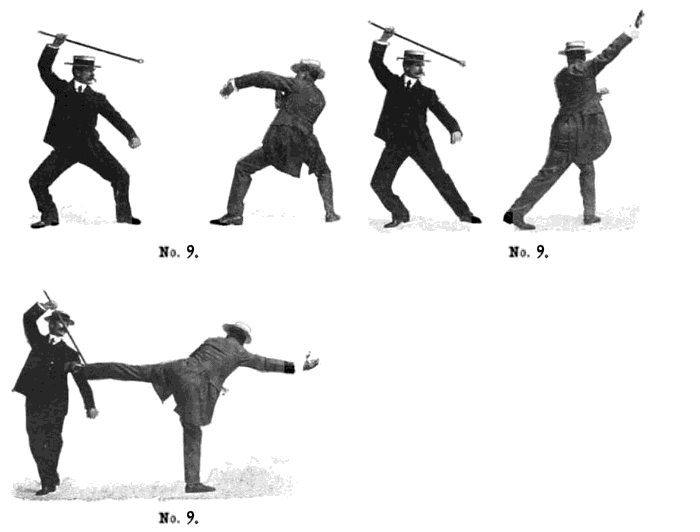
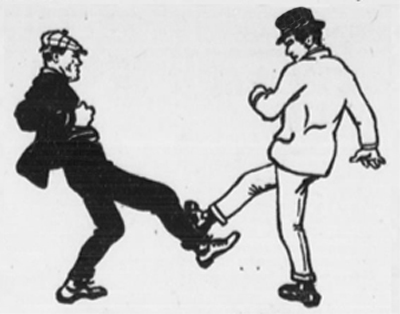
The Bartitsu canon, as demonstrated by Barton-Wright and Vigny, however, holds only a very limited arsenal of kicking techniques. The most immediately apparent is a single technique in Barton-Wright’s article series on Self Defence with a Walking Stick:

No. 9.

Glossed as “How to Defend Yourself with a Stick against the most Dangerous Kick of an Expert Kicker”, the context for this technique is clearly that of the stick-wielding Bartitsu-trained defender countering a “foreign” ruffian’s stepping side kick. It’s very likely that Barton-Wright and Vigny had in mind the infamous Apache street gangsters of Paris, who were widely known to practice savate.

On this basis, while it can be reasonably inferred that Bartitsu students might train in such kicking techniques well enough to be able to “role play” as Apache savateurs for training purposes, the side kick doesn’t necessarily offer any context clues regarding how a Bartitsu practitioner might kick in self defence.

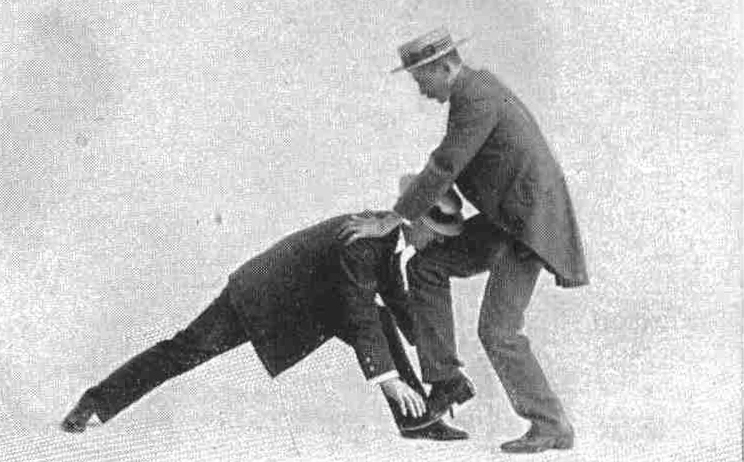
This article series also demonstrates a knee to the face attack, to be performed after the defender has hooked the attacker around the neck with the crook of his cane:

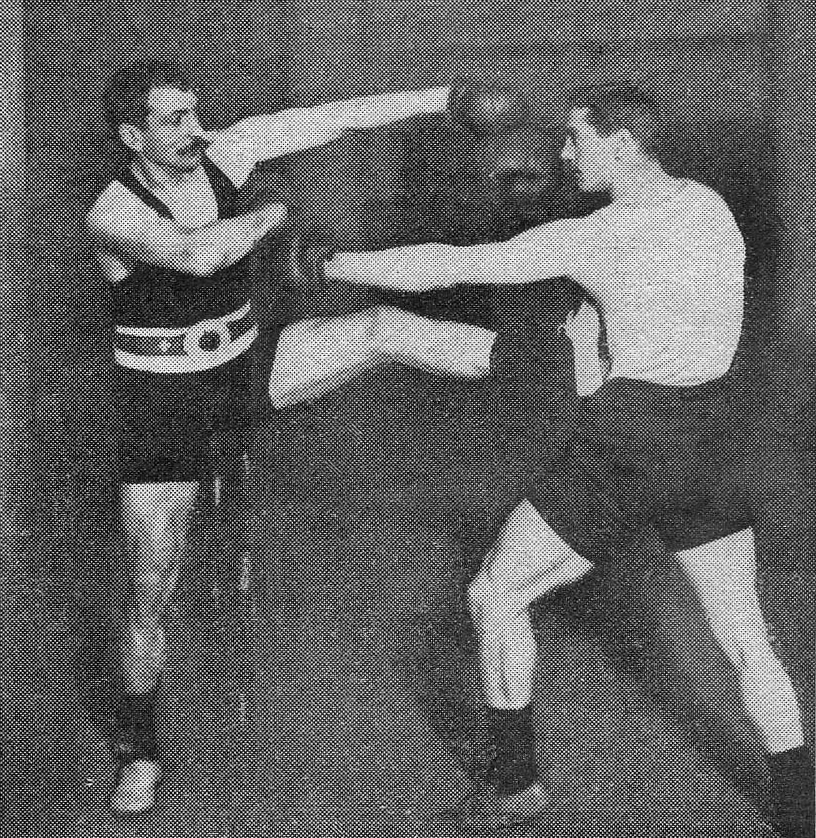
The only other photographic evidence of kicking techniques as part of the Bartitsu canon is this image of Bartitsu Club instructor Pierre Vigny demonstrating a mid-level front or crescent kick as he simultaneously blocks his opponent’s left lead punch and counters with his own left:

A later article in the Pall Mall Gazette also mentioned that the kicking methods taught at the Bartitsu Club were “somewhat different from the accepted French method.”

But how, and why?

The kick felt round the world

For historical context, it’s worth bearing in mind that – on top of the traditional and deep-rooted Anglo-French rivalries – at the time Barton-Wright was introducing his novel concept of Bartitsu to the British public, their most recent impressions of savate had been decidedly negative.

During late 1898, just as Barton-Wright had arrived in London from Japan, the Alhambra music hall had hosted a savate exhibition by French instructor Georges D’armoric and his students. Despite the savateurs’ best efforts and intentions, the reactions of their London audience and critics ranged from grudging appreciation to cat-calling. Although some rural English combat sports did incorporate kicks, kicking was widely held to be brutal and offensive to insular English sensibilities. City-dwellers, in particular, associated kicks with street gangsters rather than with “manly sport”.

Above: a London newspaper artist’s impression of the Alhambra savate exhibition.

Then, during October of 1899, Charles Charlemont had won – under extremely controversial circumstances – a “savate vs. boxing” challenge match in Paris. His opponent had been Jerry Driscoll, a former British navy champion.  The British and international sporting press was outraged at the circumstances of that match, decrying the conduct of Charlemont, the referee, the French spectators and organisers and especially at the outcome, in which Charlemont was widely held to have won via an accidental but illegal groin kick.

In this environment, it’s likely that Barton-Wright deliberately de-emphasised the kicking content of Bartitsu and distanced it from the French method as a gesture towards nationalistic sentiment and social respectability. Similarly, he may have been attempting to score points by suggesting that the Bartitsu Club was promoting a “new, improved” (even an Anglicised) version of savate.

Compounding the issue was the fact that savate was, at that time, undergoing a bitter controversy between two factions in its country of origin.

The Academics vs. the Fighters

Although the ultimate cultural origins of savate remain obscure, researchers including Jean Francois Loudcher have traced the art to the working-class custom of “bare-knuckle honour duelling” during the early 19th century.  Over the best part of the next hundred years, it evolved in a largely haphazard fashion, played as a rough-and-tumble fighting game in back alleys and cafe cellars, with occasionally successful efforts at codification and systematisation.

By c1900 there was, on one side and in the majority, those who might be characterised as “the academics” – professional instructors, notably including Joseph and Charles Charlemont, who taught and advocated for a stylised, gymnastic form of the art, practiced at least as much as a method of physical culture and artistry as of self defence.

The aim of the academic faction was to firmly establish savate as a “respectable” activity that could be offered to French soldiers and the patrons of middle-class gymnasia, as part of organised physical culture curricula. Due to their influence, the most established and popular version of savate retained the duelling-based tradition of fighting “to the first touch”, translating into a very courteous, light contact combat sport.

It is highly likely that this was the version that Barton-Wright referred to as being “quite useless as a means of self-defence when done in the way Frenchmen employ it.”  Much the same thing had been noted by an experienced French observer of the Charlemont/Driscoll fight, who remarked that Charlemont was handicapped by his long experience of “kicking gently” in academic bouts.

The smaller, opposing faction were “the fighters”, represented by Julien Leclerc and others, who preferred an updated, hard-hitting and more pragmatic savate, influenced by the non-nonsense ethos of British and American boxing.  The “fighters” represented a counter-culture within the politicised world of fin-de-siecle savate, advocating for rule changes that would push the increasingly genteel art/sport back towards its rowdy, back-alley origins.

Also – and very controversially, at the time – many of the “fighters” were professionals, or at least wanted to have the chance to fight professionally.  This caused great indignation among the “academics”, who were largely teachers and proud amateurs and who were horrified by suggestion that their art should be marred by prize-fighting.

The Devil is in the Details

According to the December, 1900 article quoted earlier:

Mr. Barton-Wright does not profess to teach his pupils how to kick each other, but merely to know how to be able to return kicks with interest should one be attacked in this manner.

Interesting but, on the face of it, puzzling; how does one not teach people how to kick each other, but still teach them to return kicks with interest?

The strongest hint yet was given in a September, 1901 interview with the Pall Mall Gazette, in which Barton-Wright reiterated his general theme with the addition of some crucial technical and tactical details:

The fencing and boxing generally taught in schools-of-arms is too academic. Although it trains the eye to a certain extent, it is of little use except as a game played with persons who will observe the rules.

The amateur (boxer) is seldom taught how to hit really hard, which is what you must do in a row. Nor is he protected against the savate, which would certainly be used on him by foreign ruffians, or the cowardly kicks often given by the English Hooligan. A little knowledge of boxing is really rather a disadvantage to (the defender) if his assailant happens to be skilled at it, because (the assailant) will will know exactly how his victim is likely to hit and guard.

So we teach a savate not at all like the French savate, but much more deadly, and which, if properly used, will smash the opponent’s ankle or even his ribs. Even if it be not used, it is very useful in teaching the pupil to keep his feet, which are almost as important in a scrimmage as his head.

… and the interviewer was also given a demonstration of the difference between the savate of the Bartitsu Club and the “accepted French style”, i.e. the style practiced by the majority of French savateurs:

He has also a guard in boxing on which you will hurt your own arm without getting within his distance, while he can kick you on the chin, in the wind, or on the ankle.

As to the usual brutal kick of the London rough, his guard for it (not difficult to learn) will cause the rough to break his own leg, and the harder he kicks the worse it will be for him.

Thus, it’s clear that both Barton-Wright and Pierre Vigny were in the minority “fighters” camp, advocating for a pragmatic, combat-oriented reform of savate that would allow full contact matches and the possibility of knock-outs.

“Come an’ take him orf. I’ve bruk ‘is leg.”

The techniques alluded to include kicks to low, medium and high targets as well as a destructive leg-breaking guard against the “brutal kick of the London rough”, which is possibly cognate with Barton-Wright’s description of “smashing the opponent’s ankle”.

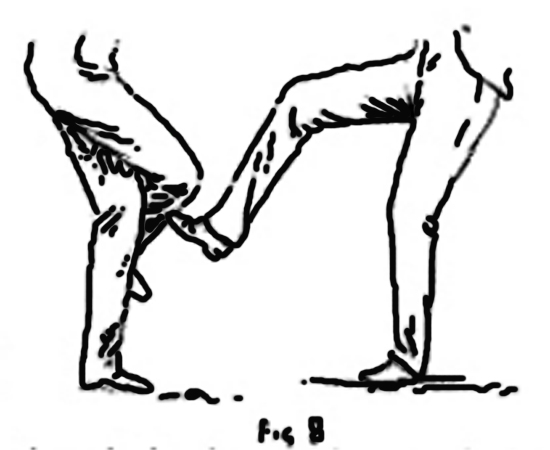
The most famous literary expression of this tactic is certainly the following fight scene from Rudyard Kipling’s In the Matter of a Private (1888), in which Private Simmons launches a vicious kicking attack at Corporal Slane:

Within striking distance, he kicked savagely at Slane’s stomach, but the weedy Corporal knew something of Simmons’s weakness, and knew, too, the deadly guard for that kick. Bowing forward and drawing up his right leg till the heel of the right foot was set some three inches above the inside of the left knee-cap, he met the blow standing on one leg —exactly as Gonds stand when they meditate —and ready for the fall that would follow.

There was an oath, the Corporal fell over to his own left as shinbone met shinbone, and the Private collapsed, his right leg broken an inch above the ankle.

“‘Pity you don’t know that guard, Sim,” said Slane, spitting out the dust as he rose. Then raising his voice—”Come an’ take him orf. I’ve bruk ‘is leg.” This was not strictly true, for the Private had accomplished his own downfall, since it is the special merit of that leg-guard that the harder the kick the greater the kicker’s discomfiture.

Synthesis

Barton-Wright clearly and concisely explained his overall tactical conception of Bartitsu unarmed combat in his February, 1901 lecture for the Japan Society of London:

In order to ensure as far as it was possible immunity against injury in cowardly attacks or quarrels, (one) must understand boxing in order to thoroughly appreciate the danger and rapidity of a well-directed blow, and the particular parts of the body which are scientifically attacked. The same, of course, applies to the use of the foot or the stick …

judo and jiujitsu are not designed as primary means of attack and defence against a boxer or a man who kicks you, but (are) only supposed to be used after coming to close quarters, and in order to get to close quarters, it is absolutely necessary to understand boxing and the use of the foot.

This statement underscores the specifically defensive value of boxing and savate “in order to get to close quarters” against the types of attacks that might be anticipated from a London Hooligan or other ruffian, with the intention of deploying jiujitsu as a type of “secret weapon”.  His comments on boxing, like those on kicking, notably emphasise the value of destructive guards that intercept and damage the aggressor’s attacking limbs.

In his article A Few Practical Hints on Self Defence (1900), Percy Longhurst offered a cognate technique, highly reminiscent of that described by Rudyard Kipling:

The English rough can, and does kick, although it is usually after his victim is on the ground; his kicking is barbarous and unscientific. There is, however, one kick that he sometimes uses that is very dangerous, causing terrible internal injuries if not stopped, and it is difficult to avoid if one does not know the counter. It is the running kick at the abdomen.

The defense is to raise the right knee and bring the leg across so that the side of the heel is resting on your left thigh. Your shinbone will catch his leg as it rises at its weakest park, and will probably cause it to break.

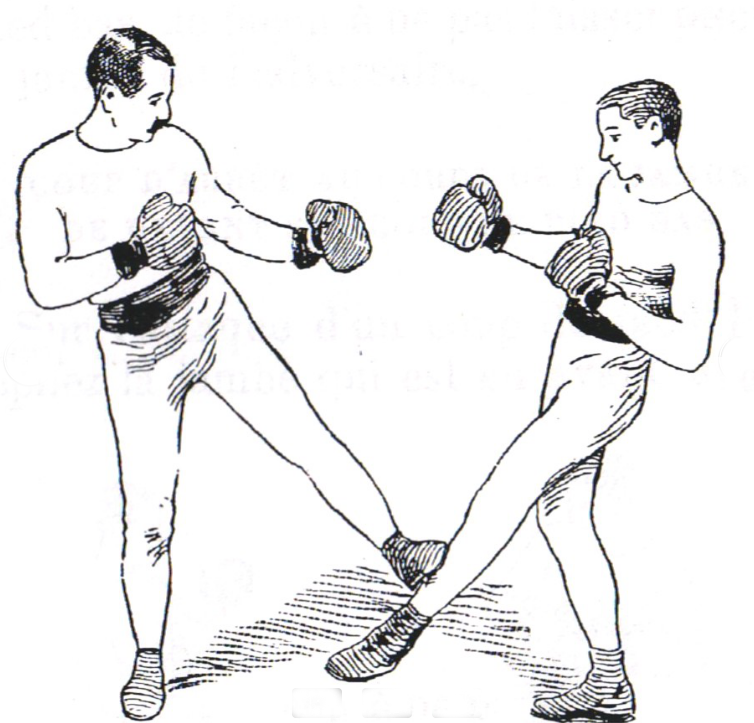
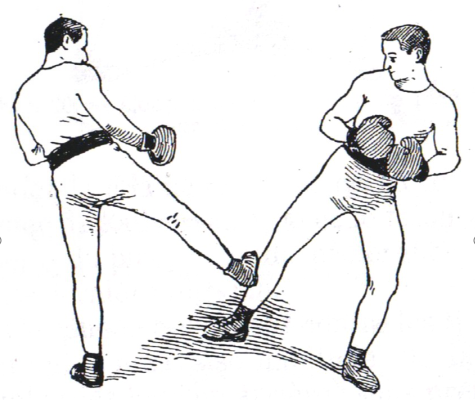
As mentioned earlier, savateur Julien Leclerc was another advocate of the “fighters” perspective and, unlike Barton-Wright or Vigny, he left a detailed record of his approach to savate in the form of his book, La Boxe Pratique: Offensive & Defensive – Conseils pour la Combat de la Rue (1903). Leclerc’s manual provided the essential, basic savate kicks detailed in the first volume of the Bartitsu Compendium (2005).

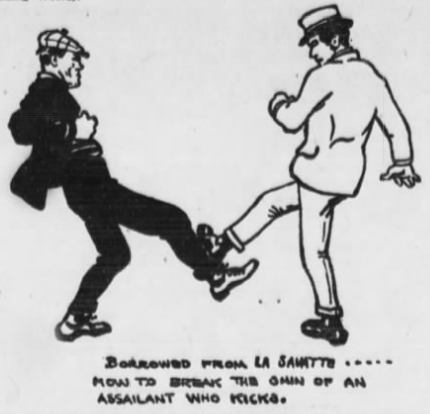
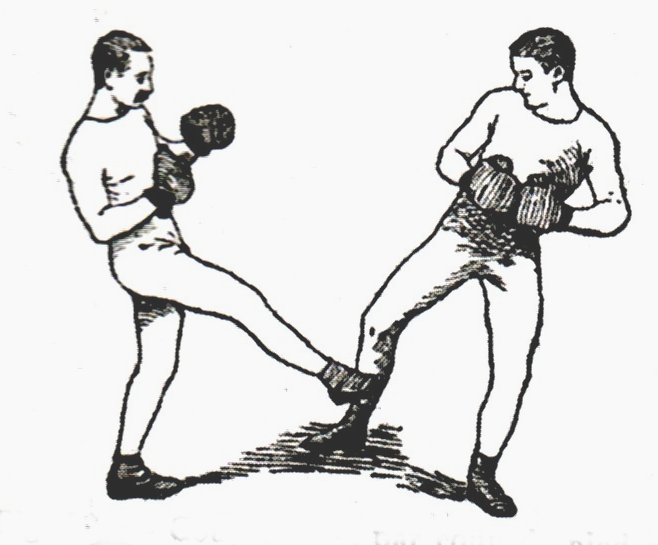
Cross-referencing Barton-Wright’s comments and Vigny’s demonstrations with Leclerc’s manual yields a focus on les coups d’arrets, or “stopping blows”; kicking into kicks, as is shown below:

Thus, the “adaptation” and “distinction” Barton-Wright referred to was, most likely, to hit harder than would be tolerated in the mainstream French salles de savate of his era, and to employ some of the kicks and – especially – counter-kicks of savate toward a Bartitsu-specific tactical goal.

The unarmed or disarmed Bartitsu practitioner should be prepared to counter kicks with hard coups d’arret, chopping into the opponent’s ankles or shins, as part of an aggressive defence strategy. While one might follow with boxing punches, atemi-waza strikes or further kicks as required by the needs of the moment, the tactical aim is to damage the opponent’s limbs and disrupt their balance en route to finishing the fight at close-quarters via jiujitsu – a legitimately “secret weapon” circa 1900, when the Bartitsu Club was the only school in the Western world where a student could study Japanese unarmed combat.

In this video, Bartitsu instructor Alex Kiermayer teaches a set of savate-based low kicks, evasions and stop-kicks:

Posted in Academia, Antagonistics, Instruction, Savate, Video | Comments Off on “Returning kicks with interest”: Counter-Kicks and Stop-Kicks in Bartitsu Unarmed Combat

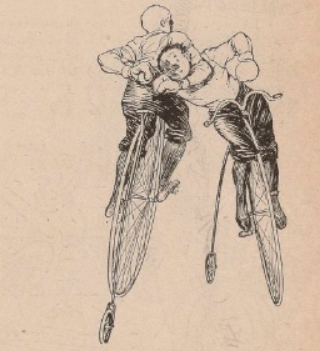
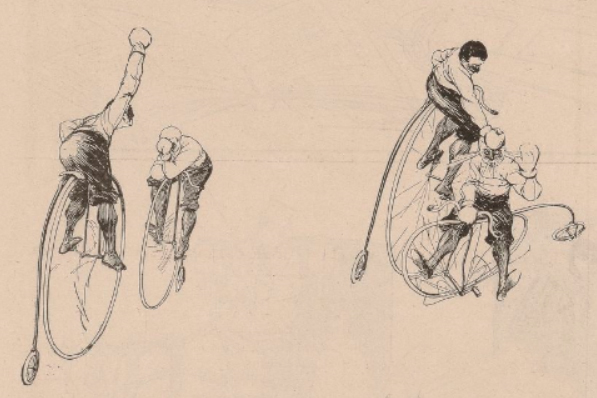
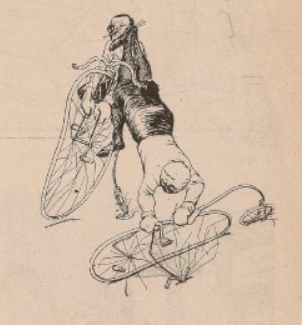
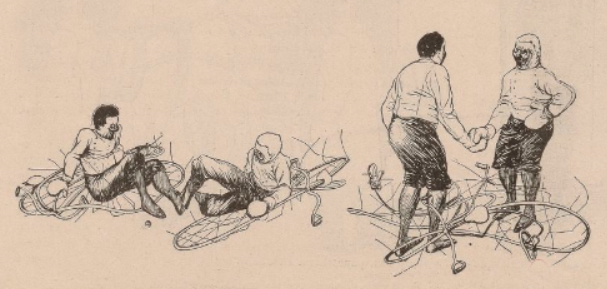
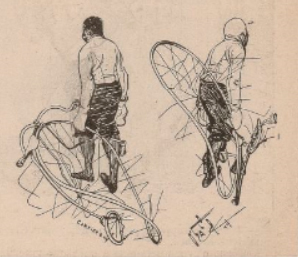
Velo-Boxe (“Bike-Boxing”) Cartoons by Marius Rossillon

  • Originally published on the Bartitsu.org site on Thursday, 10th January 2019

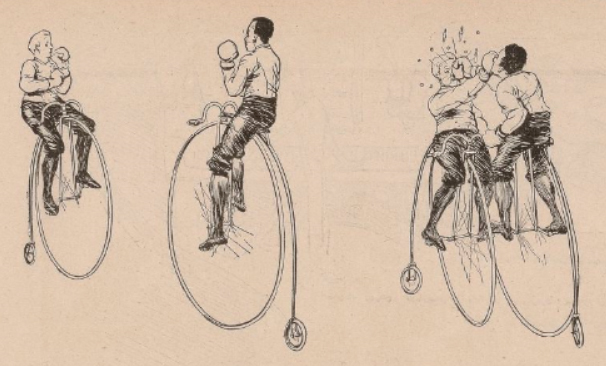
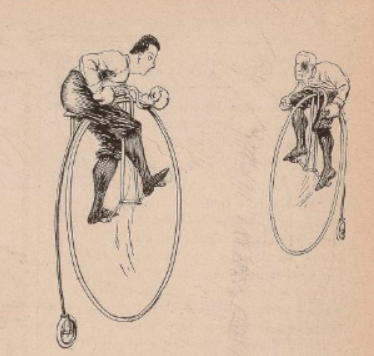
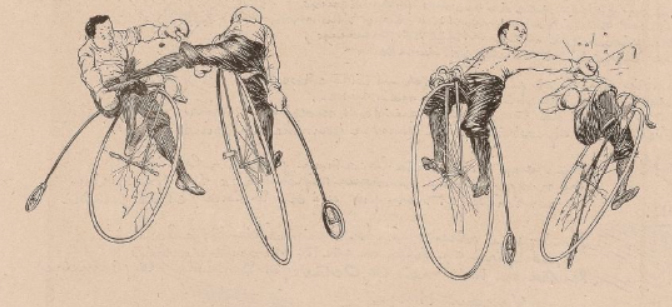
The French painter and cartoonist Marius Rossillon (1867-1946), under the pseudonym “O’Galop”, invents a bizarre new hybrid combat sport in this 1895 sketch series, which originally appeared in Le Rire.

“Velo-Boxe” appears to have been a satirical comment on state of the French honour duel during the very late 19th century.  With both the law and social sentiment steering sharply away from the tradition of life-risking duels, aggrieved parties who wanted to settled their differences physically developed some creative alternatives.  However, as the artist points out, honour can only be satisfied physically at a physical cost – the implicit question being, is it worth it?

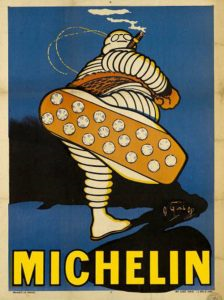
Rosillon was also, not incidentally, the creator of the “Michelin Man” character, here illustrated delivering the Coup de la Semelle Michelin (“The Kick of the Michelin Tread”) in a 1905 advertising poster:

Posted in Antagonistics, Edwardiana, Humour, Savate | Comments Off on Velo-Boxe (“Bike-Boxing”) Cartoons by Marius Rossillon

Sherlock Holmes Wields a Deadly Scarf

  • Originally published on the Bartitsu.org site on Thursday, 7th February 2019

Bartitsu is particularly noted for its weaponising of gentlemanly accoutrements such as walking sticksumbrellas and overcoats.  We’ve also previously examined the circa 1900 use of bowler hatsbelts and flat caps as weapons.

The use of weighted scarves as improvised and concealed weapons has a pedigree extending at least as far back as the early 19th century, when members of the Indian Thugee and Phansigari cults infamously employed their rumāl scarves to strangle their victims.  A heavy coin knotted into the end of the rumāl allowed Thug assassins to swiftly and silently “noose” their prey from behind.  This weapon and technique was elaborated by the French popular novelist Eugène Sue, who detailed the art of Thuggee strangulation in his 1884/5 series The Wandering Jew:

(The Strangler) then took a long and thin cord which was encircled round his waist, at one of the extremities of which was a ball of lead, in shape and size like an egg. After having tied the other end of this string round his right wrist, the Strangler again listened, and then disappeared, groping his way along the tall grass in the direction of the Indian, who came on slowly, singing his plaintive and gentle ditty.

At this instant, the sinister visage of the Strangler arose before him; he heard a whistling like that of a sling, and then felt a cord, thrown with equal swiftness and power, encircle his neck with a triple fold, and, at the same moment, the lead with which it was loaded struck him violently on the back of his head.

The assault was so sudden and unexpected, that Djalma’s attendant could not utter one cry — one groan.

He staggered — the Strangler gave a violent twist to his cord — the dark visage of the slave became a black purple, and he fell on his knees, tossing his arms wildly in the air.

The Strangler turned him over, and twisted his cord so violently that the blood rushed through the skin. The victim made a few convulsive struggles, and all was over.

Although the strangler cults were successfully suppressed, the notion of robbers making use of elaborately deceptive tactics – particularly involving strangulation techniques – made its way into the emerging urban folklore of European cities, as in during the “garroting panics” of 1850s and ’60s London.  A very similar tactic was employed by Parisian Apache muggers during the early 20th century, as in the notorious coup du pere Francois trick.

Famed “baritsu” practitioner Sherlock Holmes (Christopher Plummer) wields an adaptation of the Indian rumāl in the 1979 movie Murder by Decree, which pits Holmes against the arch-fiend Jack the Ripper.

In one scene set in Holmes’ lab, Dr. John Watson (James Mason) advises his comrade to arm himself, and offers Holmes a revolver – but Holmes demonstrates that he is, in fact, already armed, by smashing through a large glass beaker with a roll of coins concealed in a hidden pocket in his long scarf. Holmes then begins to explain the weapon’s origin, but Watson remarks that he already knows about the rumāl from his time serving as an Army doctor in India.

The climactic fight scene represents what may well be the only combat scarf vs. sword-cane encounter in the annals of cinema:

In 2010, American martial artist Jason Gibbs released the BattleScarf – essentially a standard scarf with pockets, but accompanied by a DVD illustrating how to use it as a striking and entangling weapon. Here’s a (slightly tongue-in-cheek) promotional clip, demonstrating the serious striking power that can be generated by this type of weapon under ideal circumstances:

Although the BattleScarf per se is no longer available, winter scarves with pockets at the ends are easily obtained from clothing stores and may be worth the consideration of modern urban adventurers.

Posted in Antagonistics, Pop-culture, Sherlock Holmes, Video | Comments Off on Sherlock Holmes Wields a Deadly Scarf

The Annotated “Bartitsu: Its Exponent Interviewed” (1901)

  • Originally published on the Bartitsu.org site on Thursday, 31st January 2019

The following interview with Bartitsu founder E.W. Barton-Wright first appeared in the Pall Mall Gazette of 5 September 1901, during the height of the Bartitsu Club era.  It was found and republished by the Bartitsu Society in October of 2011 and subsequently inspired several new insights into the tactics of Bartitsu as a practical martial art.

This post re-examines the interview in light of more recent discoveries, with added notes (in italics) for context and clarity.


Edward Barton-Wright, the founder of Bartitsu.

BARTITSU: ITS EXPONENT INTERVIEWED

One of our contributors lately called on Mr. Barton-Wright in his well-appointed gymnasium in Shaftesbury Avenue, when the following conversation took place:

What is the word Bartitsu? – It is a compound word, made up of parts of my own name, and of the Japanese Ju-jitsu, which means fighting to the last.

What do you claim for your system? – It teaches a man to defend himself effectively without firearms or any other weapons than a stick or umbrella, against the attack of another, perhaps much stronger or heavier than himself.

How does it differ from the usual fencing or boxing? – The fencing and boxing generally taught in schools-of-arms is too academic. Although it trains the eye to a certain extent, it is of little use except as a game played with persons who will observe the rules. Most of the hits in (single)stick or sabre play are taken up by the hilt, which a man is not very likely to take out with him on his walks.


This was a frequent theme of Barton-Wright’s (and, implicitly, of Pierre Vigny’s), and refers to the exclusion, within Vigny’s stick fighting system, of parries in the orthodox fencing-based guards of tierce and quarte.  The Vigny system was virtually unique for its time in defaulting to high or “hanging” guards, in which the defender’s stick-wielding hand is always positioned above the point of impact between the two weapons.

Barton-Wright’s pointed comment about recreational fencing and boxing being “too academic” was significant especially with regards to the ongoing “practicality vs. artistry” arguments in French martial arts circles circa 1900.


The head, too, which is a part which an assailant who means business would naturally go for, is so well protected that the learner gets careless of exposing it.

And the boxing? – The same objection. The amateur is seldom taught how to hit really hard, which is what you must do in a row.


Pierre Vigny also addressed this point, in some detail, in a rare October 1900 letter published in the French journal La Constitutionelle.   In contrast to the extravagantly polite, academic style that was then being successfully promoted by Vigny’s rivals Charles and Joseph Charlemont,  the style of kickboxing taught by Vigny at the Bartitsu Club was closer to the continuous, full-contact model of English and American boxing.


Nor is he protected against the savate, which would certainly be used on him by foreign ruffians, or the cowardly kicks often given by the English Hooligan.

A little knowledge of boxing is really rather a disadvantage to (the defender) if his assailant happens to be skilled at it, because (the assailant) will know exactly how his victim is likely to hit and guard.


Barton-Wright here alludes to the so-called “secret style of boxing” which appears to have been a collaboration between himself and Vigny; more to follow on that subject.


And you can teach any one to protect himself against all this? – Certainly. The walking-stick play we will show you directly. As to boxing, we have guards which are not at all like the guards taught in schools, and which will make the assailant hurt his own hand and arm very seriously.

So we teach a savate not at all like the French savate, but much more deadly, and which, if properly used, will smash the opponent’s ankle or even his ribs.


Aside from hitting harder than would normally be tolerated in recreational boxing, “Bartitsu (kick)boxing” – with its emphasis on actual unarmed combat, rather than sport and exercise – notably included, as Barton-Wright discussed elsewhere, guards “done in a slightly different style from boxing, being much more numerous as well”.  This interview clarifies that these guards served the specific tactical purpose of damaging the opponent’s attacking limbs en route to the unarmed defender entering to close quarters.


Even if it be not used, it is very useful in teaching the pupil to keep his feet, which are almost as important in a scrimmage as his head.

Anything else? – My own experience is that the biggest man in a fight generally tries to close. By the grips or clutches I can teach, the biggest man can be seized and made powerless in a few seconds.


Barton-Wright evidently considered jiujitsu to be something of a “secret weapon” – an entirely valid point of view at this time, because his Bartitsu School of Arms was literally the only place outside of Japan where English students could learn the “art of yielding”.  Jiujitsu was presented as the “endgame” in all of the various tactical unarmed combat scenarios proposed by Barton-Wright during this period.


If you sow this knowledge broadcast it might be bad for the police.– Yes; but it cannot be picked up without a regular course of instruction, or merely by seeing the tricks. Moreover, this is a club with a committee of gentlemen, among whom are Lord Alwyne Compton, Mr. Herbert Gladstone, and others, and no-one is taught here unless we are satisfied that he is not likely to make bad use of his knowledge.


Previous commentaries upon Bartitsu from outside observers, including some journalists, had questioned whether the art had any real application other than by “chuckers-out” (Edwardian slang for nightclub bouncers).  The Pall Mall Gazette interviewer was not the first to worry about what might happen if “hooligans” were to learn the art, though still other commentators imagined scenarios in which Bartitsu Club members might patrol “hooligan infested” areas of London to exercise their proficiency.

This skepticism over motivations raises the important point that Bartitsu was an extreme novelty in its time and place; a method of recreational antagonistics that was nevertheless practiced primarily to prepare the student for self-defence, with sporting and exercise benefits being of secondary concern.  Vetting by the Bartitsu Club’s “committee of gentlemen” was, thus,  a necessary step towards establishing social respectability. 


It must have taken you some time to work out all this? – Yes, but it was in great measure a matter of necessity. As a mining engineer in all parts of the world, I have often had to deal with very unscrupulous fighters, and, being a light man, I had to protect myself with something else than my fists.


In March of 1902, a report on a Bartitsu Club exhibition at Oxford University included the following anecdote about Barton-Wright’s perilous travels abroad; “He had frequently been attacked abroad, where they did not believe in our methods of fair play and would injure a man with a bottle, knife, chair, or any weapon which came to hand, and it was very useful to know how to prevent a man from using a knife upon one, though he might not stab one very deeply, yet there was danger of bleeding to death in some lonely place before help could be brought.

He had been attacked with picks, crowbars, scythes, spades, and various other weapons, and, as quick as he was in boxing, he was obliged to close with his man, and had he not known anything of wrestling, he would have been overpowered many times. As a means of meeting emergencies of that kind, he recommended (this) form of self-defence.”

The tactic of closing in to grappling range against opponents armed with more powerful weapons might well have influenced Barton-Wright’s collaborations with Pierre Vigny vis-a-vis Bartitsu stick fighting.  


Mr. Barton-Wright then gave our contributor a demonstration of his method. His fencing-master, M. Pierre Vigny, stripped to the waist and without any other weapon than an ordinary walking-stick, will allow you to attack him with singlestick, sabre, knife or any other short weapon without your being able to touch him, he taking all blows on what fencers call the forte of his stick. He will at the same time reply on your head, and knuckles; while, if he is given a stick with the ordinary crook handle, he will catch you by the arm, leg or back of the neck, inflicting in nearly every case a nasty fall.

He has also a guard in boxing on which you will hurt your own arm without getting within his distance, while he can kick you on the chin, in the wind, or on the ankle. As to the usual brutal kick of the London rough, his guard for it (not difficult to learn) will cause the rough to break his own leg, and the harder he kicks the worse it will be for him.


Again, emphasis is given to the destructive blocks of the “secret style of boxing” practiced at the Bartitsu Club.


Mr. Barton-Wright himself shows you wrestling tricks, by which, by merely taking hold of a man’s hand, you have him at your mercy, and can throw him on the ground or lead him about as you wish, the principle being, apparently, that you set your muscles and joints against your opponent’s in such a way that the more he struggles, the more he hurts himself.


This is one of the comparatively few concrete references to Edward Barton-Wright actually teaching at the Bartitsu Club.


A couple decidedly bad to beat.

Posted in Academia, Antagonistics, Boxing, Jiujitsu, Savate, Vigny stick fighting | Comments Off on The Annotated “Bartitsu: Its Exponent Interviewed” (1901)

Revivals of Gladiatorial Combat in Belle Époque France

  • Originally published on the Bartitsu.org site on Sunday, 29th September 2013

Georges Dubois was something of a Renaissance man; a professional sculptor, Olympic athlete, author, theatrical fight director and fencing teacher who famously challenged Ernest Regnier (a.k.a. “Re-Nie”) to a savate vs. jiujitsu contest in 1905.

Dubois was also a pioneering French revivalist of historical combat systems, including Renaissance-era rapier and dagger fencing as well as the “ancient combats” of the gladiatorial arena. See this new article by Phil Crawley on Dubois’ reconstructions of the fighting styles of the Murmillo and Retiarius.

Posted in Antagonistics | Comments Off on Revivals of Gladiatorial Combat in Belle Époque France

The Sting of the Green Hornet

  • Originally published on the Bartitsu.org site on Thursday, 27th December 2018

Having previously shone a spotlight on John SteedAdam Adamant and Harry Hart, it’s fitting that our periodic documentation of the use of umbrella and cane weapons by fictional heroes should now focus on Britt Reid – better known to generations of pop-culture aficionados as the Green Hornet.

The Hornet was created in 1936 for a WXYZ radio serial produced by George W. Trendle and Fran Striker.  As such, the character narrowly pre-dated the costumed superhero tradition generally (though arguably) conceded to have begun with the first appearance of Superman in Action Comics #1, which was published in April of 1938.  From the successful radio series, the Hornet flew straight into a movie serial, pulp novels, comic books and, most famously, a 1966-7 TV series starring Van Williams and Bruce Lee.

In common with many of his predecessors, Britt Reid was a wealthy businessman who assumed a masked persona to foil wrongdoers who considered themselves to be above the law.   As far as the police, the general public or the criminal underworld were aware, however, the Green Hornet was, himself, a mob boss; Reid believed that the best way to dismantle crime was from within.  He and his partner/bodyguard Kato employed a range of ingenious weapons and gadgets, most famously including the Black Beauty – a “rolling arsenal” in the guise of a tricked out sedan – and the “hornet sting”, an extendable sonic ray gun that could destroy locks or even blow doors off their hinges.  The “sting” also occasionally doubled as a cane weapon in hand-to-hand combat.

The fight scenes in the Green Hornet TV series are typical of their vintage, apart from the unique and indelible presence of Bruce Lee, whose gung fu skills were first showcased for a mainstream audience as Kato.  The Hornet’s own fighting style was the standard ’60s Hollywood concoction of cowboy haymakers and general roughhousing, except for when he happened to have the hornet sting in his hands at the moment the action kicked off.  Under those circumstances, the masked hero tended (sensibly enough) to hold the weapon in an extended “bayonet grip”, using the shaft to parry or block incoming punches and retaliating with bar strikes; he also very occasionally used single-handed cane strikes to disarm enemies at close quarters.

Here’s a quick compilation of excerpts from the Green Hornet series mostly showcasing the hornet sting as a close-combat weapon:

… and yes, that was John Carradine as the villainous “Scarf” being choked out by Bruce Lee.

The tone of The Green Hornet series was much darker and more realistic than that of the contemporaneous Batman show, which was produced by the same company.  It did not, however, achieve Batman’s pop-culture resonance and lasted only one season.  The characters of the Green Hornet and Kato have lived on via sporadic comic book revivals and in the 2011 action-comedy feature film starring Seth Rogen and Jay Chou.

Posted in Pop-culture, Video | Comments Off on The Sting of the Green Hornet

Demolition Derby: A Short History of the Weaponised Bowler Hat

  • Originally published on the Bartitsu.org site on Tuesday, 26th September 2017

Given that we have already outlined the histories of the weaponised umbrella and hat-pin and have tested the historicity and practicality of the razor-blade cap, it seems fitting to now consider the bowler hat-as-weapon in both fact and fiction.

Perhaps surprisingly, the original bowler hat may have been designed with self-defence somewhat in mind. In 1849, London hat-makers Thomas and William Bowler received a commission to create a new type of hat for gamekeepers working on the estate of Thomas Coke, the 1st Earl of Leicester. Previously, Coke’s gamekeepers had worn top hats, which were inclined to get knocked off by low-hanging branches, and so the bowler was designed to fit snugly to the head.

Another consideration, however, was that the gamekeepers needed some protection against unexpected club-blows to the head delivered by stealthy poachers, so the hats were made from hard felt and built to take a knock.

The new style quickly became very popular among the working classes and was also adopted by members of the Plug Uglies street gang, who were rumoured to stuff their bowlers with scraps of wool cloth, felt and leather for extra protection in street fights.

By the turn of the 20th century, the bowler had become popular among middle-class men.  Simultaneously, self-defence authorities began to explore the offensive, as well as defensive, possibilities of the bowler hat, as demonstrated here in John J. O’Brien’s The Japanese Secret Science: Jiu Jitsu (1905):

Writing in La Vie au Grand Air of December 8, 1906, Jean Joseph Renaud warned his readers to beware of a “classic trick” employed by “Apache” muggers, who would courteously tip their bowlers while asking for a light for their cigars, only to convert the hat-tip into a surprise attack.

By smacking the innocent party in the face with his hat, the Apache received an instant advantage of initiative, which might then be followed up by grasping the stunned victim around both thighs and head-butting him in the stomach, spilling him backwards onto the pavement.

In L’Art de se Defendre dans la Rue, Emile Andre borrowed a trick from the Apaches, advising readers to use their own bowler hats as surprise weapons. He also recommended the bowler as an improvised hand-held shield if confronted by an attacker wielding a knife, dagger, truncheon or cane, a defensive specialty that may well have been inspired by the Spanish Manual del Baratero (1849). Andre also refers to using the hat to “beat” or strike at an opponents’ weapon, so as to disarm them.

In The Cane as a Weapon (1912), Andrew Chase Cunningham echoed Andre’s advice in recommending the hat as an improvised weapon of both offence and defence:

In case of an assailant with a knife, a very valuable guard can be made by holding the hat in the left hand by the brim. It should be firmly grasped at the side, and can be removed from the head in one motion. The hat can then be used to catch a blow from the knife, and before it can be repeated, it should be possible to deal an effective blow or jab with the cane.

In case of an attack with a pistol, a chance may occur to shy the hat into the opponent’s face and thus secure a chance to strike with the cane.

The use of the hat as a guard is, of course, not confined to the knife, but it may be used against any weapon. The only disadvantage is that it prevents passing the cane from hand to hand.

As bowler hats gradually fell out of fashion during the first half of the 20th century, so did sources treating them as weapons. By the late 1950s the idea seemed positively exotic, which may have been why it appealed to Ian Fleming in arming Oddjob, the fearsome Korean henchman featured in the James Bond novel Goldfinger (1959).

Following Oddjob’s spectacular karate demonstration, Bond asks Goldfinger why his bodyguard always wears a bowler hat:

Oddjob turned and walked stolidly back towards them. When he was half way across the floor, and without pausing or taking aim, he reached up to his hat, took it by the rim and flung it sideways with all his force. There was a loud clang. For an instant the rim of the bowler hat stuck an inch deep in the panel Goldfinger had indicated, then it fell and clattered on the floor.

Goldfinger smiled politely at Bond. ‘A light but very strong alloy, Mr Bond. I fear that will have damaged the felt covering, but Oddjob will put on another. He’s surprisingly quick with a needle and thread. As you can imagine, that blow would have smashed a man’s skull or half severed his neck. A homely and a most ingeniously concealed weapon, I’m sure you’ll agree.’

‘Yes, indeed.’ Bond smiled with equal politeness. ‘Useful chap to have around.’

As played by professional wrestler Harold Sakata in the 1964 film adaptation, Oddjob actually wore and wielded a Sandringham hat rather than a bowler, but that minor change didn’t seem to affect his aim.

The enormous popular success of the Goldfinger movie also served to reintroduce the idea of the bowler hat-as-weapon into pop-culture, perhaps most notably as used by the dapper British secret agent John Steed (Patrick MacNee) of The Avengers TV series.  Steed’s primary weapon was always his reinforced umbrella, but he was occasionally seen to use his (presumably also reinforced) bowler hat to execute a surprise disarm or knock-out blow, accompanied by a hollow, metallic “bonk!” sound effect.

Posted in Antagonistics, Hooliganism | Comments Off on Demolition Derby: A Short History of the Weaponised Bowler Hat

Bartitsu Home-Training Tip: Indian Clubs Make Great Cane Substitutes

With group classes off the table until further notice, martial arts practitioners are switching en masse to home- and self-training. A handy tip for Bartitsu practitioners is to use an Indian clubs as a substitute for the Vigny cane, whose 3.5 foot length poses a risk to indoor furnishings and ceilings. A relatively light (1.5 – 2 lb) Indian club suitably mimics the balance and handling of the asymmetrically-weighted Vigny walking stick for drilling purposes.

While we’re at it, here’s a good basic Indian club warm-up routine from The Art of Manliness:

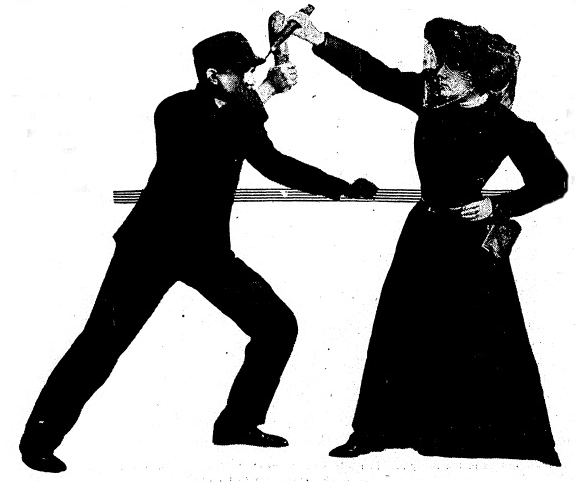
As a side-note, there’s also a Bartitsu connection between Indian clubs and the radical suffragette movement. Edith Garrud, who became the jujitsu instructress for the secret Bodyguard Society of the Women’s Social and Political Union, had trained with former Bartitsu Club instructors Yukio Tani and Sadakazu Uyenishi. As well as unarmed self-defence, Garrud also taught the members of the Bodyguard how to use Indian clubs as concealed weapons against the truncheons of the London police:

Indian-club wielding Bodyguards burst forth in this panel from the 2015 graphic novel
Suffrajitsu: Mrs. Pankhurst’s Amazons.
Posted in Instruction, Physical Culture, Video, Vigny stick fighting | Comments Off on Bartitsu Home-Training Tip: Indian Clubs Make Great Cane Substitutes

Fisticuffs!

Instructor Alex Kiermayer strikes a pugilistic pose during a recent seminar in Germany.

Posted in Boxing | Comments Off on Fisticuffs!

“How to Defend Yourself” (Popular Mechanics, November 1926)

During the late 19th century, newspaper and magazine articles tended to skirt the subject of practical self-defence. The popularity of feature articles on that subject was spurred by Edward Barton-Wright’s Bartitsu series for Pearson’s Magazine in 1898-99 and continued through to the outbreak of the First World War. By the late 1920s, they had almost become passé.

This Popular Mechanics feature on the subject of self-protection against “rogues and stick-up men” offers a compilation of street-fighting tricks ranging from the common-sense to the somewhat fanciful, though the author’s emphasis on quick thinking and improvisation under pressure is as valid now as it was during the roaring ’20s.

Strategy is more effective than strength if one only knows how to use it in a dealing with bullies, ruffians or holdup men. A frail five-foot man can, figuratively, make a whipped dog out of a seven-foot rogue if he knows how to use his brain to make up for his inferiority in physical power.

There is even a way to prevent being held up at the point of a gun which is about 90% effective, if one only knows the trick. That is the simple expedient of keeping one or both hands in one’s pocket while passing through locations where a hold-up might be attempted.

No bandit, except one bereft of his senses, or with a reckless disregard for retaining a whole hide, would ever try to hold up a man who’s right hand reposes languidly in his coat pocket. The bandit has no knowledge that the hand in the pocket may not repose upon the butt of a pistol. The wise stickup-man therefore chooses for his victim one who can be told to “reach for the sky” without the possibility of bringing a trigger-finger unexpectedly into action.

No blanket rules can be set down to offer complete defense against the attacks of strong-arm bandits and bullies, but a generalization of methods of defense can be made which will serve almost every purpose. First of all, it should be remembered that all rules of fair play have no part in dealing with an adversary who is obviously outside the pale of law and order and public decency.

The problem of the person on the defensive is that of getting the best of the attacker by brain work and doing it in the quickest and most effective way.

The element of surprise movement is just as important to an individual seeking to defend himself as it has always been with armies. Catching the enemy unawares, and upon a quarter where he never anticipated and attack, is always one of the surest ways of getting the best of him. Thus, the big bully who launches an assault upon a person of lesser physique is usually taken completely off his guard when the little fellow hauls off with a quick fist and plants a blow squarely in the pit of his opponent’s abdomen. When this happens, the fellow who received the blow usually fold up like a jackknife, and spends the next 2 or 3 minutes gasping for breath, or howling with pain. We say that such a blow “knocks the wind out of one.” It does that figuratively but not literally. The jolt from even a fairly weak abdominal punch is absorbed by the intestines, the spleen and the lower part of the stomach. There are no bones to protect these vital organs from serious, or even fatal, injury. A blow of equal force could be landed upon the chest without the slightest injury to the recipient.

 Next among body blows for putting an attacker out of combat, the groin is about the most vulnerable part of the body. Moreover, a bully or rogue seldom expects his harmless-looking victim to make use of his feet in defending himself. He is therefore taken completely off his guard, and is knocked out cold when the intended victim lets fly with the point of a shoe which catches him in the groin. If the person on the defensive has heavy shoes, the kick is all the more effective.

Umbrellas, canes, walking sticks, hat pins and many other articles which people commonly carry may be used as thoroughly efficient weapons for repelling the most vicious attack, if one knows just how to wield them. A person who is attacked while carrying an umbrella usually makes the mistake of attempting to use it as a club. A clubbed umbrella is scarcely more dangerous than a big feather, but the same umbrella, if thrust into an attacker’s face, automatically becomes a dangerous javelin that will gouge out an eye, rip the nose, or tear into the mouth or cheeks like a sword. An umbrella with the point dressed down by a few strokes of a file is also a terrible weapon when used javelin-fashion.

The intended victim of an attacker, who carries a cane or walking stick, usually clubs down upon his opponent in an effort to defend himself. It would require a very heavy cane to inflict in a serious injury by a downward swing of that instrument. An arm suddenly raised will ward off the blow completely. But, let the walking stick welder swing his improvised weapon horizontally, like a Chinaman will let drive with a broadsword, and even a light walking stick becomes a dangerous, or even deadly, weapon. With a cane swung horizontally, the man defending himself is more apt to catch his assailant unexpectedly. The blow is aimed upon the side of the head, and a good stiff jolt there will make a huge bullies see stars. It may break an eardrum, or cave in the side of the skull at a point where it is very thin. If the blow can be landed slightly below and a little behind the ear, even a light walking stick will crush the skull.

Fist blows aimed at the face are effective, but as a means of self-defense are not so good, especially since the average ruffian is usually something of a pugilist, and probably of a physique superior to his intended victim. The little fellow, therefore, should endeavor to defend himself, bearing in mind that fingernails gouging at his enemy’s eyes are more apt to inflict serious injury than a small weak fist bringing up against a hard lantern jaw. Hat pins, for women who wear them in these days of a small hats and bobbed hair, are, and always have been, potential weapons of self defense. They are to the owner, when wielded in the direction of an opponent’s eyes, precisely what the cat’s claws are in turning an angry dog. Women and girls who are annoyed by “mashers” have the most effective means of curtailing such an annoyance by cool-headed wit. Instead of displaying antagonism, they have but to feign approval – and then pass the annoyer over to the nearest police department.

In cases of personal combat, when the person on the defensive has been seized, or has clinched with the antagonist, the most effective defense available is to make quick and decisive use of one’s teeth. A study of police records of hundreds of attack cases reveals the fact that only one person in 50 ever seems to remember to bite the assailant when there is no other available method of besting him. Yet many instances also are recorded of persons who have completely defended themselves from attacks by making use of the teeth. A physically weak person can easily trim a finger off the hand of a husky rogue, or will make such a dent in his hand or arm that he’ll think of nothing but the pain.

Among classes of persons who frequently have occasion to act in self-defense, newspaper reporters and photographers probably top the list. They are constantly called upon to interview or photograph persons who don’t desire to be interviewed or photographed. Arguments and attacks are the logical outcome. There are innumerable opportunities for such squabbles, but they are always avoided by using a few of the repelling methods known to every newspaper man. Some of these methods are worth reciting here because they can be adopted or modified to meet the requirements of most persons in moments of urgent self-defense.

The newspaper photographer’s ever handy weapon of defense is the very camera that so often gets him into trouble. Few would expect a press photographer to use his camera either as a shield or as a weapon, but such use of it has the tremendous advantage of surprise. A 15 pound camera when suddenly lifted to shield one’s face from a fist blow offers splendid protection, as well as shock-absorbing qualities that will probably cause more damage to the fist than to the camera itself. Likewise, the same camera, when swung by the handle, becomes a weapon that will crack a head – or, better still, send that the opposing party scurrying beyond harm’s Way. The reporter’s favorite weapon is a lead pencil held like a dagger against the ball of the thumb and thrust in the direction of the antagonist’s face. No sane person will risk an eye against such an implement. Hence the threat in most cases ends the encounter before active warfare begins. 

In the development of improvised weapons of self defense there are absolutely endless possibilities, depending, of course, largely upon the resourcefulness and initiative of the individual. Pins, belts with metal buckles, a shoe jerked off the foot and clubbed by the toe end, sticks, stones, tin cans, glass tableware and crockery that can be conveniently broken to make a jagged edge, and many other things, are recorded among articles that have been pressed into service by persons desperately in needs of defense. Wit and self-reliance are, indeed, the most powerful mediums for self-protection when it must be individually furnished.

Many suggestions are contained in police records of persons who have avoided indignities by means of quick wit. A few of these are listed for the valuable knowledge they may offer to others. A physician, who makes numerous calls at all hours of day and night, carries an ounce of red pepper done up in oiled paper, sewed into cheesecloth, and tide on the end of a buckskin thong.

Another, almost humorous incident of self-defense was that of a little fellow who was being set upon by a big bully as the result of their respective automobiles having locked fenders. The bully attempted to administer a chastisement upon the driver of the other car, but got a reception entirely unexpected. The little fellow grabbed a small hand fire extinguisher off the dash of his machine, then squirted his attacker in the face with the highly volatile fluid. A policeman who arrived on the scene to investigate the traffic jam found the bullying motorist rubbing his eyes, gasping for breath, and rid of all thought of personal combat.

We would hardly think of a strand of wire as an instrument for overpowering a bandit and delivering him into the hands of the police, but at least one incident of that sort has been recorded. A man was coming home one night when he was attacked by a footpad. A sharp scuffle followed during which the intended victim of the attack became entangled with a wire. Quick to think and act, he got the wire off his own feet and succeeded in taking a turn around the bandit’s neck with the thin strand of metal. After that, strangling the attacker into submission and leading him to the nearest police call box was the work of a few minutes. 

Posted in Antagonistics | Comments Off on “How to Defend Yourself” (Popular Mechanics, November 1926)