- Originally published on the Bartitsu.org site on Wednesday, 18th August 2010
Screen captures from the upcoming feature documentary “Bartitsu: the Lost Martial Art of Sherlock Holmes”, currently in post-production.


Screen captures from the upcoming feature documentary “Bartitsu: the Lost Martial Art of Sherlock Holmes”, currently in post-production.
Originally published on the Bartitsu.org site on Monday, 16th August 2010

Stefan Dieke announces a new, ongoing Bartitsu course to commence in September at the Alte Kampfkunst, his full-time Western martial arts academy in Wuppertal, Germany.
Bartitsu classes will be held every Wednesday from 6.30 to 8.00 pm.
The new course will initially focus on the cane and boxing aspects of E.W. Barton-Wright’s “New Art of Self Defence” and will then extend into the kicking and grappling elements. The course details, etc. are available in German here.
On the 9th and 10th of October Stefan will be teaching a ten-hour, two day introductory seminar on Bartitsu, addressing all four main elements of the art.
Wuppertal, which is world famous for its Edwardian-era sky train, is located between Cologne, Düsseldorf and the Ruhr area.
(With thanks to the late Richard Bowen as well as to John Bowen and Joe Svinth.)
William E. Steers is one of the “mystery men” of the early British jiujitsu scene. His name appears in connection with those of many more famous figures – London Budokwai principal Gunji Koizumi, judo founder Jigoro Kano, soldier/author/journalist E.J. Harrison and pioneering challenge wrestlers Mitsuyo Maeda, Yukio Tani and Sadakazu Uyenishi.
Unfortunately, few biographical details are available, and those that are offer a scattershot impression of William Steers. We know that he was born circa 1857. Contemporary sources noted him as having been an auditor for the British Ministry of Munitions; he was also an “extraordinary scholar” and a member of the Society of Arts. By the age of forty he had evidently travelled widely in various capacities throughout the British Empire, possibly as far away as New Zealand.
In 1903 Steers set sail for Japan, where he befriended E.J. Harrison and began training in jiujitsu. Returning to London the following year, Steers joined the Golden Square dojo of former Bartitsu Club instructor Sadakazu Uyenishi. There he made the acquaintance of Gunji Koizumi, who had recently arrived from Liverpool where he had been briefly affiliated with the highly dubious Kara Ashikaga School of Jiujitsu. During this period Steers may also have studied with Mitsuyo Maeda, a prominent competitor on the professional wrestling circuit.
Circa 1909, Steers commissioned the design and construction of an extraordinary house in the Surrey Downs. As it was built atop one of the highest hills in the Tandridge district, near the town of Caterham, Steers named his new home “Hilltop”.

Created by the architectural firm of Parker and Unwin, Hilltop featured a unique blending of Japanese aesthetics with those of the then-burgeoning English Arts and Crafts movement. According to an article in The Craftsman journal of 1910:
By a life spent in close study of the characters and customs of many nations, perhaps more especially of the Japanese, he has gained that breadth of outlook which much travel alone can give, and has come to feel that we have much to learn from the older civilizations of the East, civilizations which on the other hand, we of the West are beginning to mar.
It’s likely that the gi-wearing figure standing in the doorway in the following picture is Steers himself:

The interior of the house featured a graceful combination of Asian and European motifs:


However, by far the most unusual feature of Hilltop was its gymnasium, which melded the typical features of an Edwardian physical culture studio with those of a Japanese martial arts dojo.
Quoting the architect:
… when Mr. Steers came to settle in England it was his wish to do this in a home and among surroundings which would make it possible for him to practice and demonstrate to others what he had come to believe in. His position being as follows:—that it is everyone’s first duty to society and to himself or herself to be always in the most perfect health possible. He even goes so far as to say that few of us are justified in being ill, and would put no duty before that of keeping in perfect health, claiming that only when this has been accomplished are we capable of our best in any sphere, and that it is our duty never to give anything short of our best.
Believing in the physical and perhaps even greater mental alertness and agility resulting from the practice of the Japanese art of self-defense, jiujitsu, he would have it taught in our schools and colleges, to our military, naval and police forces. He holds that its practice gives a physical, mental and moral self-reliance which nothing else can.
One of the principal rooms of his house had therefore to be so planned as to give ample facilities for the practice of this art, while at the same time it was not to be spoiled for the many other uses to which it might be put. On the accompanying plans this room is called the gymnasium. It is worthy of careful study from both decorator and athlete.

It was not possible to secure quite as much sunshine in this room as could have been wished, partly owing to considerations for its privacy and partly to the necessary position for the living room. The gymnasium, however, gets all the northeast, east and southeast sun there may be, that is the morning sun, and its use as a gymnasium is almost entirely in the morning. The front of this room being composed of rolling shutters and large opening windows through which one enters onto an exercising lawn, terminating in an open-air swimming bath, necessitated extreme privacy and therefore an aspect away from the road which runs by the south end of the house. The room is carried to the full height of the house—that is, two stories—so, when the rolling shutters, together with the French windows on either side of them and the row of windows above are all open, as is almost always the case, the room is a very high one with practically one side open; in fact, it becomes a three-walled room. This sense of openness and airiness may be experienced which would be unobtainable in a less lofty room, even though as open in front. The floor, like a dancing floor, is carried on springs, and is covered with Japanese reed mats two inches thick. A dressing room and bath are connected with the gymnasium.
In summer, with mattresses thrown down at night upon the reed mats and the front thrown open, this room becomes one of the most delightful sleeping apartments imaginable. The Japanese custom of having no apartments set aside exclusively for sleeping in is one that Mr. Steers holds we might well adopt. Is it not possible that in some of our smaller houses we could frequently with advantage so adapt the furniture in some of the rooms in which part of our daily occupations are performed, that by simply throwing down mattresses and bedclothes when night comes we could sleep quite comfortably? Some claim that it is unhealthy to sleep at night in a room used in the daytime; surely this idea belongs to the days when it was customary to keep all windows closed. In these days when we all appreciate the hygienic value of fresh air and no longer open windows merely to “air the room,” but live with the windows open day and night, this claim can have no significance.

The decoration of the gymnasium was undertaken by Mr. Hugh Wallis of Altrincham. He was asked to go to Caterham, to stand in the middle of the room and imagine he was standing in a green glade or clearing in a forest, then to paint on the rough plaster of the walls the vistas among the trees, their foliage, boles, stems and branches, glimpses of sky and distant landscape, and in the foreground, characteristic woodland flowers in the grass. When the artist reached Caterham, however, the spirit of the delightful Surrey scenery surrounding him took so great a hold of the imagination that he had perforce to reproduce it in his delightfully decorative style. The vistas between the trees widened out and became filled with glimpses of distant country, broadening finally into wide peaceful scenes in the luxuriant Surrey countryside.
According to British judo historian Richard Bowen, Steers shared Hilltop with fellow jujitsuka E. H. Nelson, who had helped to organise their teacher Sadakazu Uyenishi’s “Text-Book of Ju-Jitsu”. Strangely, however, Steers was only to occupy Hilltop for a few years. In 1911 he sold the property and the following year he returned to Japan, where he enrolled at the Kodokan in Tokyo and became a student of Jigoro Kano’s. Kano later described Steers as having been the most earnest foreign student he had ever taught. At the age of fifty-five Steers was awarded the black belt rank in Kodokan judo, being only the second Westerner ever to achieve that rank.
Re-settling in London, Steers continued to display an almost evangelical zeal for judo, most especially for its emphasis on both moral and physical fitness. In 1918, at the age of sixty-one, he gave a speech entitled “A Perfect Manhood, or, Judo of the Kodokwan”. During the lecture he advocated free tuition in judo for almost every English citizen and performed a demonstration of “hand-throws, waist-throws, leg-throws, and lateral and frontal sutemi – a sacrifice for a gain.” This event aroused huge enthusiasm within the newly-founded London Budokwai, whose members sent copies of the text to many hundreds of politicians and educational institutions. Unfortunately, nothing came of their efforts.
Steers became Budokwai member number 52 and went on to become the clubs’ first honourary secretary. He was responsible for introducing his friend E.J. Harrison to the club, and later, the prominent American martial artist and scholar Robert W. Smith.
Steers’ most historically significant accomplishment, though, was that he was instrumental in forging ties between the London Budokwai and the Kodokan. In 1920 the Budokwai hosted a visit by Professor Kano and 4th-dan instructor Aida Hikochi, and thereafter the club officially took up the study of judo. Both former Bartitsu Club instructor Yukio Tani and Gunji Koizumi were accredited Kodokan 2nd-dan black belts, with Tani becoming the Budokwai’s first professional teacher. This shift marked the end of the era of eclectic “British jiujitsu” begun in 1898 by E.W. Barton-Wright, and the beginning of the formal development of judo in the UK.
William E. Steers died in his early 70s during the year 1930.
A British Pathe newsreel from 1937, including a brief shot (0:25-27) that may be the only surviving film footage of the then 56 year old former Bartitsu Club instructor Yukio Tani. Tani suffered a stroke in this same year, but continued to coach from the sidelines of the Budokwai until his death on January 24, 1950.

GoogleBooks has made available this thrilling 12-page tale for red-blooded boys of all ages by Percy Longhurst (author of Jiu-Jitsu and Other Methods of Self Defence). Originally published in the August 1911 edition of Boys’ Life Magazine, it reads like nothing so much as a jiujitsu-themed prototype for the original Karate Kid movie.
For full enjoyment of the story, please note that the term Jap was not used pejoratively during the Victorian or Edwardian periods, being rather in the nature of a simple abbreviation (q.v. “Brit” for British, “Aussie” for Australian, etc.) The modern pejorative use dates to the Second World War.
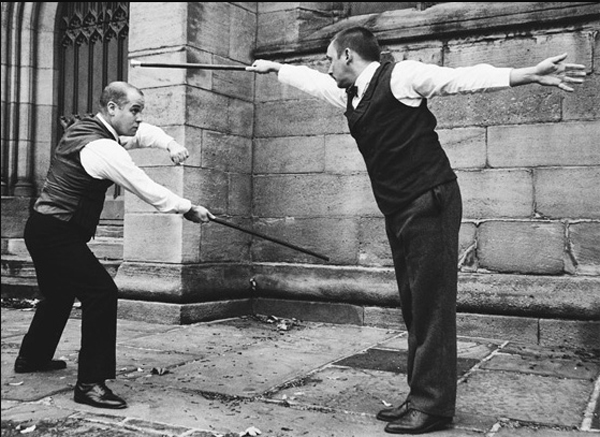
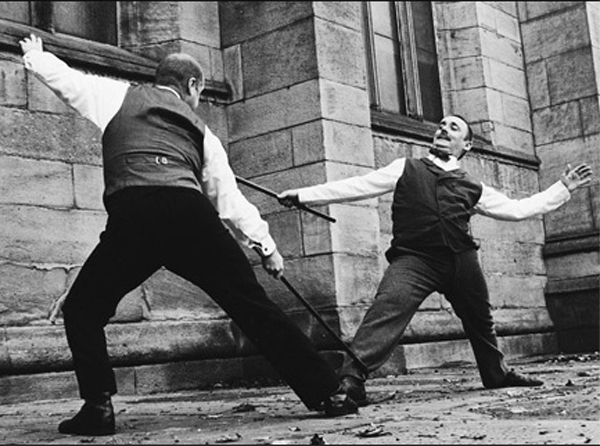
Royal Armouries fight interpreters Rob Temple (as Dr. John Watson, right) and Keith Ducklin (as Sherlock Holmes, left) demonstrate Bartitsu cane fighting poses during their 2001 presentation “Bartitsu, the martial art of Sherlock Holmes”. Inspired by the online publication of E.W. Barton-Wright’s articles at the Electronic Journals of Martial Arts and Sciences Journal of Manly Arts, this was the first known public demonstration of Bartitsu since 1902.
Although Bartitsu slightly pre-dates Sir Robert Baden-Powell’s Scouting movement, both were original and novel products of their founders’ Edwardian ideals. Scouting quickly captured the international imagination and went on to become the most successful youth movement in the world, whereas Bartitsu had only a brief moment in the sun and was then all but forgotten throughout the 20th century.
One of E.W. Barton-Wright’s most historically significant achievements was his introduction of Japanese unarmed combat to the Western world. Whereas jiujitsu had occasionally been glossed in popular magazines and academic journals prior to 1898, it was Barton-Wright’s articles for Pearson’s Magazine, his public demonstrations and classes via the Bartitsu Club that began the pre-WW1 jiujitsu boom.
Circa 1906, as Baden-Powell was formulating the concepts and practices of his nascent youth movement, he was impressed by former Bartitsu Club instructor Sadakazu Uyenishi‘s jiujitsu exhibition at Windsor Castle. Along with campfire lighting and first aid, jiujitsu was among the skills demonstrated during the final day of Baden-Powell’s initial, experimental Scout camp on Brownsea Island during August of 1907.
Shortly thereafter, the first set of Boy Scout merit badges were produced, intended to reward practical skill in any of a number of areas including one for “Master-at-Arms”. To qualify for this badge, a Scout was required to participate in one, two or three of the following sports – fencing with the foil, singlestick or quarterstaff, boxing, wrestling and jiujitsu.

Curiously, the Master-at-Arms badge appeared in the US Boy Scouts Association handbook in 1910, but was dropped the following year.
In 1912 Baden-Powell, who had recently returned to England after a world tour visiting Scouts in many different countries, offered these observations on the martial arts training he had witnessed in Japan:
I went and saw a lot of them at their daily practice of fencing with bamboo sticks and practicing jiu-jitsu to make themselves strong and active and good-tempered. I say good-tempered because it is very much like boxing; you have to take a good many hard knocks and take them smiling. If a fellow lost his temper at it, everybody would laugh at him and think him a fool. In jiu-jitsu they learn how to exercise and how to develop their muscles, how to catch hold of an enemy in many different ways so as to overpower him, how to throw him and, what is very important, how to fall easily if they get thrown themselves. I expect the Scouts of Japan, if they visit England later on, will be able to show us a thing or two in this line.
The Scottish physical education specialist W. Bruce Sutherland was, along with William and Edith Garrud, Percy Longhurst and W.H. Collingridge, among the second generation of European jiujitsu instructors. By circa 1915, as well as teaching classes for the Special Constables and the 17th Royal Scots Battalion, Sutherland advocated jiujitsu training for the Boy’s Brigade, the Cadet Corps, Junior Officers’ Training Corps and the 12th Company City of Edinburgh Boy Scouts:

Thus, Sutherland was probably among the first, if not literally the first instructors to teach jiujitsu to the Scouts. His contemporaries William Garrud and Percy Longhurst wrote simplified technical articles explaining jiujitsu “tricks” for young readers, and former Bartitsu Club fencing instructor Captain Alfred Hutton produced a monograph entitled Examples of Ju Jitsu, or Japanese Wrestling, for Schoolboys.
At about this time in faraway New Zealand, a home-grown alternative to the Scouts’ sister movement, known as the Peace Scouts, was also training youngsters in jiujitsu along with camping. The N.Z. Peace Scouts, who eventually amalgamated with the Girl Guides, was perhaps the first national organisation to promote martial arts training for girls.
In 1923 H.G. Lang, a British police Superintendant stationed in India, produced a book entitled The Walking Stick Method of Self Defence. Lang’s stick fighting method was closely based on that of Pierre Vigny, who had been the chief instructor at the Bartitsu Club. Lang’s method was endorsed by several leaders of the Scouting movement in India and he included exercises specifically for the “Training of Organised Bodies”, such as Scout troupes. He even went so far as to suggest that the Scout’s traditional staff might be profitably replaced with a walking stick of the length advocated in his system.
Two years later the British Scouting Association produced a manual for the master-at-arms badge, setting out simplified instructions for singlestick, quarterstaff and foil fencing and well as boxing, wrestling and jiujitsu. Kirk Lawson has recently made available a facsimile copy of the 1925 manual, based on an original found by Robert Reinberger.

In many cases it seems that the stated requirements for achieving the Master-at-Arms badge did not quite keep up with the practical options available to most Scouts. Certainly, Scouting manuals continued to refer to singlestick and quarterstaff fencing long after those sports had largely faded from popularity, although anecdotal evidence suggests that some older Scoutmasters continued to teach them even into the 1970s.
Master-at-Arms badges (or equivalents) are still available in some national Scouting associations, but the requirements have changed according to local and national policies and social trends. The Health and Safety Guide of the present Boy Scouts of America organisation, for example, states that
“Boxing, karate, and related martial arts—except judo, aikido, and Tai Chi—are not authorized activities.
… presumably due to liability concerns. The Master-at-Arms badge was never re-instated within the American Scouting movement.
The present incarnation of the Master-at-Arms badge of the (British) Scout Association recognises only fencing, shooting and archery. However, the Baden-Powell (or Traditional) Scouts still maintain the Master-at-Arms badge in close to its original form, requiring candidates to:
1. Demonstrate proficiency in 1 of the following: Single stick, Quarterstaff, Fencing, Boxing, Judo, Wrestling, Archery or any recognised martial art.
2. In all the ‘contest’ events, Scout must have taken part in an encounter under proper ring conditions and be able to demonstrate the correct methods of attack and defence.
3. Give evidence of being in training for the scheduled item for a period of not less than 3 months.
The popular trend towards enormous, flamboyant hats reached its zenith during the Edwardian era. Circa 1901, fashionable ladies’ headwear featured elaborate assemblies of taffeta, silk bows, coloured ostrich feathers, flowers and even artificial fruit.

The mainstay of the Edwardian hat was the artfully concealed hatpin, and as the hats themselves grew ever larger, so too did the pins. Some antique examples are thirteen inches long and resemble nothing so much as unbated, miniature fencing foils.
A wealth of evidence from the period demonstrates that hatpins were popularly regarded as secret weapons, and indeed as “every woman’s weapon” against the depredations of hooligans and ill-mannered brutes. Laws against hatpins of “excessive length”, or the wearing of hatpins without protective stoppers, were proposed in Hamburg, Berlin and New York among other cities. At least ostensibly, these laws were intended not so much to ban the use of hatpins in self-defence as to mitigate the incidence of accidental hatpin related injuries inflicted upon blameless fellow passengers in crowded tram-cars.
Certainly, though, the hatpin was the weapon of choice for Edwardian novelists and playwrights who had to extricate their heroines from tight spots.
From Harold MacGrath’s novel “Parrot & Co”, 1914:
Craig stepped in front of them, smiling as he raised his helmet. “This is an unexpected pleasure.”
Elsa, looking coldly beyond him, attempted to pass.
“Surely you remember me?”
“I remember an insolent cad,” replied Elsa, her eyes beginning to burn dangerously. “Will you stand aside?”
He threw a swift glance about. He saw with satisfaction that none but natives was in evidence.
Elsa’s glance roved, too, with a little chill of despair. In stories Warrington would have appeared about this time and soundly trounced this impudent scoundrel. She realized that she must settle this affair alone. She was not a soldier’s daughter for nothing.
“Stand aside!”
“Hoity-toity!” he laughed. He had been drinking liberally and was a shade reckless. “Why not be a good fellow? Over here nobody minds. I know a neat little restaurant. Bring the old lady along,” with a genial nod toward the quaking Martha.
Resolutely Elsa’s hand went up to her helmet, and with a flourish drew out one of the long steel pins.
“Oh, Elsa!” warned Martha.
“Be still! This fellow needs a lesson. Once more, Mr. Craig, will you stand aside? ”
Had he been sober he would have seen the real danger in the young woman’s eyes.
“Cruel!” he said. ” At least, one kiss,” putting out his arms.
Elsa, merciless in her fury, plunged the pin into his wrist. It stung like a hornet; and with a gasp of pain, Craig leaped back out of range, sobered.
“Why, you she-cat!”
“I warned you,” she replied, her voice steady but low. “The second stab will be serious. Stand aside.”
He stepped into the gutter, biting his lips and straining his uninjured hand over the hurting throb in his wrist. The hat-pin as a weapon of defense he had hitherto accepted as reporters’ yarns. He was now thoroughly convinced of the truth. He had had wide experience with women. His advantage had always been in the fact that the general run of them will submit to insult rather than create a scene. This dark-eyed Judith was distinctly an exception to the rule. Gad! She might have missed his wrist and jabbed him in the throat. He swore, and walked off down the street.
Elsa set a pace which Martha, with her wabbling knees, found difficult to maintain.
“You might have killed him!” she cried breathlessly.
“You can’t kill that kind of a snake with a hat-pin; you have to stamp on its head. But I rather believe it will be some time before Mr. Craig will again make the mistake of insulting a woman because she appears to be defenseless.” Elsa’s chin was in the air. The choking sensation in her throat began to subside. “The deadly hat-pin; can’t you see the story in the newspapers? Well, I for one am not afraid to use it.”
Perhaps less frequently than in popular fiction, but still present in newspaper articles and medical journals of the time, we find reports of women wounding male attackers via well-placed jabs with their hatpins. For example, according to a story in the New York Times of January 10, 1898, a Miss Sadie Hawkins assisted a Chicago tram-car conductor named Symington in fending off two determined would-be robbers by stabbing them both repeatedly in the arms and legs with her hatpin, causing the aggressors so much grief that they jumped off the moving tram to escape the onslaught.
Hatpins were also apparently among the covert weapons used by Suffragettes in their struggles against the London bobbies, augmenting their judicious use of Indian clubs and jiujitsu.
Unfortunately there is a paucity of technical instruction on the hatpin as a weapon. The picture emerges, though, of a two-phase counter-strategy against over-confident ruffians who seized their intended victims by the shoulders or arms. First, the defender would feign shock and indignation, her hand flying up apparently to steady her enormous hat, but in reality to pluck out a hatpin. Then, in one movement, she would jab the weapon forcefully into the offending hand or wrist; Mr. MacGrath was not the only writer to compare the resulting pain to “the sting of a hornet”. This might well suffice to discourage any further offence. If not, the consensus on following-up was to stab the assailant in the face or, if more conveniently accessible, “the place where it hurts the most”.
Hatpin tactics are illustrated in these photographs excerpted from a 1904 self defence article that was featured in the San Francisco Sunday Call newspaper:

“When attacked from behind, she grasps a hatpin. Turning quickly, she is able to strike a fatal blow in the face.”
… and described in the risque music hall ballad, “Never Go Walking Out Without Your Hat Pin”:
My Granny was a very shrewd old lady,
The smartest woman that I ever met.
She used to say, “Now listen to me, Sadie,
There’s one thing that you never must forget.”
Never go walking out without your hat pin.
The law won’t let you carry more than that.
For if you go walking out without your hat pin,
You may lose your head as well as lose your hat.”
My Granny said men never could be trusted.
No matter how refined they might appear.
She said that many maidens’ hearts got busted
Because men never had but one idea.
I’ve heard that Grandpa really was a mess,
So Grandma knew whereof she spoke, I guess.
Never go walking out without your hat pin.
Not even to some very classy joints.
For when a fellow sees you’ve got a hat pin
He’s very much more apt to get the point.
My Mama, too, set quite a bad example.
She never heeded Grandmama’s advice.
She found that if you give a man a sample,
The sample somehow never does suffice.
In fact, it’s rumored I might not have been
If Mum had not gone out without her pin.
Never go walking out without your hat pin.
It’s about the best protection you have got.
For if you go walking out without your hat pin,
You may come home without your you-know-what!

(From the June 1911 issue of “Popular Mechanics” magazine)
All the weapons used by the Apaches in Paris are unique, but none are more ingenious than these curious rings and the device known as the “thorn punch”. The latter, held as shown in the illustration and delivered with a hard, straight blow, would drop a man as if hit by a sledge. The rings, however, are more subtle, as they appear to be nothing more than ordinary finger adornments with the exaggerated settings or heads often worn by fad extremists, but hidden within the hand is an extension. This rests against the palm when the fist is doubled and adds much force to the blow.
A promotional postcard (circa 1905) showing former Bartitsu Club instructor Yukio Tani demonstrating a flying armbar (juji gatame) on his manager, the strongman William “Apollo” Bankier:

… and here’s a compilation of the same technique applied in various Brazilian Jiujitsu contests: