Early 20th Century French Self Defence Manuals Translated by M.P. Lynch

A heads-up that a number of rare French antagonistics manuals, most dating from the period immediately following the brief Bartitsu Club era, are now available in English translation via Amazon, courtesy of M.P. Lynch. All the translations are available for under US$3.00 each and are available free to Kindle Unlimited subscribers.

The titles include:

HOOKS, TRIPS, THROWS, & TAKEDOWNS: Standup Grappling: The Cherpillod Method – note that this 1905 manual on stand-up wrestling was written by former Bartitsu Club wrestling and physical culture instructor Armand Cherpillod.

YE OLDE RUFF & TUMBLE: Romein De Hooge – a translation of de Hooge’s Klare Onderrichtinge der Voortreffelijke Worstel-Konst (“Clear Education in the Magnificent Art of Wrestling”) from 1674. The “magnificent art” in this case has less to do with gentlemanly grappling and more to do with winning an Amsterdam bar brawl if you happen to be unarmed when things kick off.

100 WAYS TO DEFEND YOURSELF IN THE STREET: by Émile André

The Secrets of Jiu Jitsu – written by Ernest Regnier, a.k.a. “Re-Nie”, who had trained with Bartitsu Club instructors and went on to pioneer jujutsu in France.

HOW TO DEFEND YOURSELF: CANE – FISTS – DIRTY TRICKS – by Georges Dubois, the well-known Parisian athlete and artist who had lost a savate vs. jujutsu encounter with “Re-Nie” but carried on the produce this excellent manual on street self defence.

WRESTLE: The Joseph Clère Method

BOXING & BATON, CANE & CHAUSSON: The Julien Delauney Method

THE ART OF SELF DEFENSE IN THE STREET: Savate – Boxing – Grappling – Cane – Knife

100 Ways to Defend Yourself in the Street: With Weapons from canes to knives and knuckle dusters
Emile André’s : The Basics of La Canne & Batôn

“Moving Pictures” of Savate and la Canne

If Bartitsu Club instructor Pierre Vigny had seen this film footage, he’d probably have shaken his head at much of it. At the turn of the 20th century, Vigny was among a minority of savate instructors advocating for a reformation of the rules and conventions governing the sport, which, if widely adopted, would have pushed competitive savate closer to the full-contact model of professional boxing. He was also a maverick when it come to la canne, having devised his own, self-defence-oriented version of the style that eliminated many of the fencing-based guards shown in the second film.

The Bartitsu and Suffrajitsu Stories as Rendered by Teenagers

It’s satisfying to see the torches of interest in Bartitsu and Suffrajitsu being taken up by (much) younger enthusiasts. Here are three recent video documents on aspects of Edwardian-era antagonistics, by researcher/presenters who had yet to be born when the Bartitsu revival got underway in the early 2000s.

A well-researched video presentation on Bartitsu by Davi Gabriel, Luca Holanda, José Enzo and João Victor da Silva as part of the physical education studies course in Parnamirim (Rio Grande do Norte), Brazil.

Cora Price presents her first place-winning (and highly accurate) account of Suffrajitsu history for the National History Day Utah 2021 Junior Individual Documentary competition.

Pembroke Hill School student Erin Lowe presents her (again, very accurate) 2017 National History Day Gold Medal winning performance of the Suffrajitsu story at the Harry S. Truman Library in Independence, Missouri.

The Soft Art: Ju-Jitsu (The Sketch, March 22 1905)

Edwardian journalists, handicapped by the lack of standardised spelling of Japanese words in English, did the best they could via phonetics. “Tarro Myaki’s” name is properly rendered at Taro Miyake, and he was prominent among the second wave of Japanese jujutsuka to visit England during the very early 20th century.

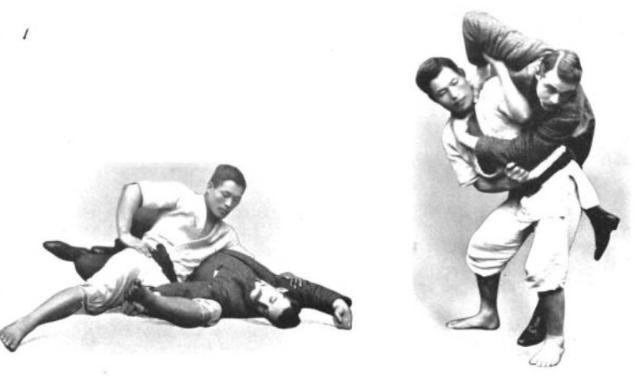
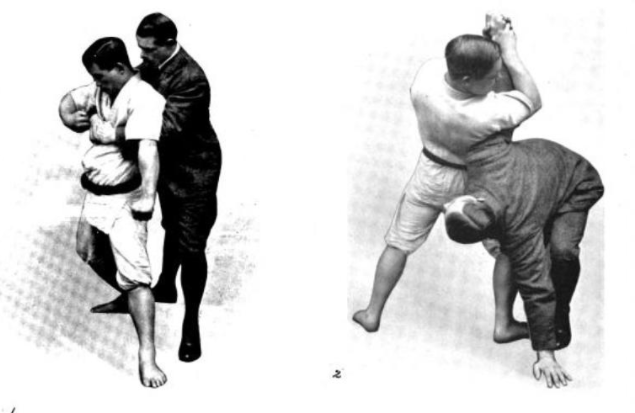
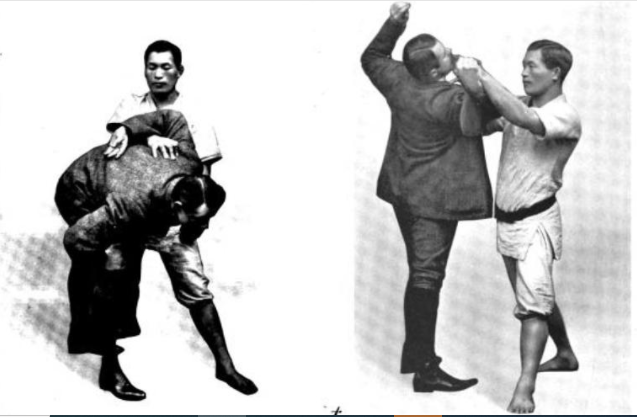
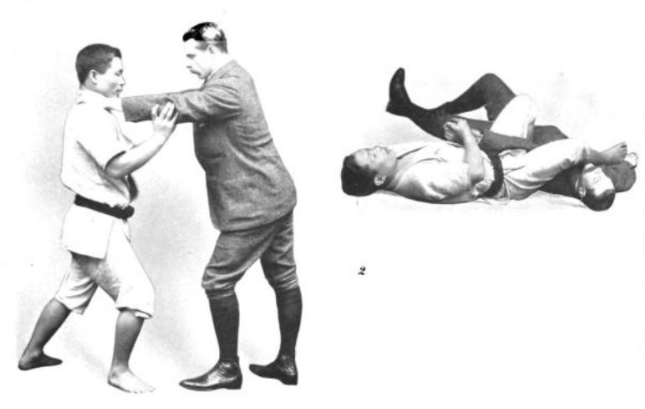
This recently-discovered photo-feature from The Sketch magazine shows Miyake demonstrating several basic jujutsu waza.

Tarro Myaki, who is champion of the world, and who is shown in these photographs, beat Yukio Tani at the end of last year and has recently been wrestling with Joe Carroll. He is 23, weighs 11 and 1/2 stone and is 5’8″ in height.

A number of police constables are already being initiated into the mysteries of Ju-jitsu, and the military authorities have visited Tarro Myaki’s school with a view to having the “soft art” taught to the Army and Navy.

(1.) Should his enemy attack him by catching him by the neck, the exponent of Ju-jitsu pushes up his adversary’s right arm, and pulls at the sleeve of the left, at the same time swinging round sharply with his left foot (4.) Until the position here shown is obtained. The attacker is then cross-buttocked, and thus made ready to receive an arm-lock or a neck-hold.

(2.) To attain this common arm-lock, the Ju-jitsu user places his right leg lightly over his opponent’s neck, in order to prevent him rising, and, pressing his left firmly against his adversary’s body, seizes his arm, and holds it with the thumb upwards. He then presses on the limb, using his thigh as a fulcrum, and is thus able break it should he be forced to do so.

(3.) The arm-lock here illustrated is somewhat similar that shown Photograph 2, in this case the pressure is even greater, and is put on by the leg and foot.

(1.) When he wishes to throw a man who is holding him round the waist from behind, the exponent of Ju-jitsu first strikes his opponent’s hand sharply on the knuckles, thus causing him to release his grip. He then seizes his adversary’s right hand (2.) And, without moving his right leg, carries his left round, at the same time putting on the arm-lock (U-de-na-ta) here shown.

(3.) The arrest of a man is a comparatively simple matter if he is held in the way here illustrated. The upward pressure placed upon the upper part of the prisoner’s arm would dislocate the limb if its owner did not move forward. (4.) Should anyone attempt to catch hold of his collar with his right hand, the practiser of Ju-jitsu defends himself by placing his left hand under his opponent’s wrist, thereby guarding himself, and at the same time throwing his right hand under the upper part of his adversary’s arm. He then locks his fingers and forces backward, throwing his man or breaking his arm if resistance is offered.

Photographs by the Biograph Studio.