
Martial artist Niimi Satoshi offers an idiosyncratic interpretation of both armed and unarmed (neo-)Bartitsu in the first section of this video by Budo Channel Japan.
Monthly Archives: July 2022
“Vigny’s la Canne, Boxing and the Olympics”
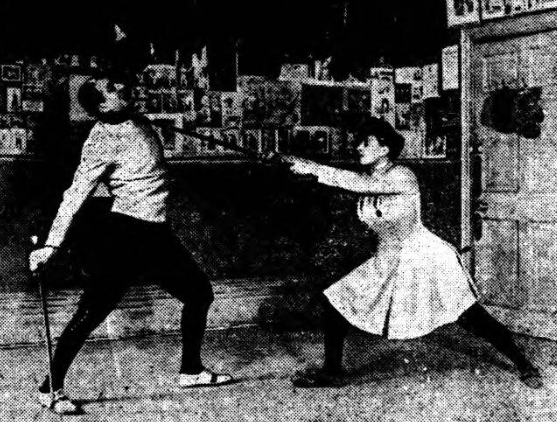
Our old colleague Maxime Chouinard has published some original research – a rarity, at present – on Pierre Vigny and his arts of self-defence. The article Vigny’s la Canne, Boxing and the Olympics does sterling service by offering an alternative translation for the 1912 Revue Olympique report on the Vigny style (which, as is noted correctly, was originally translated and published in the Bartitsu Compendium, and which received a revised and annotated translation here in 2018), also identifying the author as none other than modern Olympics founder Pierre de Coubertin!
The article also includes a translation of Vigny’s obituary, as it appeared in Le Journal de Genève of September 23rd, 1943. Here’s an excerpt:
Pierre Vigny, a sportsman of conviction from the start, passed away in Nyon at the age of 77. With him disappears a master who had set a goal of developing ever more defense sports, a branch which is currently abandoned. Maybe we are wrong to forsake self-defence. He himself declared that it is much easier to defend oneself with a stick than a knife or a revolver. He made a point of putting in their place ten adversaries with his method. Pierre (unreadable) as he had very much studied sports such as la canne, fencing, French and English boxing, and jiu-jitsu. But he really excelled in the art of la canne and had perfectioned the French method as to make it much more effective.
Another Update re. The Bartitsu Compendium, Volume III
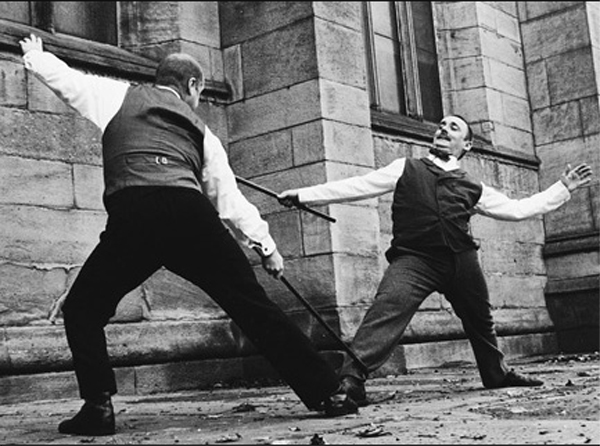
The third volume of the Compendium is currently being compiled, following the publications of Volume I in 2005 and Volume II in 2008.
Vol. III opens with a 166-page retrospective on the life and times of Edward Barton-Wright and the rise and fall of his Bartitsu School of Arms in Soho at the turn of the 20th century. This section represents the first truly comprehensive telling of the “Bartitsu story” in a long-form narrative format, drawing from twenty years of intensive research.
A curated Anthology section compiles the best and most interesting articles published on Bartitsu.org (now BartitsuSociety.com) between 2008-2019, plus a selection of new articles on subjects of diverse interest to Bartitsu aficionados.
Section 3, “Techniques and Tactics” reveals exactly how Bartitsu combined and distinguished itself from the other antagonistics of its era, via a combination of hard-won historical data and the practical experience of the modern revival movement.
The final section offers a look back at the first twenty years of the Bartitsu revival, including the art’s influence on pop-culture and the activities of the Bartitsu Society as a grassroots, open-source martial arts association.
Stay tuned for further details as the Bartitsu Compendium, Volume III nears publication!