
A trailer for this recent Blackeyed Theatre production, which clearly featured its fair complement of Bartitsu-flavoured action scenes.
Monthly Archives: February 2026
“The New Art of Self Defence: How Bartitsu Reimagined ‘Antagonistics’ in Edwardian England”
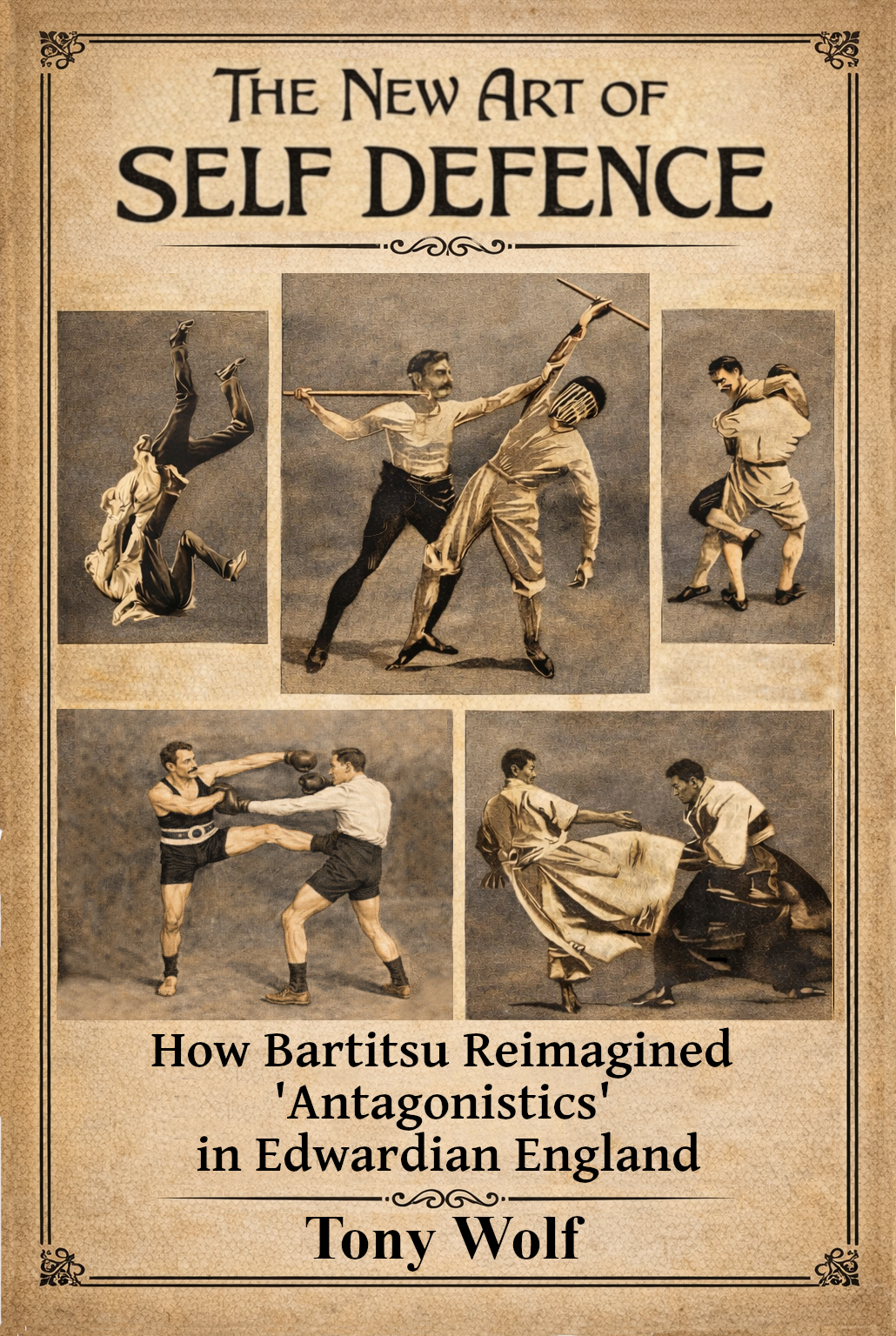
Now available from Amazon, this new book is a revised, updated and significantly expanded version of the “Bartitsu Story” section of The Bartitsu Compendium, Vol. III (2022). As the third volume of the Compendium was a bookshelf-busting 629 large-format pages, readers interested in the complete social history of Bartitsu may prefer this shorter work.
At the dawn of the twentieth century, Edwardian London was gripped by newspaper panics over “hooligan” street violence, a booming culture of athletic self-improvement and a growing fascination with “Oriental” arts and cultures. That combination created the perfect conditions for Bartitsu; a radical experiment in personal combat.
Created by engineer-adventurer Edward William Barton-Wright, Bartitsu combined Japanese jujutsu with English boxing, French savate and a unique method of walking-stick defence into a single, modern system of antagonistics. It was designed not for the battlefield nor the prize ring, but for the dangerous new realities of urban life. For a few remarkable years, the Bartitsu School of Arms stood at the international crossroads of physical culture, self defence and spectacle, staging music-hall challenges, provoking public controversies and attracting an elite and eccentric clientele.
Then, in mid-1902, it disappeared almost without a trace.
The New Art of Self Defence: How Bartitsu Reimagined Antagonistics in Edwardian England tells the full story of this long-forgotten movement. Drawing on contemporary journalism and archival research, it vividly reconstructs the rise and fall of Barton-Wright’s “New Art”. Bartitsu is thus revealed as a rare thing: an early, artisanal and speculative attempt to rethink personal combat for the modern age, decades before the world was ready.
“There’s an art to fighting …”: “Young Sherlock” trailer promises action and intrigue
“The Bartitsu Club of London” (L’Éducation physique : revue sportive illustrée, October 1, 1902)
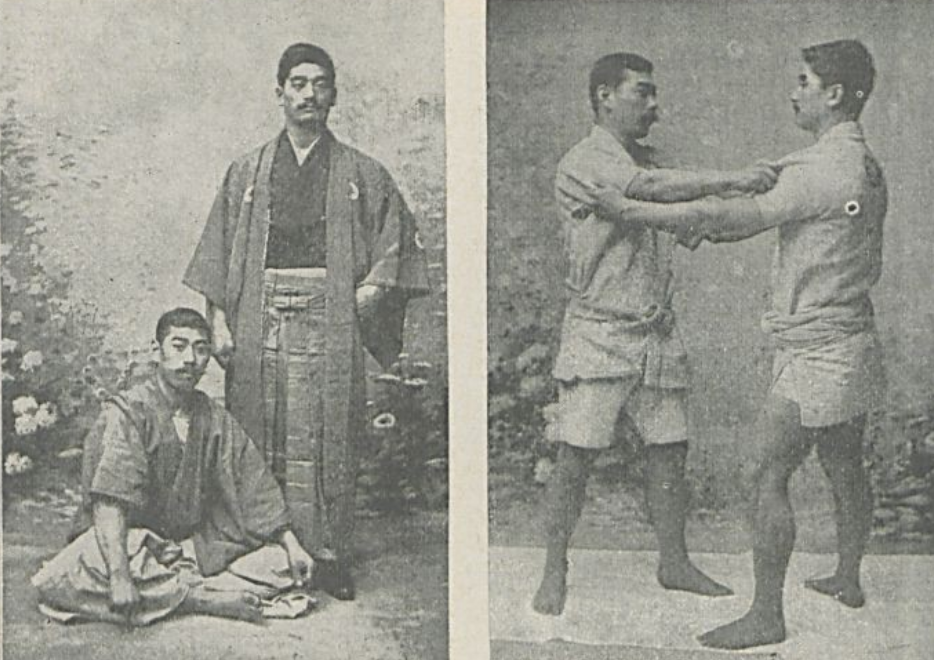
Here follows a translation of this short 1902 article; notably, the Bartitsu School of Arms had actually closed by the time this piece was first published.
Jacketed Wrestling
The Bartitsu Club of London is directed by M. Pierre Vigny, who has occupied the post of professor there for the past three years. The premises are situated in Shaftesbury Avenue, in a spacious basement illuminated by electric light and furnished with mats to soften the impact of falls. A new School of Self-Defence and Fencing has just been inaugurated there, which we believe is destined for the greatest success.
Let us say a few words concerning the Japanese instructors who teach jacket wrestling, or what might more properly be described as the art of self-defence against assault. The two Japanese are of small stature, but admirably proportioned, and possess an agility that borders on the prodigious. They teach a form of wrestling entirely unknown here in France: jacket wrestling.
In place of ordinary street attire, the contestants don a kind of short jacket made of stout canvas; and, each seizing his opponent at will—by the collar, the sleeves, or the skirts of the garment—they endeavour mutually to throw one another, and to place the adversary in a position where he is incapable of doing harm.
When the two Japanese are engaged with other opponents, they are invincible, so great are their dexterity and their mastery of this form of wrestling. Any wrestler who finds himself face to face with them is compelled to acknowledge defeat, and they make him perform the most extraordinary somersaults imaginable. Yet they are not men of great physical strength; rather, they employ the force of their adversaries to throw them and reduce them to complete immobility. It must, however, be noted that without the jacket they are no longer able to employ those mysterious methods which so completely disconcert all who contend with them.
We witnessed the Swiss wrestler Cherpillod, a man of great vigour, reduced to helplessness by one of these small Japanese. Their knowledge of anatomy greatly assists them in overcoming their opponents, even by the infliction of pain when necessary. The photographs reproduced opposite will give a clearer idea of their method of work.
We ourselves attempted a few holds of jacket wrestling with one of the two Japanese, and the experience was decidedly amusing. Conscious of our superior strength, we seized our adversary in a front waist-grip and hurled him to the ground upon his back. The little man did not even attempt to resist, but allowed himself to fall; yet scarcely had his shoulders touched the ground when his foot came to rest upon our chest, and we executed a masterly pirouette over our opponent, who found himself above us and held us helpless—by pain and by means of various positions of the body, the nature of which one scarcely realises until subjected to them oneself.
All this is understood almost at once. It is prodigious. But let us repeat once again that there is one sine qua non condition for their victory over an opponent: the use of the special garment known as the jacket.