Portraits of Sadakazu “Raku” Uyenishi

  • Originally published on the Bartitsu.org site on Saturday, 5th March 2016

Sadakazu Uyenishi was aged just twenty years when he arrived in London to join E.W. Barton-Wright’s new Bartitsu enterprise during the year 1900. Although he was young, Uyenishi was already a highly experienced martial artist, skilled at kenjutsu (swordplay) as well as the use of the rokushakubo and hanbo (the six foot staff and three foot baton, respectively). His unarmed combat training had been with sensei Yataro Handa in Osaka.

Uyenishi and his training partner Yukio Tani both taught jiujitsu classes at the Bartitsu Club, also performing demonstrations and competing in open “challenge” contests against all comers in the great London music halls.

After the closure of the Bartitsu Club in 1902, Uyenishi continued to teach via his own dojo in London’s Golden Square district, as well as wrestling in challenge bouts. In 1905, with the assistance of his student E.H. Nelson and writing under his professional wrestling alias of “Raku”, Uyenishi produced his Text-Book of Ju-Jutsu, which was illustrated with cinematographic photo-series and which became a popular reference work. He also taught what may have been the first jiujitsu classes for English soldiers, at Aldershot Camp.

Little is known of Uyenishi’s life after he returned to Japan in late 1908. Percy Longhurst, writing an updated biography of Uyenishi for the 9th edition of his “Text-Book” published just after the Second World War, noted that Uyenishi had died “some years before”.

Raku2
Raku1
Raku3
Posted in Biography, Jiujitsu | Comments Off on Portraits of Sadakazu “Raku” Uyenishi

The Life’s Work of Percy Longhurst

  • Originally published on the Bartitsu.org site on Saturday, 5th March 2016

Percy William Longhurst (1874-1959) was a lifelong wrestling and antagonistics enthusiast, a prolific writer and a significant figure in the history of Bartitsu.

Unfortunately, comparatively little is known of Longhurst’s biography, especially his early life.  As an adult he served the National Amateur Wrestling Association of Great Britain in various official capacities, including Treasurer, Secretary and President.  In 1899 he won the English Light-Weight Wrestling Competition and, in the same year, became one of the very first European-style wrestlers to challenge E.W. Barton-Wright’s Japanese jiujitsuka.  Losing both experimental matches, Longhurst became an enthusiastic proponent of Japanese unarmed combat for sport and, especially, as a means of self defence.

Longhurst’s 1900 article, A Few Practical Hints On Self-Defence, and his subsequent references to having learned some jiujitsu from Barton-Wright himself, strongly suggest that he was at least a sometime-member of the Bartitsu Club in Shaftesbury Avenue.  He also studied with both Yukio Tani and Sadakazu Uyenishi, but the chronology there is unclear.

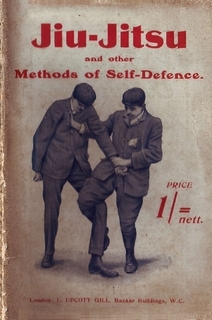
Longhurst’s first major contribution to the self defence milieu was his seminal book Jiu-Jitsu and Other Methods of Self Defence, originally published in 1906 and in print, via at least ten subsequent editions, for many decades thereafter.  This book is, for most practical purposes, the closest thing to a “Bartitsu manual” published in English, covering Longhurst’s idiosyncratic blend of various British regional wrestling styles with Japanese jiujitsu and also including some techniques of boxing and walking stick self defence.  It remains a valuable resource towards the development of neo-Bartitsu styles.

During the heated “boxing vs. jiujitsu” debate that played out in the pages of Health and Strength magazine during 1906, Longhurst produced a notably balanced and realistic illustrated article on the subject.  Despite “mixed” boxing vs. wrestling or jiujitsu contests being at least theoretically illegal under the then-current law, which would have defined such contests as “brawling in a public place”, Longhurst had clearly participated in these types of matches “behind closed doors”.

Unlike several of his contemporaries, notably including William and Edith Garrud and W. Bruce Sutherland, Longhurst does not appear to have ever set up his own school, nor even to have taught public self defence classes.  However, it is clear from his writings on the subjects of jiujitsu and “combined” self defence that he was both  knowledgeable and practically experienced, so it’s not unlikely that he trained informally, albeit over a long period, probably with his colleagues in the wrestling community.

He was, however, along with Garrud, Sutherland and Percy Bickerdike, among the founding members of the British Ju Jitsu Society, which formed in 1920.  The BJJS may have been established somewhat in reaction to the London Budokwai, which represented a shift away from the “old guard” of eclectic British jiujitsu and towards the new model of Kodokan judo.  The Society produced a newsletter and several detailed monographs on subjects such as atemi-waza (pressure-point techniques) and ne-waza (ground-fighting techniques).

Percy Longhurst continued to write prolifically throughout the early and mid-20th century, producing dozens of books and articles mostly on the subjects of athletics, wrestling and self-defence.  In writing for “Boy’s Own” magazines he occasionally used the pen-name Brian Kingston.  His output included juvenile adventure stories (such as “The Secret Lock“, written in 1911, which reads very much like a jiujitsu-themed prototype for the Karate Kid movies) as well as histories and expositions of various British wrestling styles.  His essay “The Hunt for the Man Monkey”, a purportedly true cryptozoological adventure describing a tragic encounter with an unknown, ferocious ape-like creature in the wild jungles of Borneo, was especially popular.

During the 1930s Longhurst was involved in an interesting project to create a new calisthenic wrestling style referred to as “standing catch-as-catch-can”, in which the object was to lift opponents off the floor rather than to throw them to the floor.  He also produced introductions for reprints and revisions of a number of books that had been written by his Edwardian-era colleagues, including Sadakazu Uyenishi’s Text-Book of Jujitsu, W.H. Collingridge’s Tricks of Self Defence and William Garrud’s The Complete Jujitsuan.

Percy Longhurst passed away at the respectable age of 85, having made a number of unique and valuable contributions to his chosen field.

Posted in Antagonistics, Biography, Boxing, Fiction, Jiujitsu, Wrestling | Comments Off on The Life’s Work of Percy Longhurst

Society Women Wrestlers: Ladies’ Craze for Japanese Ju-jitsu (Daily Mirror, April 4, 1904)

  • Originally published on the Bartitsu.org site on Sunday, 6th March 2016

Note – “Lady Clara Vere de Vere”, referred to below, is actually a character in an 1840s poem of the same title by Alfred, Lord Tennyson; the author of this article is using the name generically to refer to “ladies of the upper crust”.

Latest Drawing-Room Craze

Yukio Tani, the great Japanese exponent of ju-jitsu, who is quite confident of beating his English opponent in the great match for £200 a side, puts in several hours a week instructing the dames and damsels of Mayfair in the noble art of (Japanese) self-defence. Lady Clara Vere de Vere has taken up Ju-jitsu , as the science is called, with vigour, and is rapidly making herself competent to tackle the burliest hooligan who ever donned cap and muffler. The writer on Saturday received the testimony of “Apollo,” the Jap’s manager, on the subject.

The strong man was at breakfast when our reporter called at his cozy flat in Shaftesbury avenue, but he readily consented to talk.

Makes Women Graceful

“Ju-jitsu”, said he, “is particularly adapted for ladies for several reasons. In the first place, no muscular strength is required, for it is all a question of ‘knack’ and quickness. In the second the science, apart from its usefulness as a means of self-defence, induces grace of carriage and develops the’ figure. You see, to be a competent ju-jitsuist you must hold yourself upright. Whereas, in other styles of wrestling, one has to adopt a crouching attitude, which contracts the chest and makes the figure ugly.”

The fad, it appears, commenced when Tani began to take engagements to appear at private houses and give exhibitions’ of wrestling in the Japanese style. Fashionable hostesses began to vote Hungarian fiddlers and Polish tenors altogether out-moded after they had seen the lithe and graceful Jap and his manager give a glimpse of ju-jitsu. Sometimes, at dances, the wrestling-mats were spread on the ball-room floor between waltzes, and looking on at a bout of ju-jitsu gave the dancers a rest. The grace, the quickness, and the absence of violence which are the distinguishing marks of ju-jitsu fascinated Lady Clara Vere de Vere, and from seeing it done to wanting to do it herself was but a step. Now, Tani has his hands full putting fair and aristocratic aspirants up to the various locks and holds which constitute the Japanese art of self-defence.

Keenness of the Ladies

“A girl,” says the authority, “will learn ju-jitsu in one-third of the time, and with one-half the trouble, compared with a man. For one thing, they are keener about it; and for another, we cannot get the men to take it seriously enough to moderate their drinking, smoking and late hours – all of which are not conducive to excellence in ju-jitsu.

“Again, a girl is more anxious to improve her general physique than the male thing – and there is no doubt that this style of wrestling is a first-class thing for health and beauty.

An ever-present terror to women living in the country is the prowling tramp. But, armed with a knowledge of ju-jitsu, madame or mademoiselle may take her unattended walks abroad, and in the event of an encounter with the ‘hobo,’ may give him the alternative of crying quarter or having an arm broken.”

So fashionable is the new craze becoming that some West End stationers are printing invitation cards with “Wrestling” in the corner where “Dancing” or “Music” was wont to stand.

Posted in Jiujitsu | Comments Off on Society Women Wrestlers: Ladies’ Craze for Japanese Ju-jitsu (Daily Mirror, April 4, 1904)

The Japanese Wrestlers (The Sketch, October 2, 1901)

  • Originally published on the Bartitsu.org site on Sunday, 13th March 2016

This very ordinary short report on one of E.W. Barton-Wright’s 1901 jiujitsu promotions includes a distinctly unusual photograph. The man on the left is probably Yukio Tani who was, along with Sadakazu Uyenishi, performing this type of exhibition for Barton-Wright at this time. The man on the right, however, does not look at all like Uyenishi, who was closely comparable to Tani in both age and physique. No other Japanese jiujitsuka are known to have been active in London during 1901, let alone to have been performing martial arts demonstrations and challenge matches under the Bartitsu banner.

It’s possible that the Sketch made use of an archival photograph and that the man on the right was actually either Yukio Tani’s older brother, who is known to us only by his initial, K., or S. Yamamoto. Along with Yukio, K. Tani and Yamamoto had been among the first group of jiujitsuka that Barton-Wright had brought to England in late 1899. The elder Tani and Yamamoto left after only a few months, apparently due to a miscommunication or misunderstanding about the type of work they would be asked to do. Yukio stayed on and was joined by Uyenishi in early 1900.

No other photographs of either K. Tani or S. Yamamoto are confirmed to exist.


Tani Yamamoto

So much enthusiasm has been created by the introduction into this country of the Japanese Secret Art of Self Defence that the Management have entered into an agreement with Mr. Barton-Wright for the appearance of his two Japanese Champions at the Empire Theatre from Monday last.  New features have been introduced, and, in order that the utility of these methods may be properly tested, members of the audience are invited to go upon the stage.  Mr. Barton-Wright has already arranged some important contests with three English Champion Wrestlers.

Posted in Canonical Bartitsu, Jiujitsu | Comments Off on The Japanese Wrestlers (The Sketch, October 2, 1901)

“The World We Live In: Self-Defence” – Some Words of Wisdom from Suffragette Martial Arts Trainer Edith Garrud

  • Originally published on the Bartitsu.org site on Sunday, 13th March 2016

The following article was first published in Votes for Women, the newspaper of the Women’s Social and Political Union, during March of 1910. At that time, Edith Garrud (right, above) had been running her “Suffragettes Self Defence Club”, which was advertised in Votes for Women, since at least December of the previous year. The club was based at Leighton Lodge in Edwardes Square, Kensington, a facility which also included a number of studios for classes in sculpture, painting and voice. The Suffragette self defence classes started at 7.00 p.m. each Tuesday and Thursday evening and cost 5s, 6d per month.

Click on the article to read it at full size:

The World We Live In

Eight months after this article was written, the intensity of the “suffrage question” was dramatically boosted when a large but ostensibly peaceful suffragette rally in central London escalated into the violent confrontation that became known as the Black Friday riot. That event forced the urgency and evolution of Mrs. Garrud’s training and by 1912 her Votes for Women advertisements read:

Ju-Jutsu (self-defence) for Suffragettes, private or class lessons daily, 10.30 to 7.30; special terms to W. S. P. U. members; Sunday class by arrangement; Boxing and Fencing by specialists. — Edith Garrud, 9, Argyll Place, Regent Street

By 1913 – in response to the Cat and Mouse Act, which allowed hunger-striking suffragette prisoners to be released and then re-arrested once they had recovered their health – Mrs. Garrud was training the secret Bodyguard Society, also known as the Amazons, in preparation for their violent confrontations with the police.

Posted in Jiujitsu, Suffrajitsu | Comments Off on “The World We Live In: Self-Defence” – Some Words of Wisdom from Suffragette Martial Arts Trainer Edith Garrud

Registration Now Open for the 2nd International Pugilism Symposium

  • Originally published on the Bartitsu.org site on Monday, 21st March 2016

When? Saturday May 21 and Sunday May 22, 2016


Where? River Valley Complex in Leaf River, IL.

Two days of intensive instruction in historic bare knuckle boxing with some of the top instructors in the world!!

Gallowglass Academy is pleased to announce the following list of fabulous instructors and classes:

Tim Ruzicki: 1) The Single Time Counters of Pugilism 2) Using Your Elbows

Martin Austwick: 1) Sparring Applications in Pugilism  2) The “Dirty Tricks” of Pugilism

Ken Pfrenger: 1) Proper Use and Feeding of Focus Mitts  2) The Pugilism of Ancient Greece and Rome

Kirk Lawson: 1) Grappling in Pugilism  2) Striking the Vital Points

Allen Reed: 1) Pugilism for Self Defense

Go to the Gallowglass Academy site for further information and online registration!

Posted in Boxing, Seminars | Comments Off on Registration Now Open for the 2nd International Pugilism Symposium

Bartitsu Display at the 2016 Festival of Steam and Transport

  • Originally published on the Bartitsu.org site on Friday, 1st April 2016

This recent event in Chatham, Kent, England included a dashing Bartitsu demonstration by members of the Metropolitan Bartitsu Club …

MBC 4
MBC 3
MBC 2
MBC1
Posted in Canonical Bartitsu, Exhibitions, Vigny stick fighting | Comments Off on Bartitsu Display at the 2016 Festival of Steam and Transport

Bespoke Umbrella Self-Defence at the Academie Duello

  • Originally published on the Bartitsu.org site on Saturday, 9th April 2016

Vancouver-based fashion and style company Style by Sarai hosted this Kingsman-themed event at the Academie Duello Western martial arts school, including an umbrella self-defence lesson with Bartitsu instructor David McCormick.

Posted in Canonical Bartitsu, Pop-culture, Video | Comments Off on Bespoke Umbrella Self-Defence at the Academie Duello

“Fencing and Bartitsu at the Bath Club” (Illustrated Sporting and Dramatic News, March 18, 1899)

  • Originally published on the Bartitsu.org site on Friday, 15th April 2016

On Thursday, the 9th inst., “ladies’ night”, an amusing and instructive evening was spent by the members and their friends, gathered in considerable numbers. The first part of the entertainment consisted of an exhibition, under the management of Captain A. Hutton, of Elizabethan methods of sword–play and fencing. It is unnecessary to state that this was admirable in every way, the most taking items being the Two-Handed Sword contest between Messrs. E. Stenson Cook, L.R.B., and W.P. Gate, L.R.B.; Rapier and Dagger, between Captain A. Hutton and Mr. W. H. Grenfell; and Rapier and Cloak. Mr. E. Campbell–Muir was indisposed, and unable to give his exhibition of trick–riding; and in order that the audience might not lack amusement, Mr. W. Henry, of the Life Saving Society, probably our best exponent of ornamental swimming, gave a very fine exhibition of the art. Miss Lewin afterwards also gave a good display of swimming and diving.

The last and most novel feature of the program was Mr. E. W. Barton–Wright’s exhibition of the new mode of self–defence, which he has named “Bartitsu.” It was therefore a considerable disappointment to all present when they learned that Mr. Barton–Wright, and his friend who was to assist him in his exposition, were both suffering from damages of a more or lasts serious character, sustained in a cab accident that they had been in the night before. However, Mr. Barton–Wright, though damaged, came forward, and showed some of his “chips,” as wrestlers style them.

Although unable to speak from experience, we must confess to being a good deal impressed by some of his methods. The manner in which he showed how to receive the attack of a heavier and more powerful man, grappling him by the throat or shoulders, was very striking. He gave way, and dropped on his back, drawing his opponent with him, and while holding to his adversary he applied leverage by means of his foot placed on the body of his assailant, causing him to turn a complete somersault, so that he fell at full-length upon his back. The illustration number three shows this.

Another method for holding an opponent on the ground so that he shall be unable to rise, is shown in number four, and a means of leading a refractory and unwilling person from a room is number five. This last is somewhat of an old friend we remember having practiced on ourselves at school, although the hold was not quite taken in the same way. On the whole, it seems as though there were a good deal in Mr. Barton–Wright’s methods, and, unquestionably, as applied by him, they are most formidable. It would be interesting to see him opposed to a really high–class, catch–as–catch–can wrestler, as giving a distinct line for arriving at a judgment as to the value of Bartitsu.

Bath Club 1
Bath Club 2
Bath Club 3
Bath Club 4
Bath Club 5
Posted in Canonical Bartitsu, E. W. Barton-Wright, Exhibitions, Fencing, Jiujitsu | Comments Off on “Fencing and Bartitsu at the Bath Club” (Illustrated Sporting and Dramatic News, March 18, 1899)

“The Rise of the Jujitsu-Suffragettes: Martial Arts in fin-de-siècle Great Britain”

  • Originally published on the Bartitsu.org site on Thursday, 28th April 2016

Click here to contact the organisers and/or to book your place for this fascinating lecture on the real secret society of suffragette bodyguards who inspired the Suffrajitsu trilogy!

When?  6.30 – 8.00 p.m., May 19th, 2016

Where? Asia House, Library, 63 New Cavendish Street, London, W1G 7LP

How much? Admission: £8

What’s it about? The lecture will explore the blossoming of martial arts in Great Britain at the turn of the 20th century, investigating the Victorian obsession for self-defence, the appeal of the ‘exotic East’, and gender as a social and cultural construct.

Starting with the mid-Victorian garotting panics, Dr Godfrey will show how a fear of violent street crime was entangled with a fascination with Indian thuggee and how in response, civilians manufactured gruesome weapons.

By the end of the 19th century, the use of violent forms of self-defence had become unfashionable and Japanese martial arts were considered to be the ideal, minimally aggressive way to fend off attackers. Experts from Japan taught politicians, the public and police alike the art of jujitsu and women sensationally took up jujitsu in the campaign for women’s suffrage.

A century later, martial arts with an Edwardian twist are again in vogue.


 Lecturer: Emelyne Godfrey

Dr Godfrey is a writer and researcher specialising in the Victorian and Edwardian eras. She is a regular contributor to the Times Literary Supplement and has been interviewed by the BBC on numerous occasions. Author of Masculinity, Crime and Self-Defence in Victorian Literature (2010), and Femininity, Crime and Self-Defence in Victorian Literature and Society (2012), her latest work Utopias and Dystopias in the Fiction of H.G. Wells and William Morris will be available in September 2016. Dr Godfrey is currently working on a book on the suffragettes.

Posted in Academia, Canonical Bartitsu, Edwardiana, Jiujitsu, Suffrajitsu | Comments Off on “The Rise of the Jujitsu-Suffragettes: Martial Arts in fin-de-siècle Great Britain”