A 1915 Sketch of E.W. Barton-Wright

  • Originally published on the Bartitsu.org site on Saturday, 29th April 2017
This image has an empty alt attribute; its file name is image-6.png

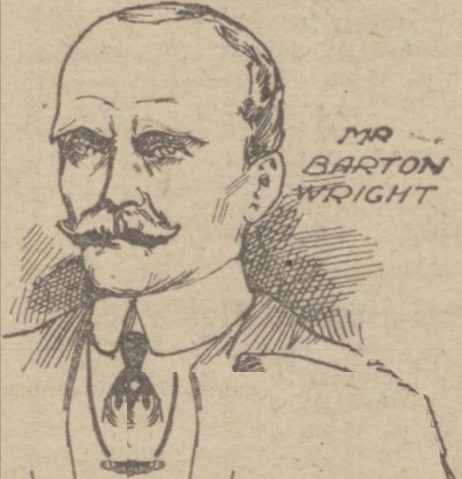
A rare portrait sketch of Bartitsu founder E.W. Barton-Wright from The People newspaper of 24 October, 1915.

At this time, Barton-Wright would have been aged about 55 and was managing his impressively-appointed therapeutic clinic in Oxford Street:

Posted in E. W. Barton-Wright | Comments Off on A 1915 Sketch of E.W. Barton-Wright

Sherlock Holmes’ Bartitsu at the Royal Armouries Museum

  • Originally published on the Bartitsu.org site on Monday, 1st May 2017

Scenes from the Sherlock, Stock and Barrel festival taking place at the Royal Armouries Museum in Leeds, UK. This event marks the return of Bartitsu demonstrations to the Museum, which was also the site of the first modern Bartitsu revival demos in 2001.

Posted in Canonical Bartitsu, Exhibitions | Comments Off on Sherlock Holmes’ Bartitsu at the Royal Armouries Museum

Marguerite Vigny (a.k.a. “Miss Sanderson”) Competes at the Cercle Hoche (1908)

  • Originally published on the Bartitsu.org site on Tuesday, 2nd May 2017

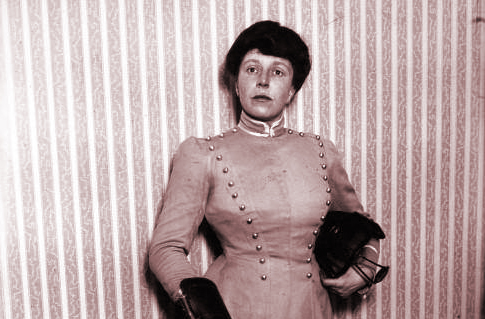
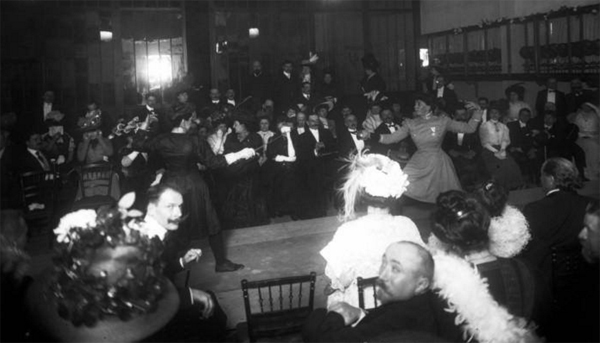
Founded in Paris in 1900, the Cercle Hoche was an exclusive fencing and athletic club whose amenities included a luxurious bathroom, a billiard room, a courtyard garden and a restaurant. On the 27th of May, 1908, the club hosted an all-women fencing tournament.  Among the competitors was Marguerite Vigny, who went by the professional name of “Miss Sanderson”.

An expert fencer who had frequently and successfully competed in England, she was also the wife of former Bartitsu Club instructor Pierre Vigny and the proponent of a unique system of women’s self-defence employing umbrellas and parasols.

Marguerite Vigny narrowly lost her bout in this tournament, as her opponent – Mme. Rouviere, seen standing centre, above – gained six “touches” to Vigny’s five.

Posted in Fencing | Comments Off on Marguerite Vigny (a.k.a. “Miss Sanderson”) Competes at the Cercle Hoche (1908)

“The Unknown Wrestler: Jiu-Jitsu Constables Defeated” (1906)

  • Originally published on the Bartitsu.org site on Friday, 5th May 2017

From the Shipley Times and Express of 23 February, 1906:

An exciting, though impromptu, jiu-jitsu contest was witnessed in the early the hours of Monday morning at Snow Hill Police Station. Two constables had arrested a well-dressed, powerfully-built man of about forty years of age at Alderegate Street at quarter past two, on a charge of disorderly conduct. With considerable difficulty the constables got their prisoner, who described himself as Arthur Leonard Paget, merchant, and gave an address in Clerkenwell — to the police station.

There he was released for moment, while the charge against him was being taken down. Suddenly throwing off his silk hat and two coats, he challenged any single policeman present to put him in the dock. Several of tha officers, as it happened, had learned jiu-iitsu from a Japanese expert, and, well aware the helplessness of an ordinary wrestler against jiu-jitsu methods, they smilingly accepted the challenge.

One of them stepped forward, and before he could get hold he found himself lying on the floor. When he had made another essay with similar results, he realised that his opponent knew more about jiu-jitsu than he did. A second policeman advanced the attack, but the formidable unknown threw him as easily as the other man.

Then three or four constables together rushed in, and a desperate struggle followed. Even against such odds Paget’s great strength and scientific skill enabled him for long time to hold his own. One after another the policemen want down, but they came on again. At length they tired out and threw their antagonist, who was then locked in a cell and left to cool down.

Speculation in the Force as to whether or not they had arrested Mr. Hackenschmidt was set at rest later as the prisoner, who assured an inquisitive officer that his description of himself was correct, and added that he used to be an Army drill instructor.

Taken before the Guildhall magistrates subsequently, Paget admitted that he was under the influence of drink, but urged that the unreasonable conduct of the constables in interfering with him at the outset had caused him to lose his temper. He was fined £5 and costs for being disorderly and assaulting the police.

Posted in Jiujitsu | Comments Off on “The Unknown Wrestler: Jiu-Jitsu Constables Defeated” (1906)

Vigny-Style Sparring in Santiago, Chile

  • Originally published on the Bartitsu.org site on Saturday, 6th May 2017

Walking-stick sparring in the Bartitsu/Vigny style, as practiced in Santiago, Chile.  Note the tactical shifts between the double-handed, rear and front guards:

Posted in Sparring, Video, Vigny stick fighting | Comments Off on Vigny-Style Sparring in Santiago, Chile

Dr. Emelyne Godfrey’s Presentation on Bartitsu and the Jiujitsu Suffragettes

  • Originally published on the Bartitsu.org site on Saturday, 6th May 2017

Here’s a full video record of Dr. Emelyne Godfrey’s recent presentation on Bartitsu and suffragette jiujitsu, delivered for the Martial Arts Studies Research Network.  The presentation is followed by a question and answer session, beginning at about 32 minutes into the video.

Posted in Academia, Canonical Bartitsu, E. W. Barton-Wright, Suffrajitsu, Video | Comments Off on Dr. Emelyne Godfrey’s Presentation on Bartitsu and the Jiujitsu Suffragettes

The Apache’s Foe (The Bystander, 12 September 1906)

  • Originally published on the Bartitsu.org site on Wednesday, 10th May 2017

Burglaries in Paris and the provinces, wherein the revolver and the knife, as a rule, play an important role, are becoming more and more frequent. The police seem powerless, and the attacked citizens, paralysed by fear, do not make use of the weapons at their disposal, with the result that the ghastly list of murdered persons has been swelling of late to an alarming extent.

But help has come from an unexpected quarter. The Apache has encountered a formidable foe, on whom he never reckoned, and that foe is woman. Under normal conditions, a woman shudders at the thought of shedding blood, but when she once decides to kill, her hand does not tremble.

We have had many instances of that of late. A young woman was married to a scoundrel who wanted to force her to get her living in the streets, whereupon she left him and went back to her mother. A month ago the fellow burst into the room where the two women were dining, and with horrible threats called upon his wife to return to him. Before he had time to strike her, he fell to the ground with the carving knife buried in his throat. She informed the jury that if she deserved punishment it was for not having performed the deed sooner and the twelve gentlemen evidently agreed with her, for she was at once acquitted.

The Modern Amazons

Last week a girl distinguished herself in a similar manner. She was nursing her sick sister and waiting her father’s return, when two men attempted to break the shutters of the lonely cottage. In an instant she had seized her father’s rifle, and lodged a bullet in one of the burglars’ heads. There was no necessity to fire a second shot. Number one was “out of business” as the Americans say and the other had fled. She then resumed her sewing, as if nothing had occurred. Her name is Mlle. Brazy, and if she were placed at the head of a company of Amazons, I feel certain the Paris streets would be safer at night than they are at present.

Our policemen appear to be always in doubt as to when they may or may not use their revolvers, and whilst they are weighing the matter, the psychological moment has passed. Women do not trouble about the subtleties ot the law. If they are threatened they strike, if they are struck they kill. They are doing good work as long as they continue to aim their shots at the enemies of Society.

Posted in Edwardiana, Hooliganism | Comments Off on The Apache’s Foe (The Bystander, 12 September 1906)

Bartitsu with Allen Reed at “Cogs and Corsets” in Bloomington, IL

  • Originally published on the Bartitsu.org site on Thursday, 11th May 2017

Come learn the martial art made famous by Sherlock Holmes when he fought with his nemesis Prof. Moriarty at the top of Reichenbach Falls. Prof. Reed spent many years tracking down and apprehending miscreants who violated the law. Now in retirement he brings his experience in antagonistics, fisticuffs and preventing mayhem to ladies and gentlemen who may find themselves in need of such training when waylaid by hooligans upon the highways and byways.

The class is scheduled for 2 PM on Saturday June 3rd on the lawn of the historic courthouse in Bloomington, IL. For more information about all the events of the three day festival (June 2 to 4, 2017) see http://www.cogsandcorsetsil.com.

Posted in Canonical Bartitsu, Seminars | Comments Off on Bartitsu with Allen Reed at “Cogs and Corsets” in Bloomington, IL

“Bartitsu at the Tivoli Theatre” (1901)

  • Originally published on the Bartitsu.org site on Friday, 12th May 2017

From the Morning Post of 23 August, 1901:

Yesterday afternoon Mr. Barton-Wright gave a private exhibition of Bartitsu, his system of self-defence, which, though mainly founded on Japanese methods, is not exclusively confined to them. The inventor, who opened the proceedings with short explanatory speech, claims that his system combines all that is best in East or West. It is based on strictly anatomical and mechanical principles, and enables five stone of knowledge to throw twenty stone of ignorance out of the window with less apparent exertion than normally attends the pulling up of a blind.

The legs play an even more prominent part than the arms and several English principles are set at defiance. Our styles of wrestling are too conventional, too detached from life. A man who is down on three points, so far from being defeated, occupies a strong defensive and offensive position. Really, the fun has just began. Our “Don’t kick man when he is down,” should, in fact, be revised, and should read, “Keep clear of man when he is down, or he may kick you.”

The two best Japanese light-weights were in attendance, and gave a startling exhibition of their art. Not all was quite novel. Mr. Kawakami has familiarised us with some of the throws, and there were other grips and similar devices which it part of constable’s business to master. But there was an abundance of novelty.

First, the combatants, wearing bicycling skirts and barefooted, gave an exposition the various kinds of catches. It did not seem to matter where the one caught hold of the other, he was invariably thrown off and down with violence to the resonant floor. Did grasp his adversary by the hair? The adversary, with a toss of the head, jerked him over his shoulder as if he had been raindrop.

Next came the throws, not the whole three hundred of them, but just a few samples. They included some very quiet and effective means of settling your man, which might be useful to girls anxious to rid themselves of an ill-waltzing partner. Others were much more terrific and wholly unsuitable to the ball-room.

Then came some mere feats of strength. Previous invitations to test the genuineness of the display had been disregarded, but the audience had now conquered its first feeling of shyness, and there was no trouble making up a small party to stand on the exponent’s chest and otherwise prevent him from rising from the ground. He rose all the same. Then a portly gentleman vainly tried to keep him down by sitting on his head. Anon another heavy-weight pressed a long pole against his neck, much as Mr. Punch endeavours to shore up his dead, only harder. In five seconds the heavy-weight was in full retreat.

And many other strange spectacles were seen, which may not be so much as enumerated. It will readily be surmised that, in so resourceful a system, one is not accounted beaten till one gives in, the sign of surrender being smack on any part of his victor’s anatomy that happens to be handy. The display will on Monday take its place in the regular bill, of which it is certain to prove an extremely popular item.

Posted in Canonical Bartitsu, Exhibitions, Jiujitsu | Comments Off on “Bartitsu at the Tivoli Theatre” (1901)

Bartitsu Exhibition at Shorncliffe Army Camp (1902)

  • Originally published on the Bartitsu.org site on Wednesday, 17th May 2017

During early 1902, the instructors of the Bartitsu School of Arms and Physical Culture hit the road for a series of touring martial arts exhibitions in Oxford, Cambridge and Nottingham. This recently-discovered report from the Sporting Life of 15 February, 1902 confirms a fourth venue – the gymnasium of the historic Shorncliffe Army Camp near Cheriton, Kent.

Posted in Canonical Bartitsu, Exhibitions | Comments Off on Bartitsu Exhibition at Shorncliffe Army Camp (1902)