“Drunk History” (US) Tells the Story of the Suffragette Bodyguards

  • Originally published on the Bartitsu.org site on Wednesday, 21st February 2018

The Comedy Channel’s hit series Drunk History, in which interesting past events are related by inebriated comedians, has followed in the footsteps of the UK version of the show by featuring the jujitsuffragettes of the Edwardian English women’s rights movement.  “Civil Rights” was the title and theme of Drunk History’s episode 5, season 5 show, which screened in the US on Feb. 20, 2018.

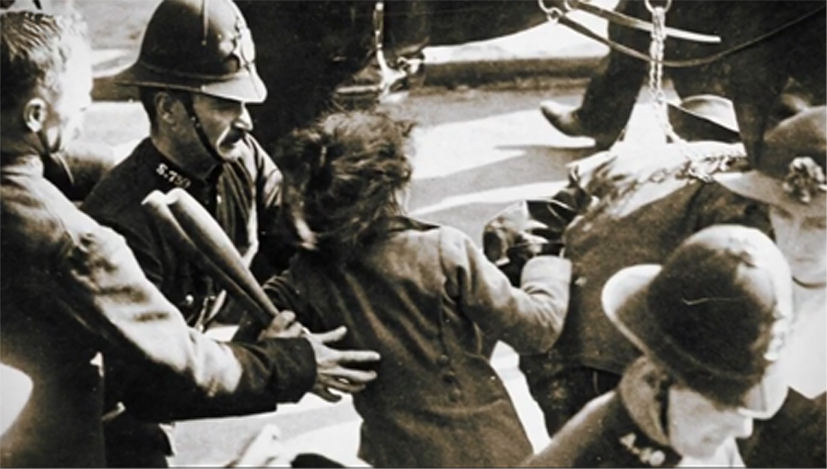
The suffrajitsu segment is narrated by Kirby Howell-Baptiste and stars Tatiana Maslany as Emmeline Pankhurst, who is introduced leading the ill-fated “raid on Parliament” on November 10, 1910. This raid was the fourteenth attempt by the Women’s Social and Political Union to present a petition to Parliament and developed into a near riot in which many protestors complained of police brutality; the event later became known as “Black Friday”.

The Drunk History episode exerts some dramatic licence in stating that Mrs. Pankhurst’s sister was killed during the protest.  In reality, she died about a month later (possibly as the result of an accident while she was being force-fed in prison).

Actress Maria Blasucci plays martial arts instructor Edith Garrud and several scenes are set in her opulent dojo, where she is shown training the new suffragette Bodyguard team in the womanly art of jiujitsu. Gert Harding, played by Kat Dennings, is portrayed as Mrs. Garrud’s star pupil; in reality, Harding did study martial arts with Garrud and also led the Bodyguard team.

The show also offers fairly accurate representations of two key WSPU rallies in which the Bodyguard clashed with the police. The Campden Hill (Camden) rally, which was also portrayed in the Drunk History UK episode on the same theme as well as the 2015 feature film Suffragette, shows how the Bodyguard tricked the police into arresting a body double while the real Mrs. Pankhurst made her escape.

The second re-enactment is of the famous “Battle of Glasgow”, when the Bodyguard openly confronted and fought with the police on the stage of St. Andrew’s Hall, in front of some 4500 shocked witnesses. Although the show implies that this event turned the tide of the radical suffrage movement and led directly to the enfranchisement of women, the real history is (of course) vastly more complicated.

In reality, the First World War broke out shortly after the Glasgow brawl, at which point Mrs. Pankhurst suspended all militant suffrage activities and supported the government throughout the crisis, especially by organising and encouraging women to “do men’s work” while their husbands, sons and brothers were fighting overseas. It’s generally conceded that the suspension of WSPU militancy, in combination with the work done by women during wartime, tipped the balance in favour of “votes for women” as the conflict drew to a close.

The “Civil Rights” episode of Drunk History also includes interesting segments on the Birmingham Children’s March and the disability rights activists who organized America’s longest sit-in of a federal building. Note that the dialogue does include some swearing and mildly raunchy slang and so may not be safe for work.

If you enjoy Drunk History’s take on the suffragette Bodyguard story, keep an eye out for the upcoming full-length documentary No Man Shall Protect Us, which will cover the same subject in much greater depth, albeit with much less drunken hilarity, and check out the graphic novel Suffrajitsu: Mrs. Pankhurst’s Amazons, written by Bartitsu instructor Tony Wolf.

Posted in Documentary, Humour, Suffrajitsu, Video | Comments Off on “Drunk History” (US) Tells the Story of the Suffragette Bodyguards

“Seize Him by the Throat”

  • Originally published on the Bartitsu.org site on Tuesday, 27th February 2018

Although we don’t have a full catalogue of the atemi (striking and nerve pressure techniques) practiced at the Bartitsu Club circa 1901, analysis of the writings of E.W. Barton-Wright and his associates reveals a preponderance of attacks targetting the opponent’s face and throat.  The trachea (or “tonsil”) appears as a pressure target in three of the fifteen atemi methods represented in Barton-Wright’s “New Art of Self-Defence” articles (1899).  Journalists and other observers frequently (and somewhat alarmedly) referred to these methods of unarmed Bartitsu as “fiendish science” and “foul play”.

While throat attacks were, indeed, counted as fouls in European wrestling styles, Japanese jiujitsu was concerned with practical self-defence rather than manly sport.  As Barton-Wright himself had pragmatically noted,”no method was too severe” to be applied in defence of one’s own life.

With your left hand firmly grasp his right wrist. Then seize his throat with your right hand, forcing your thumb into his tonsil. This will cause intense pain, and he will bend his head and body backwards in order to avoid it. In this position he is standing off his balance and you take this opportunity of placing your right foot behind his right knee, and then proceeding to throw him as before.

In this video, nightclub bouncer and bodyguard Scott Pilkington demonstrates the direct stopping power of a trachea hold:

Posted in Canonical Bartitsu, Instruction, Jiujitsu, Video | Comments Off on “Seize Him by the Throat”

“Self Defence for Ladies and Gentlemen” Seminar in Bavaria, Germany

  • Originally published on the Bartitsu.org site on Saturday, 3rd March 2018
Foto Alex Kiermayer

Bartitsu instructor Alex Kiermayer (above) and pugilist Christoph Reinberger are teaming up for a seminar in Victorian and Edwardian antagonistics. The two-day event will cover fisticuffs, jiujitsu, Bartitsu stick fighting and more and will take place between June 30 – July 1 2018 in the Bavarian municipality of Garching an der Alz. For all details (in the German language) please visit this site.

Posted in Antagonistics, Boxing, Canonical Bartitsu, Instruction, Jiujitsu, Vigny stick fighting | Comments Off on “Self Defence for Ladies and Gentlemen” Seminar in Bavaria, Germany

Shooting Fight Scenes for “No Man Shall Protect Us”, the Suffrajitsu Documentary

  • Originally published on the Bartitsu.org site on Monday, 5th March 2018
A London “bobby” (stuntman Cody Evans, left) takes on a member of the WSPU Bodyguard Society (stuntwoman Gabrielle Perrea, right).

The past week of production on No Man Shall Protect Us: The Hidden History of the Suffragette Bodyguards has included black-screen studio action scenes performed by a very talented pair of stuntpeople.  Rather than shooting long, elaborate fights, the aim was to create about twenty short, diverse sequences that will be edited together to illustrate key moments of the suffragette Bodyguards’ story.

Both the Bodyguards and the London police were streetwise, experienced tusslers, but – jiujutsu lessons notwithstanding – few of them were experts in a formal fighting style.  Therefore, the challenge was to keep the action within the bounds of plausibility, while still ensuring that each “fight” told its own story.  That meant that the fights had to look scrappy and relatively realistic, with the Bodyguard and the constable occasionally staggering off-balance in the heat of the action or succeeding as much through luck as through skill.

Likewise, unusually for fight scenes, the characters were not necessarily trying to hurt each other.  The suffragette’s objective was more often simply to get past or escape from the constable, whereas the constable was attempting to block or arrest the suffragette.

When clubs and truncheons were drawn, though, most bets were off …

The production has now also filmed a number of prop inserts, including demonstrations of the circa 1909 boardgame Suffragetto, to help illustrate the complex tactics of suffragette vs. police street skirmishes.

No Man Shall Protect Us is now entering the final stages of production. Once the documentary is edited, it will be made freely available as an educational resource via Vimeo.

Posted in Suffrajitsu | Comments Off on Shooting Fight Scenes for “No Man Shall Protect Us”, the Suffrajitsu Documentary

Bartitsu/Vigny Stick Sparring

  • Originally published on the Bartitsu.org site on Sunday, 11th March 2018

Andres Morales of Chile (in the white-trimmed fencing mask) demonstrates the quick, deceptive Vigny canne style, as incorporated into Bartitsu circa 1900. 

As described by a journalist from The Sporting Life newspaper in July of 1899:

(Vigny) first proceeded to demonstrate the use of the stick by showing the different attacks and guards, displaying wonderful wrist work, in which great strengths and suppleness were combined. He grasps a stout Malacca cane about six inches from the end, and does all the movements with the wrist only, and not with the fingers. He passes his stick from right hand to left and vice versa without the slightest trouble, using right-hand and left-hand alternately with equal dexterity.

Posted in Sparring, Video, Vigny stick fighting | Comments Off on Bartitsu/Vigny Stick Sparring

The Bamboo Pole Trick

  • Originally published on the Bartitsu.org site on Monday, 12th March 2018

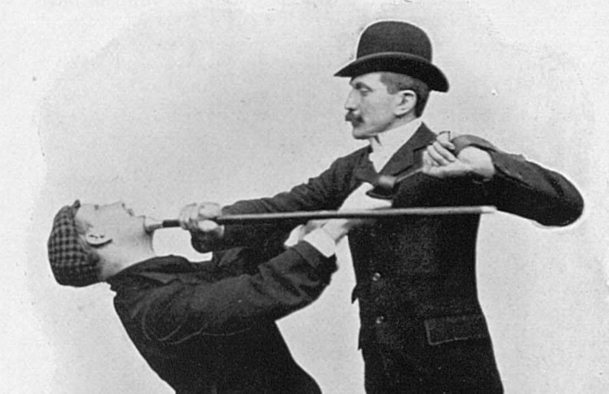
This photo published in the Italian journal La Stampa Sportiva (November, 1903) shows former Bartitsu Club instructor Sadakazu Uyenishi wheeling out an old favourite.  The “bamboo pole trick” had been a feature of some of the earliest exhibitions of jiujitsu in London, and a prone variation on the same principle was even mentioned in the memoir of Dutch anthropologist Herman ten Kate, who had trained in the same Shinden Fudo Ryu dojo in Kobe as had Bartitsu founder E.W. Barton-Wright.

Above; Yukio Tani pulls off the “bamboo pole trick” at a Bartitsu Club event during March of 1899.

As a test/demonstration, the “bamboo pole trick” legitimately does show off the performer’s ability to withstand pain and discomfort and to manage the direction of pressure against their throat.  Subtle shifts of position change the angle of pressure from “straight into the trachea” to “downward against the collar-bones”, which, though still uncomfortable and somewhat risky, is a less actively dangerous than trying to resist a pole shoved directly into the sensitive throat area.

That said, it’s really more of a carnival sideshow stunt than an exhibition of martial arts skill, and that point was not lost on some early observers of the trick in London.  According to a report published in the Sporting Times of October 20, 1900:

Then the talking began, for a gentleman of ripe years, alluded to affectionately by most of the audience as “Charley,” was not quite satisfied with the pushing experiment of arm against throat, and had something to say as to leverage and the Georgia Magnet. Whether he wanted make a match between the little American lady and the big Jap, we in the stalls could not quite catch; but when the discussion was at its height, Mr. Barton Wright appeared from behind the scenes with a message from the big Jap*. He (the big Jap) would stand against the wall, and let the doubting gentleman push with the pole as hard as be could against his throat, if afterwards the doubler would wrestle a fall with him.

It’s a little ironic that “Charley” should have cited the Georgia Magnet in his objection to the bamboo pole trick, given that E.W. Barton-Wright himself had published an expose of Georgia Magnet-style leverage tricks presented as feats of “supernatural” strength.

  • The big man cited here was probably Seizo Yamamoto, who was among the original party of three jiujitsuka imported by Barton-Wright to exhibit and teach their art to curious Londoners.  Yamamoto, along with Yukio Tani’s older brother Kaneo, only remained in London for a few months before returning to Japan.
Posted in Exhibitions, Jiujitsu | Comments Off on The Bamboo Pole Trick

Antagnonistics V in NYC

  • Originally published on the Bartitsu.org site on Sunday, 18th March 2018
[banner]

Antagonistics V – Tactical Principles of Victorian Self-Defense

with Professor Mark P. Donnelly

Saturday, April 21, 2018,  1:00 p.m. – 6:00 p.m.

440 Lafayette Street, Room 3D

New York, NY 10003

Mark P. Donnelly (Professor of Arms), an internationally-recognized expert on historical combat, will teach this five-hour “gentlemanly antagonistics” workshop.

– Explore the tactical principles of Bartitsu, and how they are still relevant today.

– Learn to use a walking stick, parasol, and other Victorian accessories to maintain “preservation of person and property when beset upon by ne’er-do-wells of nefarious intent.”

– For the first time ever, we’ll be exploring the history and use of the swordstick or sword-cane as commonly carried in Victorian and Edwardian Europe.

This workshop is a rare opportunity to study martial arts, combative theory, and obscure history in a safe, controlled, welcoming and civilized atmosphere with some of the top practitioners in the world. Open to gentlemen and ladies over 18. All experience levels welcome and all equipment provided.

Visit www.nycsteampunk.com to register. Places are limited.

Posted in Antagonistics, Canonical Bartitsu, Instruction | Comments Off on Antagnonistics V in NYC

“The Art of Self Defence” (1909)

  • Originally published on the Bartitsu.org site on Sunday, 18th March 2018

The following article by N. Tegan Lewis was originally published in the Women’s Freedom League newspaper of April 22, 1909, following the jiujitsu self-defence displays by Edith Garrud at London’s Caxton Hall (shown above).

We’ve offered a few contextual annotations, which are shown in italics.

A novel feature of the Green, White and Gold Fair, at Caxton Hall, was the jiu-jitsu displays given by women. Apart from the fact that it is splendid physical exercise, jiu-jitsu is the most suitable form of self-defence for women, success depending on the dexterous use of the opponent’s strength. The science has three branches: the throws, which require much practice; the art of self-defence exclusively, by which all attacks by violence may be resisted; and the art, when the opponent has been thrown, of wrestling on the ground and rendering him unconscious by neck locks and other means. Happily, measures so stringent as those taught in this third branch are not often necessary, but in an encounter with a desperate burglar or an escaped lunatic the knowledge would be decidedly useful.

Emily Watts, another pioneering jiujitsu instructor of this era, largely dismissed ne-waza (mat grappling) in her 1906 manual The Fine Art of Jujutsu, on grounds of sensibility rather than practicality.

In the course of the last quarter of a century women in this country have developed physically, as mentally, in an amazing way while men have been—well, let us say—at a standstill. The modern healthy girl, backed by a knowledge of some scientific art of defence, could render a very good account of herself when necessary and men “Anti’s” who are so fond of the physical force “argument” would do well to take heed in time lest the day come, and perhaps it is not far distant, when they will not be allowed to let the matter drop.

“Anti’s” refers to those who were against the movement towards women’s suffrage.  The fallacious “argument of physical force” essentially stated that women should not be given political power on the grounds that such power ultimately resolves into the ability to exert physical force.

We are all familiar with Mr. Punch’s famous advice to those about to marry, but, though Mr. Punch “were like to die of it,” we have not yet heard Mrs. Punch’s opinion on the matter. May we suggest, with all due deference to Mr. Punch, that her advice to the girl would be “learn jiu-jitsu”?

During the Edwardian period, the Punch and Judy puppet show preserved Mr. Punch’s ferocious violence against virtually all the other characters, including his wife Judy.

Such a precaution would be, let us hope in the majority of cases, merely a matter of form. At the same time it is idle to ignore the fact that there are men, in all classes of society, who habitually ill-treat their wives. At present the usual advice given to the ill-used wife, when circumstances render it practically impossible for her to leave her husband, is “do not lower yourself by retaliation, at all costs uphold your womanly dignity.” Setting aside the utter impossibility of being dignified under such circumstances this advice is, theoretically, perfectly sound. Practically jiu-jitsu is likely to prove far more effective for it is universally acknowledged that your bully is usually a coward.

The theme of jiujitsu as self-defence against an abusive husband provided the basis of the polemic playlet What Every Woman Ought to Know (1911), which included a spectacular fight scene staged by Edith Garrud.

It has long been the custom to consider women more timid than men, but one has only to scan the newspapers day by day to realize that in cases of great emergency—such as the Messina earthquake—women are every whit as brave as men; and hardly a week goes by but some woman goes to the assistance of the police in a street brawl while a crowd of men—citizens stand idly by, indifferent or amused, oblivious of any responsibility. Moreover, in the days when entrance to the army was an easy affair, many women fought side by side with the men and many instances are on record of women taking part in sea fights. There was Hannah Snell, who enlisted as a marine and saw active service, and Mary Ann Talbot, otherwise John Taylor, who was wounded in the action of the Glorious First of June, both of whom received pensions from a grateful Government. Anne Bonney and Mary Read, after serving in the Navy, turned pirates—to their own profit, doubtless, if not to that of the State.

Public opinion has hitherto been the greatest enemy to the physical development of women; the pioneer women cyclists were covered with scorn, the girls who first declared their preference for hockey over croquet were looked at askance as hoydens. Happily the world soon gets accustomed to new ideas, and to-day the girl who cycles and the girl who plays hockey are taken very much as a matter of course—just as will be the girl of to-morrow who practises jiu-jitsu. In a few years time let us hope that the woman who is not versed in the art of self-defence will be regarded, and rightly regarded, as an anomaly.

Edith Garrud’s demonstrations did, in fact, spark a wide interest in women’s jiujitsu, including a fad for “jiujitsu parties”.  Mrs. Garrud also established an exclusive “Suffragettes Self-Defence Club” and, several years thereafter, became the jiujitsu instructor for the secret Bodyguard Society of the Women’s Social and Political Union.

Posted in Jiujitsu, Suffrajitsu | Comments Off on “The Art of Self Defence” (1909)

“Stick Fighting in Trinidad” (Diss Express – 14 March, 1919)

  • Originally published on the Bartitsu.org site on Sunday, 18th March 2018
Above: lithograph of Dominican stick fighting painted by Agostino Brunias; engraved print published London (1779).

The following short article is notable for its reference to the Trinidadian stick fighting style of “playing bois”, which is closely cognate to the Grenadian bois stick style that was amalgamated with Pierre Vigny’s art of self defence with a walking stick by H.G. Lang during the early 1920s.  Although Grenadian bois seems to have evolved into a ceremonial dance, similar stick fighting sports can still be found throughout the Caribbean island chain.

Single combat in various forms survives all over the world, and different peoples have different methods of showing their prowess. In the island of Trinidad, for instance, the natives, who speak mixture of French patois and English, call their method “playing bois” (literally stick-fighting).

The stick used is about a yard long and usually made from the “puie” tree, a very hard wood. This is held at each end diagonally in front of the body, and the blow’s are struck releasing one hand and striking with either the left or the right. the carnival season bands from the various districts are made and contests take place whenever two bands meet.

The stick-men are extraordinarily clever at parrying blows, and an expert will stop a cricket ball thrown at him.

Posted in Antagonistics | Comments Off on “Stick Fighting in Trinidad” (Diss Express – 14 March, 1919)

“A Ju-jitsu Festival in Kyoto, Japan” (1909)

  • Originally published on the Bartitsu.org site on Tuesday, 27th March 2018

Sketch artist Tom Brown recorded his impressions of a “ju-jitsu festival” taking place in Kyoto for the Illustrated Sporting and Dramatic News of November 13, 1909.  He noted that he admired the wrestling itself and also the  formal courtesies offered by the competitors before and after each contest, which were “almost as elaborate as a fencing match”.

Posted in Edwardiana, Jiujitsu | Comments Off on “A Ju-jitsu Festival in Kyoto, Japan” (1909)