Originally published on the Bartitsu.org site on Sunday, 12th November 2017
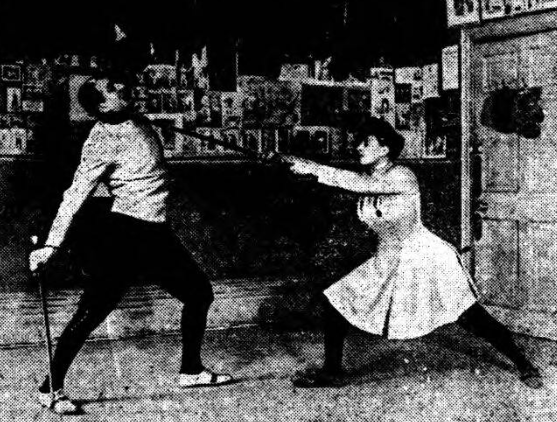
This newly-discovered image of Marguerite and Pierre Vigny shows the former demonstrating a double-handed thrust to the throat. Note that Pierre Vigny, left, is holding what appears to be a typical Vigny-style self-defence cane of his own design.
The original caption from the Weekly Irish Times of January 18, 1908 reads:
THE CHAMPION LADY FENCER – Miss Saunders*, the champion lady fencer, has issued a challenge to fence with any lady for £200 a side. In our photograph Miss Saunders, assisted by Mons. Vigny, is giving a demonstration of her system of walking-stick fencing, illustrating how people can protect themselves with a stick if they know how to fence.
* Note that Marguerite Vigny went by the professional name “Miss Sanderson”; “Miss Saunders” appears to have been a misspelling.
Referred to as the “bayonet” thrust by Bartitsu founder E.W. Barton-Wright, this attack seems to have been a favourite of Marguerite Vigny’s, as shown below:
Originally published on the Bartitsu.org site on Sunday, 19th November 2017
Bartitsu has received an unusual shout-out in the new biography Toupie Lowther: Her Life, by English author Val Brown.
Born to a wealthy, aristocratic family in 1874, May Lowther – known almost universally as “Toupie” – grew into a multi-talented woman of means, adept at opera singing, motoring and (especially) both tennis and fencing. In the latter capacity she once playfully challenged Bartitsu Club fencing instructor Captain Alfred Hutton to a match after Hutton had made a polite but, to her ear, condescending remark about female fencers.
Toupie’s other athletic enthusiasms included weightlifting, jiujitsu and possibly boxing, and Val Brown speculates that she may also have studied Bartitsu, given that the Bartitsu Club admitted female students. Although history isn’t clear on that point, Brown does note Toupie’s portrayal as a Bartitsu practitioner in the Suffrajitsu graphic novel trilogy, in which she serves as Emmeline Pankhurst’s chauffeuse and getaway driver and as the second-in-command of the clandestine “Amazons” bodyguard team. She is also featured as a significant supporting character in the spin-off novella The Isle of Dogs and as the protagonist of the short story The Pale Blue Ribbon.
In real life, Toupie Lowther was decorated for her service in France during the First World War, which included organising and operating an ambulance team under extremely dangerous conditions.
Post-War, Toupie was also a friend of writer Radclyffe Hall and her partner, sculptor Una Troubridge, until after the publication of Hall’s controversial novel The Well of Loneliness in 1928. Toupie believed that the novel’s female protagonist, the cross-dressing former WW1 ambulance driver Stephen Gordon, was based to a large extent on herself, and this seems to have caused a rift in the friendship.
An interesting woman who led a highly unusual life for her time, Toupie Lowther well deserves the wider recognition that this very readable book will undoubtedly bring her.
Toupie Lowther: Her Life is available in paperback from Amazon US and Amazon UK.
Originally published on the Bartitsu.org site on Sunday, 19th November 2017
This little-known initiative was widely publicised during December of 1914 and January of 1915:
A new corps has just been formed with the unusual title of the “Ju-Jitsu Corps.” It is directly connected with the approved regulations of the Central Association Volunteer Training Corps, and will teach the art of self-defence without weapons. All can join except those exempted from war service. A distinctive uniform, with badge, will worn, and lessons will be given by Sabri-Mahir, late Ju-Jitsu champion and instructor to the Paris police. No charges will be made, and there will be no interference with members’ daily occupation. Perfect freedom of action is allowed as regards voluntary active’ service at the front. No pay will granted, and no entrance fee or subscription is required, unless given voluntarily. The corps has been formed primarily for defence of home and country, and active members must pass the doctor. The new venture has the approval War Office, Admiralty, and Scotland Yard, and its headquarters will be at the Royal Courts of Justice, London. All inquiries should be addressed to the secretary, 509, Salisbury House, London Wall, E.C.
Sabri Mahir was, in fact, a Turkish painter and middleweight boxer who was then resident in England, but I’ve found nothing in any English nor French media supporting the claim that he was a jujitsu champion who had trained the Parisian police.
The formation of the new Corps, with its emphasis on learning “self-defence without weapons”, prompted an anonymous columnist for The Sphere to recall when:
(…) once I met a very famous Japanese exponent of ju-jitsu in the early days of the cult of this remarkable art; a giant for strength and a tiger for nimbleness. He showed me a dagger hidden in his clothes. On my asking him why he carried it, he replied that he did not consider London a safe place to be unarmed in.
It may be noteworthy that former Bartitsu Club president William Grenfell, the 1st Baron Desborough was also the president of the Volunteer Training Corps, to which the proposed Jujitsu Corps was to be affiliated. For all of this, however, there seem to be no newspaper records of any activity by the Jujitsu Corps, so it’s possible that the idea died upon the vine.
N.B. that the Scottish jujitsu instructor W. Bruce Sutherland actually did teach unarmed combat to trainee soldiers during the Great War, and that his contemporary William Garrud performed demonstrations of the art for volunteers of the London Special Constabulary.
Posted inEdwardiana, Jiujitsu|Comments Off on “Ju-Jitsu Corps”: A Novel Venture Which Has The Official Sanction (1914)
Originally published on the Bartitsu.org site on Saturday, 25th November 2017
In this experimental sparring match, Chilean Andres Morales (in the fencing mask with the white trim) employs the Vigny cane style opposed to the doble bastón (double stick) sub-system of Filipino stick fighting.
Note Andres’ expert use of measure (fighting distance) maximising his reach advantage, both offensively and via the Guard by Distance tactic:
It is always most desirable to try to entice your adversary to deliver a certain blow, and so place yourself at a great advantage by being prepared to guard it, and to deliver your counter-blow. – E.W. Barton-Wright
… combined with tactical use of ambidextrous attacks from the front, double-handed and rear guards to keep the opponent guessing:
(…) the rapid transference of the walking-stick from one hand to the other was one of the most powerful factors in offence and defence, and one likely to prove most puzzling to the opponent. – Guy’s Hospital Gazette, March 31 1900
Originally published on the Bartitsu.org site on Sunday, 26th November 2017
This article from the Bristol Mercury of May 14, 1900 is typical of many hundreds of newspaper reports illustrating the deadly potential of umbrella thrusts, whether delivered accidentally or deliberately.
In days gone by everyone carried a sword; now everyone carries an umbrella, which recent experience shows to to be almost as dangerous an instrument. During recent years its construction has been so altered that the harmless gamp, with which, at the worst, one could but thrash a man, has been turned into a rapier-like instrument, with which it is by no means difficult to run him through, and thus in moments of excitement people find themselves in in the possession of a “skewer,” the potentialities of which of they are hardly aware of.
With the object, no doubt, of giving a slim and dandified appearance, many umbrellas are now made with steel “stick,” and so fine are some of these that the point is very little thicker than the blade of a foil, and is capable of doing quite as much injury if lunged into an antagonist, and this even without the employment of much force, if the proper spot should happen to be entered.
Last Saturday a charge of manslaughter was tried at the Central Criminal Court which shows well what may be done with a steel umbrella. As the sequel of a very ordinary quarrel in a public house, the deceased followed the accused into a room and went up to him, when, as was alleged, the latter thrust an umbrella towards his face. The point entered his cheek, he became unconscious, was taken home in a cab, and died four days afterwards.
At the poet-mortem examination, four and a half inches of the umbrella stick, which was of iron, were found embedded in his skull, one inch of its length having entered his brain. This piece of iron was stated to have become so firmly fixed that the medical men who performed the post-mortem examination had to use a chisel to remove it.
The prisoner was acquitted, the jury apparently accepting the statement made by him to the effect that the deceased rushed upon the point of the umbrella, and that the fatal result was accidental. This, however, all the more emphasises what we say about the dangerous character of the modern umbrella with its rapier-like point. If, in an ordinary fray, without malice or premeditation, it is possible to bury an umbrella point upwards of four inches deep in a man’s head, it is obvious enough that, in the hands of those who are skilled in fence, steel umbrellas must be almost as dangerous as the swords which our great-grandfathers used to whip out on the smallest provocation, much to each other’s detriment.
Posted inEdwardiana|Comments Off on “The Umbrella: A Dangerous Weapon” (1900)
Originally published on the Bartitsu.org site on Sunday, 17th December 2017
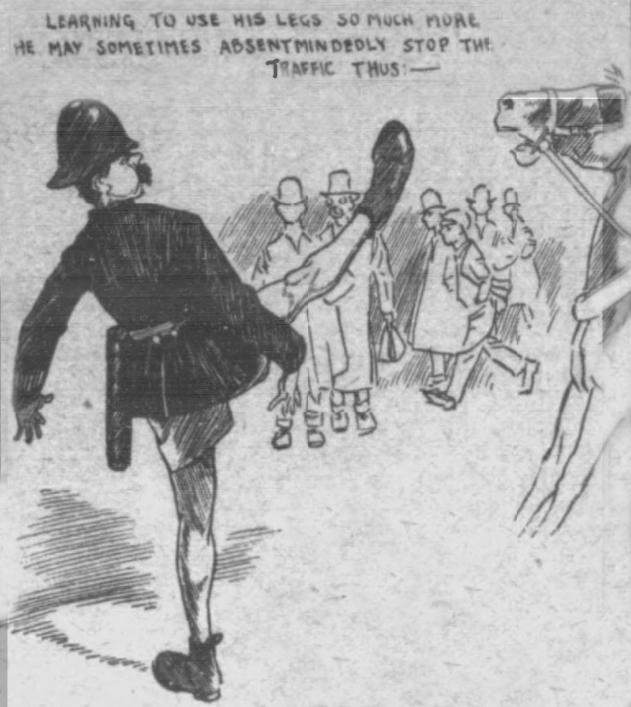
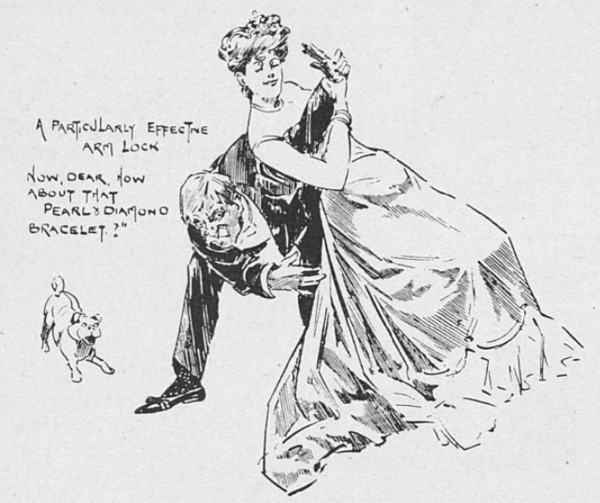
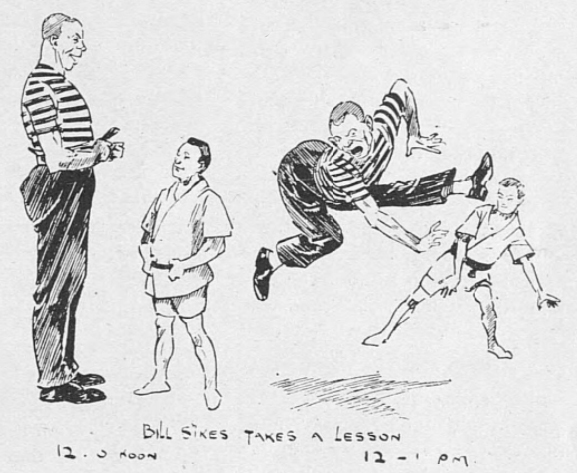
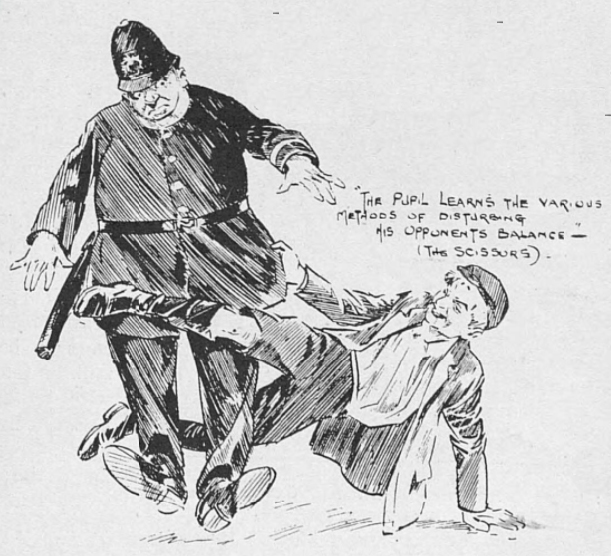
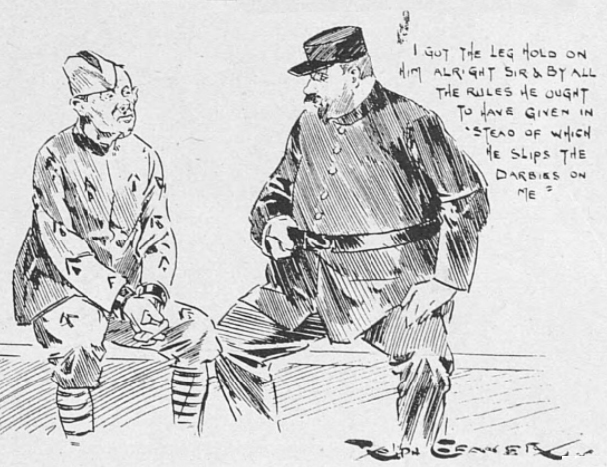
Cartoonist Ralph Cleaver imagines the ways in which jiujitsu might transform the policeman’s lot, and that of wider Edwardian society, in this series of cartoons for The Sketch.
Posted inEdwardiana, Humour, Jiujitsu|Comments Off on “Ju-Jitsu For The Police: Its Possibilities”
Originally published on the Bartitsu.org site on Sunday, 17th December 2017
This interview from the Midland Daily Telegraph of August 1, 1907 offers some further details on the life and career of Taro Miyake. A prominent member of the “second generation” of Japanese jiujitsu champions to travel to England, Miyake enjoyed great success as a challenge wrestler.
Miyake also partnered with former Bartitsu Club instructor Yukio Tani in opening London’s Japanese School of Jujitsu and, in 1906, in co-producing “The Game of Jujitsu”. This book was an unusually advanced and detailed training manual for its time, especially notable for its instruction in ne-waza (mat grappling) techniques, which were a particular specialty of Miyake’s instructors, Mataemon Tanabe and Yataro Handa. The Tanabe/Handa lineage was also a significant influence on the jiujitsu aspect of Bartitsu, as both Yukio Tani and Sadakazu Uyenishi were likewise highly trained in that specialty.
Miyake later travelled throughout Europe, again competing successfully in numerous wrestling challenge contests, before settling in Seattle, USA where he ran a jiujitsu dojo. Later in life he became interested in professional wrestling and attempted to introduce it to Japan, without great success. Miyake died in New York City in 1935.
Noting for the sake of clarity and interest that:
Taro Miyake’s name was frequently rendered as “Tarro Miyake”, “Tarro Myake” and similar variants by Edwardian journalists.
The term “Jap” carried no pejorative meaning at this time, being in the nature of a simple abbreviation like “Brit” for “British”.
This is the first reference that we have come across to W.H. Collingridge serving as Miyake’s translator. Collingridge had been a student at the Japanese School of Ju-Jitsu and later wrote a manual of his own, titled “Simple Tricks of Self-Defence”.
It is no exaggeration to say that the most-talked-of man in Coventry to-day is Tarro Miyake, champion ju-jitsu wrestler of Japan—and of the world for that matter. His exhibitions at the Hippodrome have aroused a degree of interest in the city that has seldom been equalled. Miyake ‘s fearless challenges to all comers have met with a ready response in Coventry; but the challengers, it must not be forgotten, have all received an equally ready defeat.
A “Midland Daily Telegraph” reporter had a chat with Miyake on Wednesday night before he went on to the stage to give his second performance of the evening. He was accompanied by his manager, Mr. W. H. Collingridge, and as he does not converse fluently in English — although he understands it perfectly — the conversation was carried on chiefly by the aid of Mr. Collingridge, who acted as interpreter.
Miyake, like many another champion, bears his honours lightly; and it was only after a little persuasion that he could be got to talk of his many victories. Bit by bit, however, he gave the reporter an outline of the story of hie life. It is simply a record of success. In brief, it is as follows.
He was born at Osaka about 25 years ago, and after leaving school first began to take an interest in jujitsu at the age of 18. He attended the school of Tanuba and Hauda (sic – Tanabeand Handa)- two well-known Japanese teachers—and soon he became exceedingly proficient in wrestling. He visited various small tournaments with signal success, and then tried his luck at the large ju-jitsu competition at Kioto (sic – Kyoto). Here be quickly proved his wonderful skill and succeeded in defeating 24 men in succession. Tarro accomplished this feat in the presence of Prince Komats (sic – Komatsu) and other Japanese grandees.
But his great triumph still lay before him. He celebrated it—appropriately enough—at Osaka. At the great tournament there in 1904, Miyake defeated five of the best wrestlers in Japan, and won for himself the championship of wrestling in the jujitsu style of that or any other country. For this success he received a gold medal, presented to him by the Crown Prince of Japan.
On another occasion Tarro received as the reward of his remarkable prowess a sword of honour from Prince Komatsu, President of the Buto Kukai. It was not till two and a half years ago that he came to England. Here he found another expert in ju-jitsu already installed in the person of Yukio Tani. Miyake at once challenged Yukio, and the match took place at the Tivoli Music Halt in London. The result was that Yukio met his Waterloo in seven minutes, and Tarro held his title of champion stronger than ever. In passing, it might be mentioned that one result of the encounter between Yukio and Tarro was that they became fast friends quickly after, and are now at the present moment conducting school together for the teaching of ju-jitsu at 305, Oxford Street, London, where over 350 pupils attend regularly and are taught this simple yet all powerful art of self-defence.
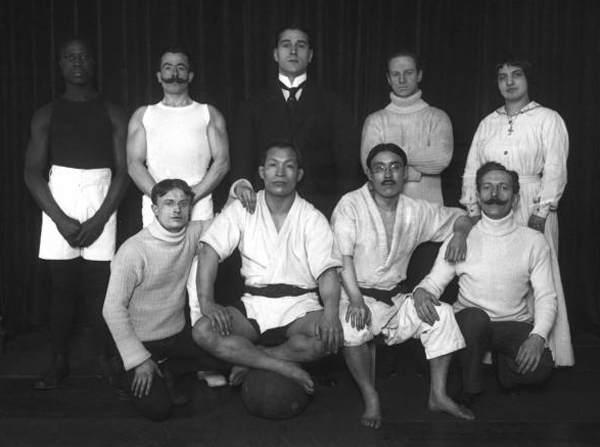
Above: Taro Miyake (seated, second from left) with some colleagues in Paris.
To describe Tarro Miyake is not a difficult task. He is taller than most of his countrymen, standing 5ft. 8in.—the avenge height of an Englishman, in fact. He is built in proportion and weighs eleven stones and a half. Altogether Tarro Miyake, when dressed in the orthodox English garb, appears very little different from an ordinary Englishman—but whether he will take this remark as a compliment or otherwise the writer is not quite sure.
He is seen at his best on the stage, however. Dressed for wrestling he wears a pair of short white cotton pants and a shirt, through the open neck of which can be seen his sun-browned skin and fine chest. With his curly hair disarranged, his fine figure and happy confident smile, Tarro presents a very pleasant picture when seen “on the boards.”
And he has good reason to have confidence in himself, for he confided last night that on only four occasions has he had to pay out the sovereign which he offers to all who stand more then seven minutes against him.
“Tarro, Yukio and I,” said Mr. Collingridge, “are trying to introduce ju-jitsu into England as a pastime. Its three great objects are moral culture, physical culture, and self-defence. It is a game which can be played equally well by the weak u by the strong.”
Asked if any of his family were wrestlers, Miyake replied in the negative. “How do you like England?” asked the reporter.
“Oh, very much, very much indeed,” replied Tarro with enthusiasm.
“He doesn’t want to go back to Japan any more,” interjected Mr. Collingridge. But though Miyake said nothing, there crept into his eyes a far-away look which told another story.
“And English wrestlers,” queried the reporter, “Do you find them easy to beat?”
“Oh, very,” was Tarro’s still smiling but rather disconcerting reply. ” Very easy,” be repeated and then explained that Englishmen when wrestling relied on their strength, while he simply depended on his skill. And his prowess has always stood him in good stead so far.
But Miyake has not only wrestled and defeated Englishmen. He has continued his success on the Continent. He was at the Athletic Tournament at Paris last year, when he succeeded in defeating all comers, including some of the best European wrestlers, and in each case his man was beaten in less than a minute. Since then Miyake has challenged Hackenschmidt, Munro, Madrali—the world of wrestlers, in fact—but has not yet succeeded in finding anyone to take him up.
A short time ago Miyake had an accident, which necessitated his undergoing a serious operation. While in the Tottenham Hospital a visit was paid to his ward by the Prince of Wales, to whom he was pointed out. His Highness admired Miyake’s fine physique, and shook him cordially by the hand—an honour of which Miyake is quite justifiably proud.
Although Miyake’s temper on the stage is imperturbable, his opponents do not always manage to keep theirs. This was illustrated a little while ago, Mr. Collingridge explained. Miyake was appearing in a northern town, when a huge black fellow, of towering height, accepted his challenge. Miyake defeated the black, but when the latter was allowed to get on his feet he “went for” the Jap, who, however, dodged the blow, and, getting the arm lock on, in his own expressive words, “sent him to sleep,” or in plain language rendered him unconscious.
“Miyake thinks a lot of Coventry,” said Mr. Collingridge. “Is that so?” asked the reporter. “Yes,” replied the Jap, “I think it is a very clean town indeed.”
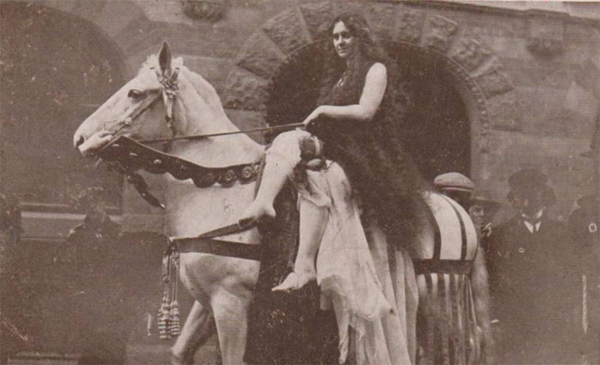
Pansy Montague, a.k.a. “La Milo”, a tableau vivant performer, processes through Coventry as Lady Godiva.
“Wouldn’t you like to stay and see La Milo as Godiva?” persisted the interviewer.
Miyake laughed, “I would like to see the procession” he said, “but can’t possibly stop as I have particular business in London next week.” He explained that he had come to Coventry as a personal favour to Mr. Barry, who is an old friend. During his stay in Coventry he has admired all the beauties of the ancient city, and hopes to renew his acquaintance with them when he returns to fulfill another engagement at the Hippodrome early next year.
The national flag of Japan may be seen flying on the Hippodrome below the Union Jack. This Miyake takes as a great compliment. He has also been very much gratified by the number of people who have stopped him in the street and shaken bands with him. This morning, at the invitation of Mr. Lennox Barry, the manager of the Hippodrome, a private exposition of ju-jitsu was given by Tarro Miyake and Mr. Collingridge, to a large number of the members of the City Police. Several of the officers tried conclusions with the redoubtable Jap, but were quickly glad to cry, “hold ! enough.” He also very carefully described, by ocular demonstration, how the various “locks” were brought about.
At the conclusion of the exhibition Mr. Charsley, the Chief Constable, thanked Mr. Barry on behalf of his men, for inviting them to the exhibition, and Miyake and Mr. Collingridge for having so kindly demonstrated the wonderful capabilities of ju-jitsu. It was, said the Chief Constable, a wonderful science and capable of great possibilities. He thought his men would have to try the locks on each other before they began practicing them on refractory offenders in the street. (“Hear, hear,” and laughter).
There was again a crowded house at the Hippodrome last night, when Jack Madden, a focal wrestler, took up the challenge of Tarro Miyake, the Japanese wrestler. Madden succeeded in holding the Jap at bay for 7mins. 45secs. and was awarded a sovereign for his splendid effort.
Posted inBiography, Interviews, Jiujitsu|Comments Off on “Miyake, the Champion of Japan: an Interesting Interview” (1907)
Originally published on the Bartitsu.org site on Wednesday, 20th December 2017
Publisher and philanthropist C. Arthur Pearson
This holiday-season article offers a departure from our usual focus on Edwardian-era martial arts and combat sports to briefly illuminate a much kinder and, therefore, more important endeavour from the same period; namely, the work of the Poor Children’s Yuletide Association.
That said, the PCYA was the brainchild of Sir C. Arthur Pearson, who is best-known to Bartitsu aficionados as the publisher of Pearson’s Magazine, without which the present-day revival of E.W. Barton-Wright’s New Art of Self Defence would probably have been impossible. Before his magazine featured Barton-Wright’s articles on “strongman” feats, jiujitsu and Vigny stick fighting, Pearson himself had accepted Barton-Wright’s offer of a personal demonstration, and then found himself flying head-over-heels via one of the first tomoe-nage (stomach throws) ever applied in England.
C. Arthur Pearson was a wealthy and influential man in Edwardian London society, with a particular philanthropic interest in the welfare of children. At that time, London’s slums were little better than when they had been described by Charles Dickens; impoverished families lived as well as they could manage, which is to say, not well. As one of Pearson’s contemporaries noted, “There are only two ‘classes’ in London – those who have too much, and those who have too little”.
In 1892, Pearson had established the Fresh Air Fund, a charitable organisation that enabled disadvantaged city children to take summer outings and holidays in the country. Thirteen years later, he observed that, while charities existed to provide for children in orphanages and hospitals during the winter holiday season, many thousands of “waifs” living in London tenements had never seen a Christmas tree, nor received a gift marking the season of goodwill. Therefore, in 1905 he set up the Poor Children’s Yuletide Association, a new and strictly non-denominational initiative that organised the distribution of Christmas treats to the children of the city’s poorest districts.
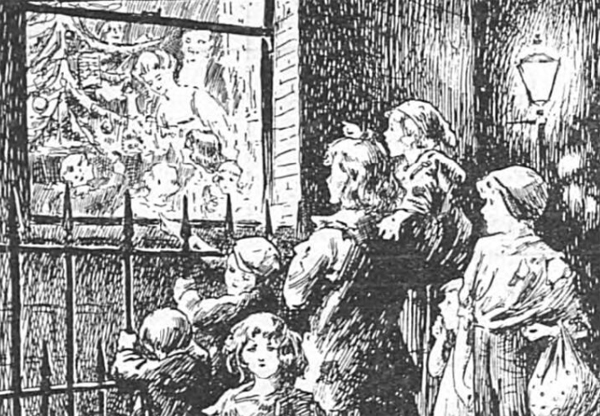
Above: not so much plucking at the heart-strings as giving them a seasonal yank, this image was widely used in advertisements promoting the good work of the PCYA.
The scheme was as ingenious as it was generous. Through emotive advertising in Pearson’s various newspapers and magazines, individuals, companies and “working groups” (including children from wealthier families) were encouraged to donate toys, scrapbooks, sweetmeats and similar Christmas presents to the PCYA. Monetary donations were also encouraged, with all proceeds going towards purchasing more gifts, as the administrative and other costs of the Association were borne by Pearson and his fellow benefactors. As a thank-you to donors, the Association then organised “Christmas Tree Parties” in venues such as Victoria Hall, featuring entertainment, refreshments and galleries of hundreds of trees laden with decorations and presents.
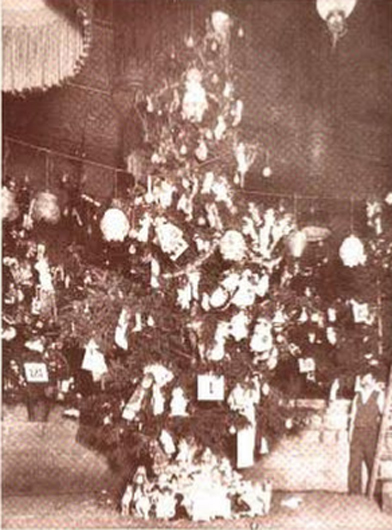
Above: a giant gift-laden tree, courtesy of the PCYA.
On Christmas morning, fleets of vans donated by some of London’s major department stores delivered the trees and presents to those schools and parish halls that the PCYA had identified as serving those most in need. This massive logistical effort resulted in bright and happy Christmas parties for London’s neediest children.
Between 1906-10 the Poor Children’s Yuletide Association organised the distribution of many hundreds of trees and hundreds of thousands of gifts, leading one commentator to aptly describe the Association as “a sort of collective Santa Claus”.
With seasonal greetings to all readers of the Bartitsu Society website, and may you have a happy and prosperous New Year.
Posted inEditorial, Edwardiana|Comments Off on “A Sort of Collective Santa Claus”: Sir C. Arthur Pearson and the Poor Children’s Yuletide Association
Originally published on the Bartitsu.org site on Sunday, 24th December 2017
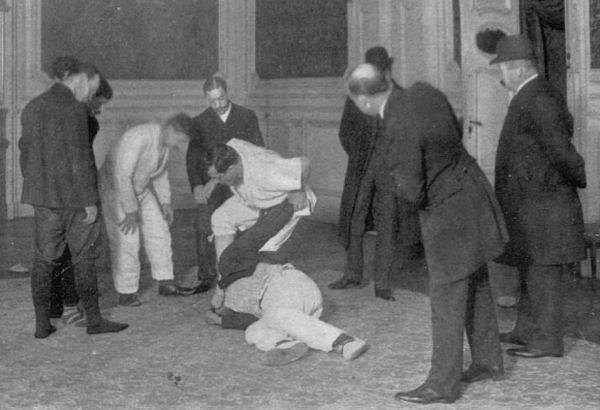
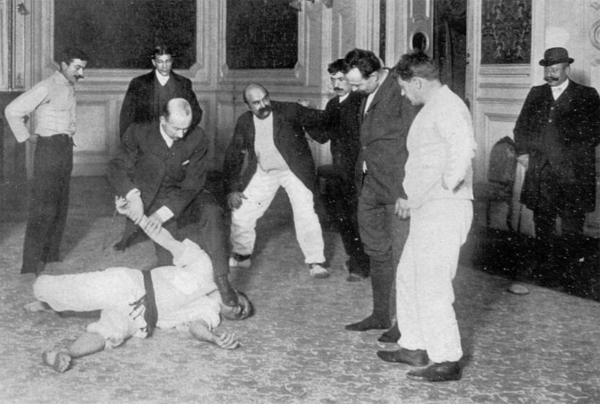
These photos from The Bystander of November 15th, 1905 portray a self-defence class taught by Ernest Regnier, a.k.a. “Re-Nie”, for senior members of the Parisian police force.
Regnier had been a proficient but down-on-his-luck wrestler until he was sponsored by the physical culture entrepreneur Edmond Desbonnet to travel to London and study at the Japanese School of Jujitsu. Upon Regnier’s return to Paris he decisively won a much-hyped contest against savateur Georges Dubois, sparking a brief but intense jiujitsu craze in the French capital. During that period he established a very nicely appointed dojo at Desbonnet’s gymnasium, wrote a text-book titled Les Secrets de Jiu-jitsu and also began instructing the French police, as shown below:
“Re-Nie” demonstrates an extended arm-bar restraint hold. A police Inspector returns the favour.
Regnier over-reached, however, when he began to challenge much stronger and more experienced wrestlers. Thereafter, the French jiujitsu boom continued mostly via books promoting the Bartitsu-like integration of Japanese unarmed combat with French savate, such as Georges Dubois’ Comment se Defendre and Jean Joseph Renaud’s La Defense dans la Rue.
Posted inJiujitsu|Comments Off on “Professor Re-nie” Instructs the Parisian Police (1905)
Originally published on the Bartitsu.org site on Friday, 16th November 2018
Instructor Tommy Joe Moore (in the white shirt and then the black singlet) and a sparring partner engage in the noble art of fisticuffs during the recent BartitsuCon event:
Posted inBoxing, Sparring, Video|Comments Off on Pugilistic Sparring at BartitsuCon 2018