Originally published on the Bartitsu.org site on Thursday, 7th March 2019
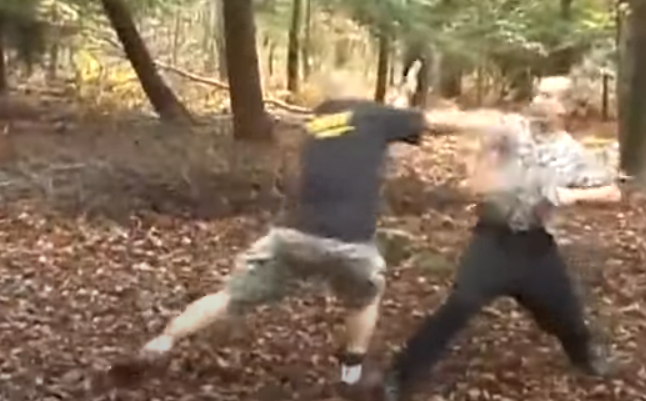
James Marwood demonstrates a restraint technique against fellow instructor George Stokoe during the filming of the BBC Timeshift documentary “Everybody was Kung-fu Fighting: The Rise of the Martial Arts in Great Britain”
Click here to read journalist Jessica Keller’s recent interview with Bartitsu instructor James Marwood for American Express Essentials Magazine:
Q – What are a Bartitsu practitioner’s most trusty weapons or resources?
A – Intelligence, thoughtfulness and politeness. Being a good person, with good manners and an open approach to people will take you a lot further in life than anything else. If that fails, then you have the tools to deal with most problems, but ideally you’ll never need them outside of the training hall.
Posted inInterviews|Comments Off on Bartitsu Instructor James Marwood Interviewed in “American Express Essentials”
Originally published on the Bartitsu.org site on Thursday, 28th February 2019
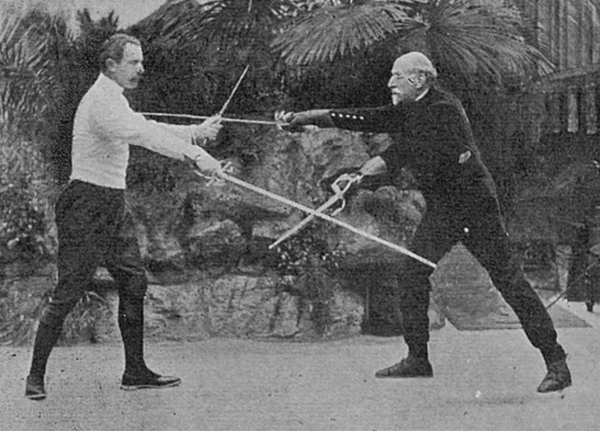
Captain Hutton (right) illustrates the art of rapier and dagger fencing.
A newly-discovered photograph of Captain Alfred Hutton, who is now famed as a pioneer of historical European martial arts reconstruction and of the establishment of competitive fencing as an English sport during the late 19th century. He was also one of the select group of “antagonistics” instructors who taught at the Bartitsu School of Arms.
Hutton was a member of the “committee of gentlemen” responsible for vetting new prospective members of the Bartitsu Club, where he also taught various forms of historical fencing. In addition to teaching his own classes, he studied both the Vigny method of stick fighting and jiujitsu with his fellow instructors.
“… may Mars who watches o’er The half-stripped votaries of the sawdust floor, Protect thee still.”
THE practical uses of boxing for the purposes of self-defence in a street or other row are considerable, but sometimes just a little overrated. Everybody is accustomed to stories, actual or invented, telling of the big bully thrashed by a little boxer. Plenty of big bullies have been thrashed by little boxers: but in the interests of truth rather than of sentiment it is as well to add that where the bully is himself a boxer (and a boxer may be fairly competent without being very courageous) the little man will wish he was a big man. Weight and height and size must of themselves tell.
But then, most fortunately, these valuable qualities sometimes tell against their owner. A hulking ruffian with no knowledge of boxing, or—what is worse — a very little knowledge, will expend his strength in futile swings and wind-mill blows; he will get his feet mixed up; he will fight himself to a standstill. And all the while the other man, little or not as the case may be, will keep himself in reserve; looking on, so to say, an interested spectator. The mighty, blundering arms will pass and repass over his head; but by a little slipping and ducking on the part of a skilled opponent, these stupid blows will never land on any vital part. And then when the giant has worn himself out and stands panting and exhausted, his antagonist—still keeping admirably cool and collected—will carefully and systematically smash him.
That is the best side of street fighting, and it happens fairly often; but it is not always safe to reckon on the ruffian being a merely hulking one: he may be a good hand, for instance, at kicking with hob-nailed boots. And so to be useful in such emergencies the boxer has to alter his methods a little and be prepared for eventualities in no way connected with the Queensberry rules.
Of course you will soon see whether the man who attacks you, or whom, for one reason or another, you feel called upon to attack, is going to fight fairly or not. In the former case all you have to do is to box as well as you can—as though you had entered for a competition with bare knuckles, but with certain modifications. In the latter you must keep a sharp look out and employ certain dodges, some of which will be indicated here, which are outside boxing.
In the first place, your position in any impromptu encounter should be rather different to that employed in ordinary sparring. You should stand more edgeways on towards your opponent, so as to give him as small a target as possible; and your attitude should be more cramped. You need not be afraid of this on the score of being tired the sooner, as such a fight is unlikely to last long. It is extremely important to guard every vital point rigidly. Your left shoulder should be held well up with the chin sunk below it. Your left arm should be more bent than is usual, your right elbow nearer the pit of your stomach, and the fist close to your face. Your feet will be in the same position as they ordinarily are.
It is an ungainly posture, and there will be none of the free and easy movement which is so essential to good boxing. But a fight in grim earnest cannot allow for the elegances of sport. You must protect yourself as best you can and damage your enemy as much as possible in the quickest time. In the case of a hooligan, you must do all in your power to disable him completely. Winning by a fair margin of points is hardly satisfactory in a street rough-and-tumble.
Note that this illustration portrays a right hand punch to the throat, although the following text details an attack to that target with the straight left.
If your opponent stands up and boxes like a man, there is one particular blow you should try and land at once; and that is a straight left at his throat. You can occasionally bring it off when boxing with gloves if your antagonist leans his head back; otherwise the size of the glove mitigates its effect, and the blow lands partly on the top part of his chin and partly on the top of his breast-bone. With the bare fist, however, there is no difficulty about bringing the knuckles into undisturbed contact with the apple of the throat. Such a blow, well delivered, may virtually finish the encounter. The man who receives it gasps for breath, and probably staggers back, laying himself open to another blow given as you please—at the side of his jaw. It is extremely painful, this throat blow, and if you happen to receive it yourself you should cover up with both hands and get away for a moment or two if possible. In order to land it, you should feint with the left at your opponent’s head in order to make him throw it back to avoid the blow. Then step in a little closer and send the left home well under his chin.
Remember always in a street fight a man who has some knowledge of boxing, but does not mean to use it fairly, will try and drive you up to a wall and hit your head back against it, if he can. The consequence of that is obvious; so always try to keep in the open. Do not waste time in hitting your man about the head if he ducks low: it will not hurt him, and you may damage your knuckles. In the same way, unless he has no coat or waistcoat on, be chary of hitting him in the body. Buttons or a watch chain may do considerable damage to your knuckles, especially when repeatedly hit. Of course you must not leave his body alone—particularly if the man is a fat or a flabby one. But make sure that when you do hit him there that the blow is a really hard one, carefully timed. With the hooligan type you should make a point of avoiding his mouth. Dangerous cases of blood-poisoning have resulted from knuckles cut on the teeth of this sort of man. Aim for his jaw, his throat, and his temples in particular.
With the man who fights “all in,” as the saying goes, who will employ any means of hurting you from half a brick to a knee in your stomach, you must be more vigilant. This kind of man will often charge with his head down, trying to butt the wind out of you. The ordinary boxer will naturally regard this as a first-class opportunity for an upper cut. So it is. But you need something much more damaging than that. It is not the slightest good being quixotic on such an occasion. You must stop the man as best you may. The thing to do in this instance is to wait for him, and as he comes in bring your right leg up in a level with the left, and lift your knee with all your power into his face. Your fists should then get a chance of completing the good work in the next second. By the same mark, never lower your own head in case your opponent may remember his knees.
Then there is the ruffian who tries to kick your shins. That is easily stopped if you can keep a cool head, and, as before, wait for him. Lift your foot off the ground six inches or so, and the fellow’s own shin will come into violent contact with the toe of your boot. More dangerous is he who pretends to fight with his fists and suddenly kicks out sideways at your stomach. Of course the most serious injuries may be caused in that way: but if you are quick enough—and the best of boxing is that it makes you alert to perceive this sort of thing as well as the fair manoeuvres of the ring—if you are quick enough then you can step back half a pace, snatch your opponent’s leg as it . rises, and by an upward jerk throw him down.
In any sort of street fight, however, do not be led into wrestling unless you are an expert at it; and keep to long range hitting, waiting your chance for a punishing blow. Little blows are of no use. It is far better to hit seldom and with all your might.
With the type of man already referred to who stops at nothing, who stoops to anything, it never does to run any risks at all. If, for example, you get your head into “chancery”—an expression now obsolete as regards boxing—you are likely to be severely handled. The origin of the phrase is fairly obvious. Having once got into actual Chancery there is considerable difficulty in getting out again. Getting your head into chancery is caused by ducking too low past your opponent’s left, so that he can bring his arm back quickly and hold your head beneath it. True that by this means he cannot hurt you much in the ordinary way as your face is protected by his body, and your left will be free to guard your own: but he may throw you badly, or he may inflict much punishment by kidney blows.
The best way to get out of chancery is to hit at your opponent’s “mark” with your left as hard as you can, at the same time getting your left heel behind his. It is not the least use pulling with your head: but if you are strong enough you may be able to loosen your antagonist’s grasp by forcing up his left arm with your right hand. But in street fighting you should make it a rule never to get near enough to your opponent to allow the possibility of chancery. In boxing, to grip a man’s head under your arm is just like any other form of holding—a matter to be dealt with instantly by the referee.
There is another kind of antagonist more frequently to be met with than any other in a street row, and that is the drunken man. He may be by practice a fair boxer or no boxer at all, or a “kick and half-brick” man. But when drunk—all types when thoroughly drunk have this in common—it is extremely difficult to hurt him. His sensibilities are deadened. His Dutch courage is heroic; and though it is but Dutch courage it serves its purpose. Men like this are easy enough to knock down as a rule, for the simple reason that standing at all is a considerable trouble to them. But unless they are very far gone in drink they will rise, little the worse for the fall, and make for you again. It is always disgusting to hit a drunken man, but it frequently has to be done—and it is as well to remember how difficult it is to make any impression on him.
Posted inAntagonistics, Boxing|Comments Off on “Actual Self-Defence” (from “The Complete Boxer”, 1914)
Originally published on the Bartitsu.org site on Saturday, 2nd December 2017
In this ingenious and curious style of wrestling, athletes contend over the possession of a solid rubber ring, with the winner being the grappler who is able to wrest the ring away from their opponent. This ’20s-vintage sport was revived some years ago by members of the Bartitsu Club of Chicago, who endorse Ring-Combat as a strenuously enjoyable form of recreation.
Posted inSparring, Video, Wrestling|Comments Off on “Ring-Combat” – A Novel 1920s Wrestling Sport
Originally published on the Bartitsu.org site on Sunday, 12th November 2017
Founded by Gunji Koizumi in 1918, the London Budokwai remains the oldest Japanese martial arts club in Europe. Former Bartitsu Club instructor Yukio Tani taught there for many years, shaping the first generation of British judoka.
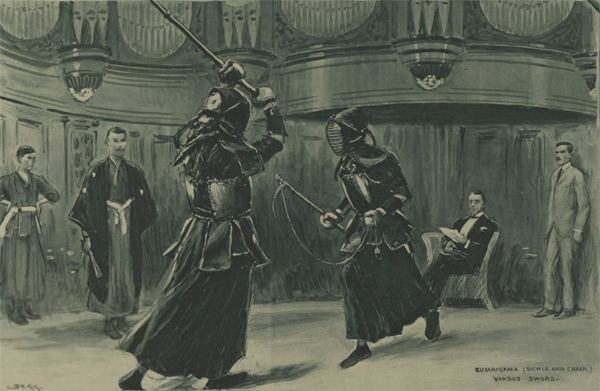
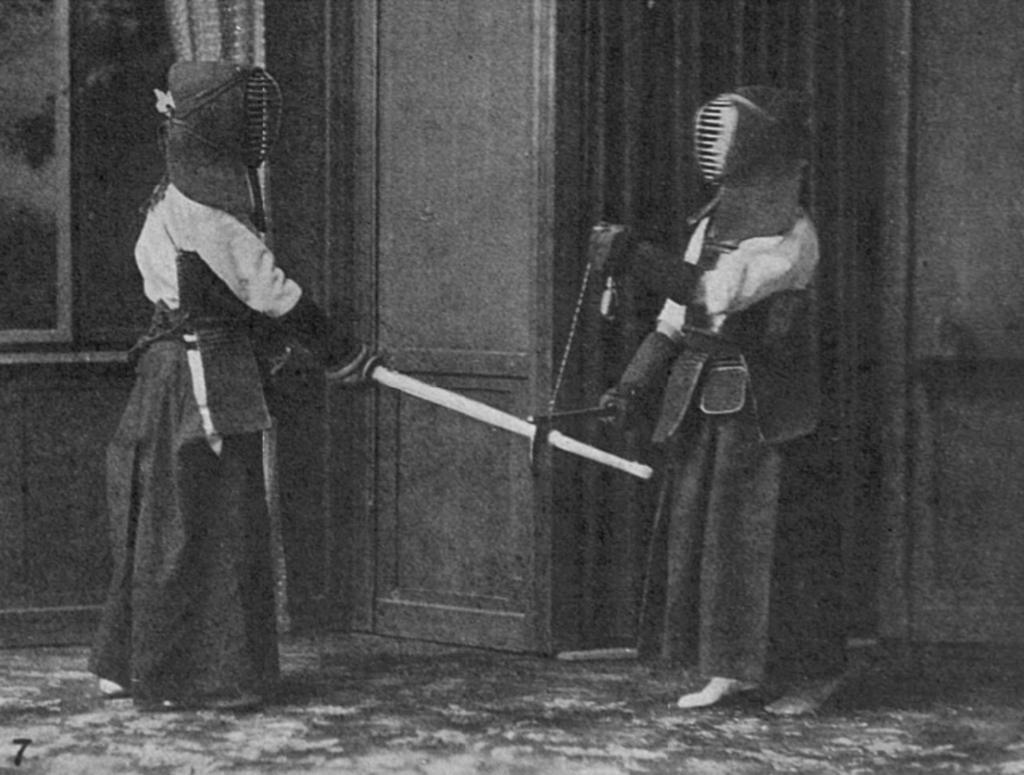
On May 31, 1919, the Budokwai hosted an exhibition at the Aeolian Hall by the visiting kendo master Sonobe Masatada, which was notable for including not only kendo and jiujitsu displays but also some highly exotic martial arts such as nabebutajutsu (the use of pot-lids as shields and knuckle-dusters), nitojutsu (fencing with a sword in each hand) and kusarigamajutsu (the use of the chain and sickle). Madame Hino Yoshiko rounded out the display with a demonstration of naginatajutsu (halberd fencing).
A similar Budokwai exhibition in 1923 again featured the kusarigama, curiously described by an Illustrated London News reporter as a “universal homely weapon” .
This excerpt from an Nito Shinkage Ryu kusarigamajutsu exhibition offers a sense of what would have been seen at the Budokwai displays about 100 years ago:
Originally published on the Bartitsu.org site on Monday, 6th November 2017
Worth bearing in mind when one’s martial practice starts to become too academic; there is gently going through the motions, and then there is Extreme Stick Fighting(click here for video). These two combatants demonstrate impressive toughness and courage in fighting full-contact and unarmoured, with very few apparent rules, on uneven, natural terrain.
While it can be argued that, for example, a classic Vigny cane would be expected to do more damage than a shorter, evenly-weighted rattan stick, it’s also important to note that adrenaline can allow a fighter to ignore many strikes that might be assumed to be fight-stoppers under less extreme circumstances. It follows that grappling, including ground-fighting, is a crucial skill. Endurance, luck, improvisation under pressure and will-power are all important factors in surviving, let alone winning, a combat of this nature.
Posted inSparring, Video|Comments Off on Extreme Stick Fighting
Originally published on the Bartitsu.org site on Monday, 6th November 2017
In the 2015 graphic novel Suffrajitsu: Mrs. Pankhurst’s Amazons, the Bartitsu School of Arms serves as the gymnasium and headquarters of a secret society of female bodyguards who protect the radical suffragettes from arrest and assault. The graphic novels were commissioned as part of the Foreworld Saga, a multimedia franchise initiated by speculative fiction authors Neal Stephenson and Mark Teppo.
While there was a real-life Bodyguard team who defended Emmeline Pankhurst and other notable suffragettes circa 1913/14, they were not, historically, based at the Bartitsu Club, which had closed its doors for the last time in 1902.
That said, as shown in the graphic novels, this fictional Bartitsu Club did draw a great deal of inspiration from history …
The physical layout of the Suffrajitsu universe’s Bartitsu School of Arms is closely based on that of the Forteza Western Martial Arts school in Ravenswood, Chicago (home of the Bartitsu Club of Chicago). Comparatively little is known about the layout of the real Bartitsu Club in Shaftesbury Avenue, except that it was a large basement space featuring white tiled walls and support pillars.
The stalwart chap bracing the punching bag in the foreground is Armand Cherpillod, who was (in real history) the Bartitsu Club’s wrestling and physical culture instructor.
The two jiujitsu throws shown in the foreground and medium ground are closely based on techniques shown in Emily Watts‘ Fine Art of Jiu-jutsu (1906). Mrs. Watts was, in fact, a student of Sadakazu Uyenishi, who is shown observing the suffragette Bodyguards’ training in the medium background.
The Amazons shown in the background are practicing the Vigny style of stick fighting and savate, as taught at the real Bartitsu Club by Pierre Vigny. The Amazon defending herself against her training partner’s savate kick is demonstrating a variation of “How to Defend Yourself with a Stick against the most Dangerous Kick of an Expert Kicker“, as per Barton-Wright’s 1901 article Self-Defence With A Walking Stick.
The elaborate sigil above Uyenishi’s head is the symbol of the Ordo Militum Vindicis Intactae, a secret order of martial artists who play a major role in the earlier Foreworld stories.
The longsword and other swords barely visible on the wall behind Uyenishi are nods to Captain Alfred Hutton, who taught Elizabethan-era fencing styles at the real Bartitsu Club.
The Amazons emerging from a trapdoor hidden under the mats of the Bartitsu Club is a reference to an anecdote told by Edith Garrud, who taught self-defence to the real suffragette Bodyguard team (and who makes a cameo appearance in the third panel above).
According to Edith, her London dojo was used as a safe-house by suffragettes escaping from the police after window-smashing protests. It featured a trapdoor in which they would hide their street clothes and any remaining missile weapons, so they would appear to be innocently practicing jiujitsu when the police came knocking at the dojo door.
The technique posters shown in the background of this picture are actually miniaturised images of real Bartitsu techniques from E.W. Barton-Wright’s “Self-Defence with a Walking Stick” article.
The sparring equipment worn by Barton-Wright and his niece and student Persephone is based on protective clothing actually worn by combat athletes during the Victorian and Edwardian periods, including cricket pads for the knees and shins, padded fencing gloves, sabre fencing masks and padded vests.
Barton-Wright (left) is assuming the classic “rear guard” of Vigny stick fighting, while Persephone counters with the “double-handed guard”.
This picture of the Bartitsu Club’s elaborate electrotherapy clinic, which is adjacent to the combat gymnasium, is closely based on photographs of Barton-Wright’s real clinic. After the Bartitsu Club closed, Barton-Wright persisted in the therapeutic field for the remainder of his career, specialising in various forms of heat, light, electrical and vibrational therapies to alleviate the pain of arthritis and rheumatism.
Originally published on the Bartitsu.org site on Monday, 6th November 2017
A historical curiosity from the Aberdeen Press and Journal of 4 January, 1911, detailing the self-defence training of psychiatric nurses via the game of “Indian wrestling” and some basic jiujitsu techniques.
Interestingly, Bartitsu Club fencing instructor Captain Alfred Hutton is believed to have been the first person in the Western world to teach Japanese martial arts as self-defence in a therapeutic environment, passing on some of the “tricks” he had learned from his young colleagues Yukio Tani and Sadakazu Uyenishi to London doctors.
Also of note is this article, which describes an informal system of “American jiujitsu” devised by psychiatric hospital workers that is said to have pre-dated the introduction of Japanese jiujitsu to the United States.
While the use of “therapeutic holds” and self-defence is still an important aspect of training for workers in psychiatric care, the modern approach completely eschews the type of painful and potentially dangerous holds described in this article, in favour of a system of non-violent, leverage-based team takedown and control techniques. The modern system is also deeply aware of the danger of positional asphyxia, strictly avoiding any holds that may inadvertently restrict a patient’s ability to breathe.
An American correspondent for the Nursing Mirror says-—I recently had the opportunity of witnessing the usefulness of jiu-jitsu as an aid to the nurses in a private sanatorium. It is included as part of course in hydrotherapy, and falls naturally into place with the study of physical movements and massage.
The nurses, for this purpose, are dressed in strong bathing costumes. They are first taught the holds and throws of Indian wrestling. This gives suppleness, and the application of their strength is new to the girls, many of whom have never since childhood put forth any severe muscular effort demanding agility. Indian wrestling is performed by two opponents holding each other by the corresponding hand and placing the corresponding foot close up to that of the adversary. The loser is the one who first moves either foot from its place or touches the ground with any other part of the body, the hand not excepted. Every muscle in the body is exercised in this way, and great improvement in the ability handle one’s self is quickly attained.
After this preparation, the holds of jiu-jitsu proper taught, and it is with these that the nurses protect from or control the patient. The chief of holds is the “straight arm”, which consists of a hyper-extension of the elbow over the fulcrum provided by either the nurse’s shoulder or forearm, the power being represented by the nurse’s other hand pulling the patient’s wrist. It is impossible withdraw from this position of mechanical disadvantage and any attempt to do so causes intense pain in the elbow, and if this is ignored, the leverage is sufficient to fracture the arm.
Another useful hold is the hammer-lock, consisting of the elevation of the arm behind the back under the shoulder, combined with an internal rotation at the wrist. The mechanical disadvantage and pain of this grip gives easy and perfect control over an obstinate or dangerous patient, and with this hold a frail woman can easily control a strong man.
Another hold is the hyperflexion of the phalanges of the fifth finger. This depends upon its painfulness, but it is a very convenient way of leading patients without attracting attention.
These are the main elements, but the nurse may sometimes find herself in difficulties when unexpectedly attacked, and jiu-jitsu teaches an appropriate way to meet every dangerous position when she is attacked. If she attacked by a patient swinging a dub, stick, or chair, there is an infallible defence, which can injure neither herself nor the patient. It is merely the football tackle – diving under the descending weapon and knocking the patient down by his legs. I venture to say that no woman, and very few men, would spontaneously attempt this until trained.
In a general melee against an active man it may not possible to obtain any of these holds, but the head and neck always offer themselves to the well-known chancery hold. Of course, very few women would even think of such a procedure unless trained, but its usefulness in a desperate situation is beyond question.
The paramount value in acquiring this skill is that the nurse can be sent for long walks with almost any kind of patients without any feeling of danger on the part of those who are responsible for her safety. The importance of this freedom to the patient is quite evident in these days of treatment by work in the open air, and has the additional merit of showing patients that their attendants have no fear of them.
Posted inJiujitsu|Comments Off on “Jiu Jitsu For Mental Nurses” (1911)
Originally published on the Bartitsu.org site on Monday, 9th October 2017
Famed comics writer/editor Denny O’Neil offers his take on the famous “baritsu” fight between Sherlock Holmes and Professor James Moriarty in these scenes from O’Neil’s Sherlock Holmes #1 (1975).
At the end of the first chapter, Holmes encounters Moriarty at the brink of the Reichenbach Falls in the Swiss Alps. Both men appear certain to plunge into the roiling abyss …
… and, indeed, that is what Holmes’ boon companion, John Watson, deduces to have happened when he examines the scene. However, as Holmes later explains:
Posted inBaritsu, Pop-culture, Sherlock Holmes|Comments Off on Baritsu in Denny O’Neil’s “Sherlock Holmes” Comic Book Adaptation (1975)
The Charlemont/Driscoll contest had a belated and little-known sequel in late March of 1904, when Thomas “Pedlar” Palmer challenged Louis Anastasie to a public bout on stage at London’s Britannia Theatre:
Posted inBoxing, Savate|Comments Off on La Savate vs. Boxing in London (The Sportsman, 26 March, 1904)