“Le Jiu-jitsu” (11 November, 1905)

  • Originally published on the Bartitsu.org site on Thursday, 3rd August 2017

A gallery of cartoons from the Parisian magazine Le Rire, imagining the impact of jiu-jitsu upon French society in the wake of jiujitsuka Ernest Regnier’s victory over savateur Georges Dubois.

Posted in Edwardiana, Humour, Jiujitsu | Comments Off on “Le Jiu-jitsu” (11 November, 1905)

“Tani, the Japanese Wrestler” (1905)

  • Originally published on the Bartitsu.org site on Tuesday, 11th July 2017

From the 1905 omnibus edition of Mind and Body: A Monthly Journal Devoted to Physical Education:

JIU-JITSU HAS 300 MOVES THAT AN EXPERT MUST KNOW, AND HE CAN THEN DEFEAT ANY STRONG MAN IGNORANT OF THEM.

TANI, the Japanese wrestler, was in the midst of a bout with an alert, muscular young Englishman from the Mile End Road. The Englishman was doing very well and the audience at the Royal, Holborn, were enthusiastically on his side, urging him with shouts of encouragement, native to East End, to hold on like death.

The odds seemed to be in his favour. He was the bigger man of the two, and apparently the stronger. He had good, stout limbs, yet he was lithe and quick. It seemed absurd to set him against the short, slight, wiry Japanese, who looked even less than his eight stone ten.

And the Japanese was down on his back, and the Englishman held him with a grip of irbn, and the Mile End Road thought he could do it for the five minutes that remained of the stipulated fifteen, and thus win the prize.

Suddenly there was a change. The Japanese wriggled out of trouble like a cat. He stepped around his opponent as lightly as if he were waltzing, seized a wrist, hitched the man down with a leg trip, and at once, sinking on his back at right angles to the Englishman, threw his leg across the man’s neck and held him there like a log until Mile End Road tapped the mat in signal of defeat.

There were some murmurings among the audience. It looked suspiciously as if the Japanese had half strangled his opponent, and the Englishman’s admission from the stage that he had nothing to complain of scarcely removed the impression. I went behind the scenes afterward and Tani showed me this particular fall.

“Well,” said he, “you are in the street and you desire my life. You have a heavy dagger and I have none. You make a downward plunge — so; and see what happens.”

I made the downward plunge in a double sense. Quick as lightning Tani had me by the wrist, his other hand pressed hard on my shoulder, the back of his leg pressing inward on the back of mine.

I went sprawling on my back, Tani slipped down on his and his leg was curled over my throat. But,that was the least part of the operation, only designed to keep my head in position. Tani had retained his hold on my wrist and now held it with both hands. The slightest struggle on my part exerted a pressure on the elbow which went near to breaking the arm. With my disengaged hand I beat a violent tattoo on the mat to indicate that I was convinced.

“That’s all very well with me, being no lion in strength,” I said. “But what would happen with Hackenschmidt? You couldn’t get his arm down for that lock.”

“This,” said the Japanese—and he quickly turned the arm the other way, fixing the lock of exquisite agony. “In fact,” he pursued, “the bigger the man the better I like him. It is his strength, not mine, that does the mischief. That stands to reason. If I put on a lock he cannot break, the harder he may struggle against it the greater the damage he enjoys.”

To correctly appreciate jiu-jitsu, it is necessary to understand that it is more than a sport, designed to teach the student to meet every form of attack that may be made upon him.

It was developed by men who had made a profound study of anatomy and the laws of leverage and force; and it was perfected by generation after generation of clever men. Every boy of the samurai or warrior class was taught it, and it was their favorite form of competitive sport.

There is one deadly grip which always offends English notions of fair play. That is what Apollo, Tani’s manager, christened the knockout blow.

Tani grips both sides of your collar, hands crossed, palms outward, puts one foot on your thigh, and falls backward. You fall with him. Retaining his double grip on the collar and his leg on the thigh, he rolls over and you roll over with him. Then, like a cat, he is sitting astride your chest, and you are done.

This grip is generally regarded by British audiences as a strangle, and it has been known to provoke howls of protest. But it is not a strangle, as I can testify by personal experience. The pressure is all at the sides and back of the neck, the windpipe not being touched.

Appollo tried it and found the sensation that of “floating among clouds in a perfectly happy state.” He wondered how it was done, and Tani could not explain.

Then he read that a Dutch physician, while sojourning among the Japanese, found that the native doctors, when performing slight operations, used no anaesthetics, but simply applied pressure to the carotid artery, by which means the patient was rendered unconscious.

That was the explanation of the Japanese knock-out grip. Pressure on the two carotid arteries arrested the flow of blood to the brain, and the victim, if he was too proud to give the signal, drifted out of conscious existence.

I asked Tani to show me his reply to a kick. He allowed me to kick him, but he caught the foot, twisted the toe around, and on the instant had me sprawling on the mat, tied up in a contorted knot, from which I was uncommonly glad to be released.

One thing which I particularly noticed in these falls was that Tani left me to do the hard work. He cajoled me off my balancc, I fell, as he wanted me to fall, and he then had me in a lock wherein, if I was anxious for a broken bone, the breaking had to come from me. He wrestles as if he were playing chess, and while you are still standing, he makes the hold which he exercises when you are thrown.

Apollo admits that after two years’ constant practice with Tani he began to “rather fancy himself” at the art. So one day he made a wager with Tani that he could withstand him for 15 minutes. And in exactly three minutes Apollo was beaten by a hold that he had never seen before. It is asserted that there are some 300 moves in the game, with which a wrestler must be familiar before he is regarded as a master.

But, as Tani says, why use more variations than you need? “There were two of us, and we used to show the art of defense against a street attack. My comrade, he attack me, and I throw him out. But what use is that? We do it so quickly that the people think it is a made-up job, some juggling, or something, and they only laugh. It is the same when two Japanese wrestle on the stage. If you do not know the fine points of the game, how can you see they are good?

“And so it is better for me to wrestle with your Englishmen, so that you can see how we combat their attacks. And how I should love to try it on one of your biggest champions! But they want me to play their game, which I do not know: and if it is a game merely of strength, how shall a man of nine stone beat a man of fourteen?”
Posted in Jiujitsu | Comments Off on “Tani, the Japanese Wrestler” (1905)

Baritsu Demo at Sherlockon 2017 (Warsaw, Poland)

  • Originally published on the Bartitsu.org site on Thursday, 6th July 2017
Posted in Baritsu, Exhibitions, Video | Comments Off on Baritsu Demo at Sherlockon 2017 (Warsaw, Poland)

The Rear Guard and the Guard by Distance

  • Originally published on the Bartitsu.org site on Wednesday, 5th July 2017
Girded for battle, Bartłomiej Mysłek of Poland assumes a variation of the Vigny stick fighting rear guard during a recent Bartitsu sparring match.

The rear guard, also referred to by E.W. Barton-Wright as the “left guard”, is one of the signature defensive stances of the Vigny style of stick fighting. It was well-described by the anonymous author of “L’art de la canne”, an essay first published in the Revue Olympique of May, 1912:

The Vigny guard position is, in essence, a combat guard. The left arm is held in front as if bearing a shield; the right arm is raised at the rear, with the weapon held above the head, in a perpetual “spring hold.”

When you are being attacked, quickly retreat with a swift guard change and bring your cane down powerfully upon the opponent’s arm or hand. In doing this, you can be mathematically certain of reaching and damaging your target.

Immediately afterwards, you step towards him, turning your wrist rapidly and striking the steel tip of your cane into his eyes or under the nose. And here is very surprised man … !

In Barton-Wright’s “Self Defence with a Walking Stick” articles, the rear guard is consistently presented as a position of invitation, “baiting” an attack to an apparently exposed target so as to set up a devastating counter-attack via the “guard by distance” tactic.

To “guard by distance” means to avoid the opponent’s attack via footwork and body movement, as distinct from “guards by resistance” which include all defences in which the opponent’s weapon is blocked or parried by the defender’s weapon.

Vigny (right) assumes a rear guard, inviting Barton-Wright’s attack to his exposed left arm, then counters with the “guard by distance”, withdrawing the target and striking to the top of Barton-Wright’s head.
Vigny (right) assumes a variation of the rear guard inviting Barton-Wright’s attack to his head, then withdraws the target and counters with a strike to B-W’s weapon hand.
The “guard by distance” can also involve stepping towards, rather than away from, the opponent.  Here, Vigny (right) invites Barton-Wright’s attack to the left side of his head then steps inside the strike, trapping B-W’s stick and countering with a back-hand strike to the right side of B-W’s head.
Vigny (right) invites Barton-Wright’s left lead punch and counters with a strike to B-W’s knee or shin, then follows up by beating B-W’s time with a “bayonet” thrust to the midsection.
A defence, trap, counter-attack and takedown from the rear guard applied in sparring.
Posted in Instruction, Vigny stick fighting | Comments Off on The Rear Guard and the Guard by Distance

“Clever and Adroit”: More on the 1902 Nottingham Bartitsu Exhibitions

  • Originally published on the Bartitsu.org site on Wednesday, 5th April 2017

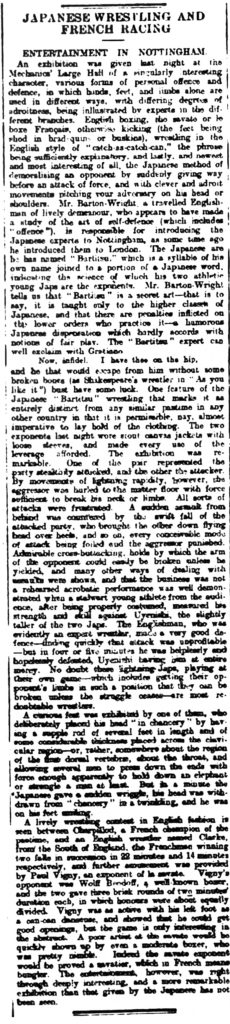
The following article from the Tuesday, 25 March 1902 edition of the Nottingham Journal is the most detailed report yet discovered on the short series of Bartitsu exhibitions held in that city.

Posted in Antagonistics, Boxing, Canonical Bartitsu, Exhibitions, Jiujitsu, Savate, Wrestling | Comments Off on “Clever and Adroit”: More on the 1902 Nottingham Bartitsu Exhibitions

Bartitsu Sparring Compilation

  • Originally published on the Bartitsu.org site on Monday, 3rd April 2017

… by engaging toughs I trained myself until I was satisfied in practical application.

– E.W. Barton-Wright, 1950

Posted in Sparring, Video, Vigny stick fighting | Comments Off on Bartitsu Sparring Compilation

“Jiu-Jitsu in the Navy” (1907)

  • Originally published on the Bartitsu.org site on Monday, 3rd April 2017

From the Illustrated Sporting and Dramatic News – Saturday 21 September, 1907:

1. Thigh arm lock. 2. Seized by the coat in front: 1st position. 3. Seized by the coat in front: 2nd position. 4. The stomach throw: 1st position. 5. The stomach throw: 2nd position. 6. A hip throw.

Jiu-Jitsu was first taught in the Navy officially about a year ago to a selected number of officers and physical training instructors who, after they became proficient in the subject, taught it in turn to other officers and petty officers. Examinations of those who have undergone a course of the lessons take place at the School of Physical Training in Portsmouth.

It is not intended that Jiu-Jitsu shall be the system of physical training for the Royal Navy, but only as one of the numerous recreative forms of gymnastics.

Posted in Jiujitsu | Comments Off on “Jiu-Jitsu in the Navy” (1907)

“Barnard College Girls Becoming Experts in Jiu Jitsu Art” (Allentown Leader, Feb. 9, 1916)

  • Originally published on the Bartitsu.org site on Tuesday, 26th January 2016
Barnard College jujitsu
Posted in Jiujitsu | Comments Off on “Barnard College Girls Becoming Experts in Jiu Jitsu Art” (Allentown Leader, Feb. 9, 1916)

Sherlock’s Baritsu Den: a Unique Gym in a Hanover Hotel

  • Originally published on the Bartitsu.org site on June 3rd, 2017
Gym

Guests at the Pelikanvietel in Hanover, Germany can get their sweat on Sherlock-style in the “Baritsu Den” gymnasium.

Posted in Baritsu, Physical Culture, Sherlock Holmes | Comments Off on Sherlock’s Baritsu Den: a Unique Gym in a Hanover Hotel

“The Gentle Art of Self Defence: A Strange and Mysterious Set of Manoeuvres Calculated to Upset the Mental Balance of Your Adversary” (1899)

  • Originally published on the Bartitsu.org site on June 3rd, 2017

The anonymous author of this March 15, 1899 To-Day Magazine satire wittily skewers E.W Barton-Wright’s “New Art of Self Defence” series for Pearson’s Magazine.

ONE of the monthly magazines which has been with us for a little time has in its current issue published an article on the “New Art of Self-Defence.”

Practical trial by the writer of the series, which To-Day now starts, has shown that it is possible for the exponent of the “New Art of Self-Defence” to do everything which he claims his art enables him to do, provided he can always find an opponent who will be good enough to use only one arm in attack or defence, and who will otherwise be amenable to the wishes of the exponent, and do nothing but what the system arranges that he shall do. The article published below, and those to follow, will show how far this system of self-defence will go, and what can be done with an opponent who has properly studied the “New Art of Self Defence,” and is determined to depart in no way from the lines laid down therein.

I AM no relation of de Rougemont, but I have learned from him that the up-to-date editor always looks coldly upon that which is probable, commonplace, or easy of explanation ; therefore with the view of getting the said editor to use his organ as the medium of supporting me, and placing my writings in the hands of the public, I have prepared a series of articles on Self-Defence, which deal entirely with carefully thought out improbabilities, which are by no means easy of explanation, and which I may at once state I don’t propose to explain.

My first interview with the editor, who accepted this series, will give some inkling of the methods of my system of self-defence. I had sent up my card and, as I expected, the editor, not knowing me, told the messenger to say he was out. I was prepared for this, and had taken the precaution of following the messenger into the room. I heard the editor’s statement, which he made without looking up.

“That remark, sir,” said I, “is a d____d lie!”

I reckoned on the man’s temper, and knew that I would immediately have an opportunity of exhibiting my art of self-defence, and so get right to the core of my business at once. I was not wrong in my calculations. He replied with a heavy metal ink, pot; I countered with the messenger, who received it full in the forehead. The ink-pot made a nasty hole in his head, and his face was splashed with ink. I would have wiped away the ink, but found he was dead, so it did not matter.

[graphic]
“I countered with the messenger”

“That,” said I to the Editor, “brings us to business.”

“Your business?” he queried, as he hurled a solid ebony ruler at my head.

“Self-defence, a new system,” I replied, and I swung him in front of me with such lightning speed that he warded off the ruler. It caught him in the wind, but he recovered in about half an hour. I waited for him to speak, or to make some move. He seated himself, and pressed a button in his desk. A bell rang without, and another messenger entered, “Put that in the waste paper basket”—he pointed to the corpse—“and fill my ink-pot.”

I took a seat while his instructions were being carried out, and when the messenger had retired we discussed my business, and came to terms. Before I give any particulars (I refuse explanations) of my art of self-defence, perhaps it will not be amiss to make a few introductory remarks as to the general conception of self-defence.

In foreign countries, when a foreigner fights, he has only one goal, and that is to get the better of his adversary, and any means is considered justifiable to obtain this end. Of course his idea of honour differs from ours, so that, whereas with us Nature’s weapons are considered the only honourable method of settling a dispute, a foreigner will not hesitate to use a wardrobe, a beer barrel, a knife and fork, or, in fact, anything that comes handy.

[graphic]
“A foreigner will not hesitate to use a knife and fork”

It is to meet eventualities of this kind that my system has been devised. The general principles may be thus summed up. (1) To get an opponent whom you can trust to do as you wish; (2) to surprise your opponent by the strangeness of your movement, and their infinite variety.

Some of the feats which I shall now describe may, perhaps, seem difficult, but if my instructions are carefully followed, and everything requisite is kept conveniently at hand, I feel sure that steady practice will make them quite easy of performance.

Feat No. 1. I will suppose now that you are walking along a silent street at night and you are attacked by a man with a knife and fork. It is always well at night to wear your overcoat hung on your shoulders without passing your arms through the sleeves. This will facilitate the mode of defence needed for the knife and fork attack. When the man approaches you, throw off your coat and give it to him, mention that you will return, and hurry off to the nearest butcher’s shop. (If all the shops are closed have no compunction in knocking up a butcher, seize the toughest steak you can find and return to the scene of action.)

If the man is gone, you have lost your overcoat, but your defence has been successful, and you are a steak, albeit a tough one, to the good. If the ruffian is still there approach him swiftly and impale the steak on his fork. While he is wrestling with the steak, take hold of him by the right leg, jerk it quickly forward, push your head into the pit of his stomach and he will lie down. Then you can recover the steak and your overcoat, and if you feel so inclined you will be able to take the knife and fork and any valuables he may have.

[merged small][ocr errors][merged small]

Feat No. 2. Here is an excellent method of forcing an undesirable person to leave a room. Say, for instance, he is a big man and overawes the policeman you may feel it necessary to call in, the best thing to do then is to immediately hire or buy a windlass, have it firmly fixed somewhere outside the room, test the chain, procure a padlock with a Yale lock and then enter the room again with the end of the chain and the padlock held in the left hand, which it will be as well to conceal behind your back.

Walk straight up to the undesirable person, seize him by the left leg, bring forward your chain, and, without telling him what you are going to do, lock the chain carefully round his ankle. Return then without loss of time to the windlass, turn the handle quickly but firmly, and in a very short time the undesirable person will leave the room. While performing this feat it will be well to keep so far out of your opponent’s reach as to make it impossible for him to hit you or retaliate in any way.

“The undesirable person will leave the room”

In case any one should fight shy of the practical use of this trick, it may be added that the person thus treated would, should he resist the action of the chain, feel such pain as to compel him to submit meekly long before any serious injury could be done to him.

It will not be necessary to impress upon the reader the importance of knowing how any undesirable person may be promptly ejected from a room. Thousands of cases have occurred in which a knowledge of this method would have been of inestimable service. No one could resist the treatment I have suggested, as the reader will be able to understand for himself by testing it on his friends.

Posted in Canonical Bartitsu, Edwardiana, Humour, Jiujitsu | Comments Off on “The Gentle Art of Self Defence: A Strange and Mysterious Set of Manoeuvres Calculated to Upset the Mental Balance of Your Adversary” (1899)