Yukio Tani vs. the Masked Wrestler (April, 1909)

  • Originally published on the Bartitsu.org site on Saturday, 10th November 2018

Still popular today in Mexican and Japanese pro-wrestling circles, the “masked wrestler” gimmick originated in Paris during the year 1867.  The original “Lutteur Masqué” was rumoured to be an athletic aristocrat who kept his identity secret so as not to bring shame upon his family.
The same story and gimmick was reported to have re-appeared about ten years later in  Bucharest.  In that instance, the masked circus wrestler was rumoured to be none other than “Prince Stourdja of Moldavia”, grappling incognito; it was also reported that a riot nearly ensued when a careless circus employee let slip the masked man’s real identity as a humble, but muscular, clown and roustabout.
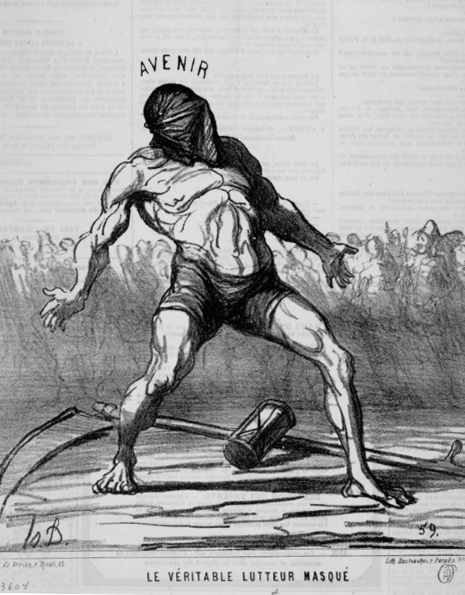
“The True Masked Wrestler” lays down his hourglass and scythe to challenge all comers

Although the mask gimmick remained a rarity,  it entered the zeitgeist to the extent that a masked wrestler character appeared in a 1903 English stage melodrama titled The Village Blacksmith, a play that would remain popular on the provincial circuit for some years to come.

In March of 1909, dramatic newspaper announcements heralded the arrival of a new “Masked Man” (M.M.) who intended to challenge former Bartitsu Club instructor Yukio Tani to a match under jiujitsu rules. The allegedly Continental grappler was speculated to be a disguised Aleksander Aberg, Frank Gotch or even the great Hackenschmidt himself, and was said to have previously challenged the famed Stanislaus Zbyszko.

At this point it’s worth noting that very limited credence can be given to anonymous newspaper reports about the activities of masked wrestlers, perhaps especially when they coincide with tours of a popular melodrama likewise featuring a M.M.  That said, The Sporting Life did its due diligence in covering the M.M./Tani challenge, especially after the two parties met at the Sporting Life office to discuss terms for the match.

Noting as usual that the term “Jap” was not used pejoratively during the very early 20th century, here follows the Sporting Life report on that meeting, from their March 26th, 1909 issue:


“A man of good family, who is traveling all over Europe for the sake of ‘taking down’ some of those wrestlers who think so much of themselves,” is the character of the notorious Man with the Mask, who has struggled with Zybysko in Vienna, and who has been mistaken for Hackenschmidt, Gotch and  Aberg. This description was given to us by Herr Neiman, the M.M.’s manager, who according to promise came to the St. Bride Street office of the Sporting Life yesterday afternoon, .

Mr. J Harrison, Tani’s manager, and Mr. Adam King had already arrived, and Herr Neiman was at once asked what he had to propose. Herr Neiman said he was in London with the M.M. for the purpose of wrestling and beating Tani, and he would deposit with the Sporting Life now £100 or £200 as a side stake in a match with Tani. The M.M. had some holds that Tani had never even dreamed of, and with these he would best the Jap.

The editor of the Sporting Life said that he hoped that no attempt would be made to play this hoary Continental trick on the long-suffering supporters of wrestling in England. The Sporting Life would not accept any money for a match in the mountebank style of wrestling, and it would strongly advise Tani, who had a good reputation in England, to steer clear of any trickery such as a man in a mask suggested. The Sporting life hoped that the man would take off his mask and tackle Tani, and only because of that hope had it allowed the man to meet in St. Bride Street.

Mr. Harrison said he could say nothing of (illegible), except that Tani would very willingly wrestle the M.M. on the ordinary terms – £20 if he stood for 15 minutes and £100 if he beat Tani, but the wrestler must be without a mask.

Herr Neiman then declared threateningly that if Tani not make a match the M.M. would find out where he was and follow him all over the country.

Mr. Harrison, amused, said he would give Herr Neiman Tani’s address, and he was further assured that a bluff of that kind would avail him nothing.

Herr Neiman said the man would not take off his mask for a million pounds, and someone suggested that it would not be safe to offer 10. Mr. Harrison said that if this man wanted to wrestle Tani with a sack over his head, Tani would wrestle him with a hammer in his hand.

We suggested that if the man would not take off his mask, he should as promised wrestle in private, but Herr Neiman declared that the M.M. had never yet wrestled in private and he did not want to start.

Wherefore we are forced to the conclusion that he is after a “gate”.

There being no prospect of unmasking this wonderful wrestler, the meeting was abortive and we shall hear the next news of the masked man from the provinces, where Tani will be performing next week.

All that we were able to glean of the wrestler who affects the mask was that he is a white man , stands about 5’8″ or 5’9″ and weighs between 13 1/2 stone and 14 stone . He wrestles (his manager says) as a hobby and he comes from so good a family that he does not want anyone to know him.


It’s evident, however, that either the colourful wrangling over terms was part of the show, or that actual terms were decided privately, because Tani and the Masked Man did compete in several jiujitsu matches during April of 1909.   The first contest took place in Newcastle on Saturday, April 1st, and was duly (and somewhat disapprovingly) described in the next day’s issue of the Sporting Life:


Wrestling has quite suddenly become interesting, if some aspects of it are not particularly edifying. We have some mountebank tricks at Newcastle-upon-Tyne where we find Yukio Tani, notwithstanding the advice we gave him last week, wrestling the man who conceals his identity, and saves his noble family from the disgrace of wrestling, behind a mask. We are astonished that Tani should mix himself up with mountebank business of this kind.

We have been informed that the man in the mask is really an official of a foreign government, and a good amateur, and that those are the reasons why he is literally keeping it dark. We cannot congratulate the continent on its amateurs. This masked man, we are further informed, is wrestling purely for the sport. He must indeed be a keen sportsman if he follows his Zybysko from Vienna to Lodz and from Lodz to St. Petersburg, and, having taken the measures of the (illegible) to England and hurries up to Newcastle- upon-Tyne after Tani, who in private, report says, once brought the mighty Zybysko low.The masked wrestler of continental fame appeared in a match against Yukio Tani, the famous jujitsu wrestler, at the Pavilion Theatre, Newcastle, last night, and stayed at the stipulated 15 minutes against the Japanese with ease. In fact, the unknown forced matters at a terrific pace for practically the whole time, exhibiting tremendous strength and evading Tani’s frequent attempts at leg holds over the neck. The masked man is undoubtedly an accomplished wrestler, though lacking in knowledge of the Japanese style, and is a splendidly developed athlete.


The Sporting Life’s skepticism re. the masked wrestler schtick was undoubtedly justified – among other things, even if the stories about the M.M. pursuing Zybysko all over Europe were true, there would be no practical way of ascertaining whether he was the same M.M. who was currently challenging Yukio Tani.  However – assuming that the actual match was a legitimate contest of skill – he must indeed have been a proficient grappler, because few wrestlers were able to last the stipulated time against Tani in his prime.

Their next recorded clash took place in the nearby town of Gateshead on the 10th of April:


On Saturday, at the Metropole Theatre, Gateshead, Yukio Tani, the famous ju-jitsu wrestler, met the “Masked Man” for £lOO a-side, in a contest under ju-jitsu rules. The “Masked Man”, since his first appearance in this country, has excited considerable curiosity, and on this occasion removed his mask for the first time.  He had had two previous unfinished contests with the Jap, and the conditions for the third meeting were a wrestle to a finish.

The “Masked Man,” though uncovered, had not had his identity revealed, though it is understood that he is a German, and has achieved considerable distinction as champion wrestler. He scales 14st. 91bs., against the Japanese wrestler’s 9st.

There was a large audience, and the umpire was Mr. Collingridge, of Newcastle. On the last occasion the pair met, the Masked Man was on the aggressive for the most part of the bout, but this time the Jap went on other tactics, and at once led off. He got his man down first, and very soon tried his favourite arm-lock, but he was not strong enough to use it to effect. The first ten minutes of the contest saw Tani doing most of the work, but his heavy opponent was playing a waiting game, and ultimately took a turn at forcing the work.

When the German got his hold he held his light opponent with apparent case, but Tani was much too clever in avoiding awkward holds, and slipped out of them when seemed to be in a bad way.  He tried his arm lock as a  counter-move to the German, but the latter was always safe in relying upon his strength to get out of trouble. After about 30 minutes of keen wrestling, the Jap looked like giving his opponent the head press, but after several attempts he was unable to muster strength enough to turn his opponent’s body over.

After a breather, on the conclusion of half an hour’s exciting work, Tani assumed the offensive, and got a strangle hold, which he was unable to use, however, to much advantage. The German took up the fighting, and for few minutes forced the pace. Tani, waiting his opportunity, however, got a verdict before most people expected it, for, at the close of nearly eight minutes’ wrestling,  he secured a neck lock, which gained him a well-deserved victory. The time of the contest was 37 minutes and 45 seconds. Tani was warmly applauded on the verdict.


Mr. Collingridge, the Newcastle-based umpire, was almost certainly W.H. Collingridge, who was himself a jiujitsu student and then instructor, as well as the author of Tricks of Self Defence (1914).

Despite the journalist’s comment suggesting that this was the third meeting between the M.M. and Tani, there seem to be no records of a bout between the Newcastle match and this one in Gateshead.  In any case, the M.M.’s unmasking for this encounter may well have been part of the terms reached between the two promotions. 

The mysterious hooded grappler’s actual identity was never publicly confirmed and has now been lost to history.
Posted in Edwardiana, Jiujitsu, Pop-culture, Wrestling | Comments Off on Yukio Tani vs. the Masked Wrestler (April, 1909)

“Getting the Short End of the Stick” in Vigny Stick Fighting

  • Originally published on the Bartitsu.org site on Thursday, 14th February 2019
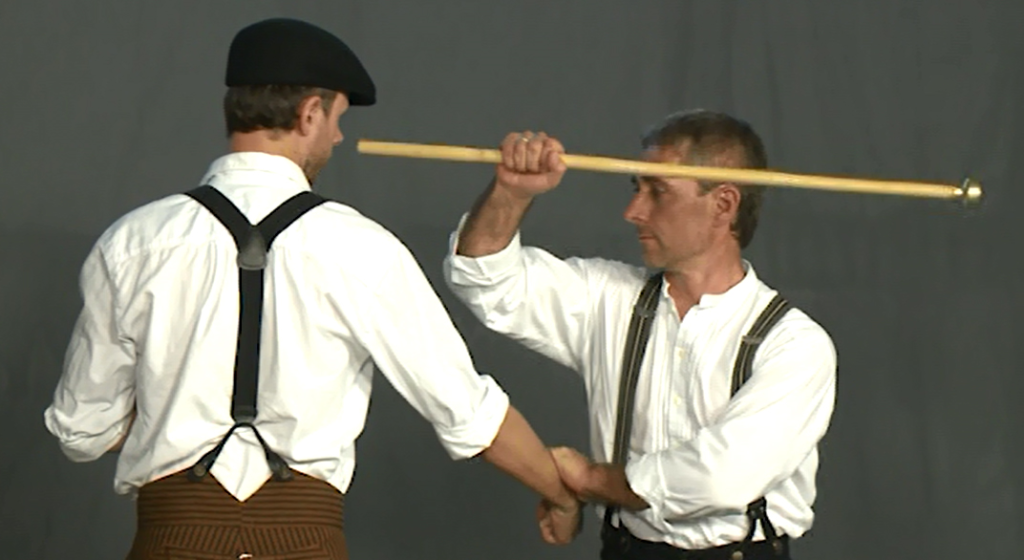
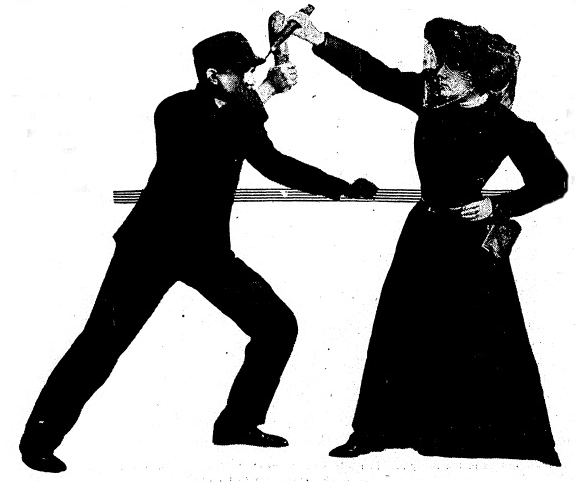
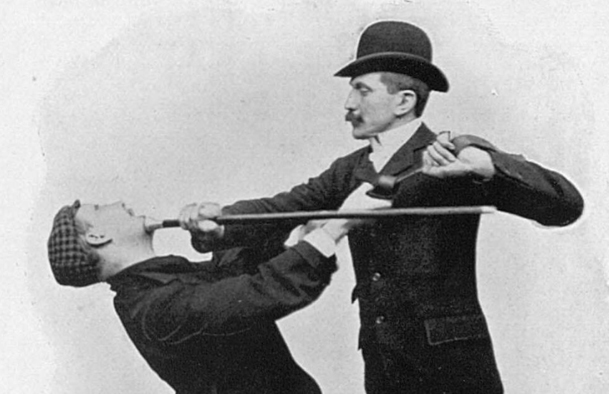
Pierre Vigny (right) demonstrates a short-end thrust to the jaw against a belt-wielding “hooligan”.

I noticed that the stick itself was held about eight inches from the end, so that after a crashing blow has been delivered it was quickly followed up by a stabbing movement with the ferrule end, which was used as if it was a dagger.

  • Street Self-Defence: How to Handle the Hooligan (1904)

One of the characteristic tactics of the Vigny stick fighting style is the use of the “short end” of the cane as a close-combat weapon.  Despite not being directly illustrated in the classic Pearson’s Magazine series, this method is frequently referred to in other sources, notably including Captain F.C. Laing’s The ‘Bartitsu’ Method of Self-Defence:

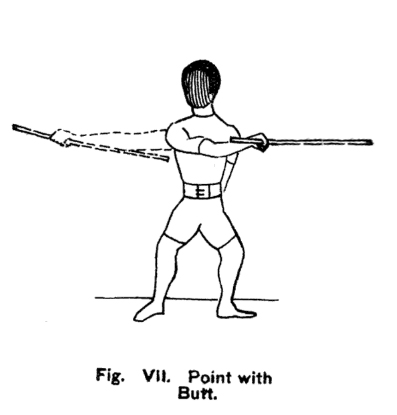
Points are made with the butt end of the stick at any part of the body, the most favourable places being at the throat and ribs.

“Point” in Laing’s usage refers to a thrust as distinct from a strike, and either the butt or ferrule end or the heavier ball-handle end (as demonstrated by Vigny in the photograph above) could be used for this purpose.

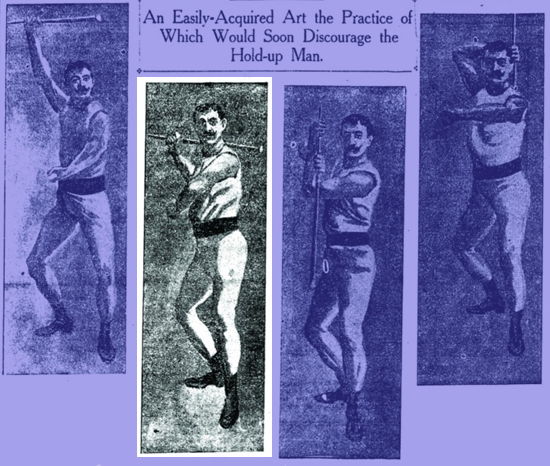
Aside from the “backhanded” preparation described and illustrated by Laing, the Vigny style also includes a guard that prepares for a forehand or direct short-end strike, shown in the second of these four illustrations from a 1904 Detroit Free Press article:

The caption for this guard reads:

2) In this posture a blow is delivered from the shoulder, or as an alternative the small end of the weapon may be used as a dagger.

Numerous observers of Vigny’s stick fighting demonstrations at the turn of the 20th century noted his use of the short-end of the stick at close quarters, and especially its effectiveness as a surprise attack.  An opponent who is set up to expect a sweeping strike with the cane may well be taken off-guard when his adversary steps in close and converts the “strike” into a stabbing thrust with the opposite end.  This description, from the London Daily News of Wednesday, October 29, 1902, is typical:

Holding a malacca cane by one hand at each end, the Professor calmly awaited the onslaught of a skilled opponent with a similar stick. The spectator never knew which hand was to deal the blow, the released end moving with lightning speed, and a short hold was taken, so that the assailant, in guarding against an impending blow, often found himself hammered or prodded with the butt.

Favoured targets for the short-end strike include the ribs, face, throat and eyes.  According to the anonymous author of L’Art de la Canne (1912), a detailed survey of the Vigny style:

After which, you advance upon him while quickly turning your wrist, thrusting the steel ferrule of the cane like a dagger into his eyes or beneath his nose. And here is a man … amazed!

… whereas Captain Laing favoured the throat:

Assume “first position,” guard head, then, before he has time to recover himself, hit him rapidly on both sides of his face, disengaging between each blow as explained, the rapidity of these blows will generally be sufficient to disconcert him; the moment you see this; dash in and hit him in the throat with the butt end of your stick, jump back at once and as you jump hit him again over the head.

Alternatively:

A man without a stick rushes at you with his fist.  He will probably strike out at your face or body with his left hand; if so, take up the ” rear guard” position and as he strikes guard with left arm, seize his left wrist, and hit his left elbow with your stick, advance right leg and point with butt end of your stick at his throat, then follow this up by thrusting your stick between his legs and so levering him over.

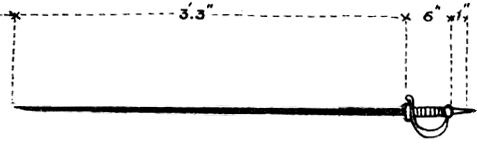
Laing’s prototype for a new cavalry sword design, which was based on Bartitsu stick fighting, included a spiked pommel for even more effective close-quarters work:

Those interested in the further possibilities of short-end play with the Vigny cane are encouraged to study the video series Bartitsu: Historical Self-Defence with a Walking Stick, which includes several more options.

Instructor Alex Kiermayer demonstrates a short-end thrust.
Posted in Antagonistics, Canonical Bartitsu, Instruction, Vigny stick fighting | Comments Off on “Getting the Short End of the Stick” in Vigny Stick Fighting

“Ju-Jitsu Vs. Boxing”: Yukio Tani takes on “Young Joseph” (From The Sporting Life, 13 April 1908)

  • Originally published on the Bartitsu.org site on February 10th, 2017

In a 1950 interview conducted by jiujitsu sensei Gunji Koizumi, Bartitsu founder E.W. Barton-Wright reminisced about trying to teach Yukio Tani to box, noting that Tani had “no aptitude for the sport”. Indeed, the academic question of whether a jiujitsuka could beat a boxer was much debated in the pages of sporting journals during the first decade of the 20th century.

Some of those “in the know” – not least including Barton-Wright and fellow self-defence authority Percy Longhurst – eschewed the nationalistic jingoism that often fuelled this type of debate and advocated for an intelligent combination of both styles for the purpose of self-defence. Under the prevailing law and social sentiment, however, a contest in which both fighters were allowed to strike and grapple as they saw fit might well have been considered “brawling in a public place”. Certainly there was no recognised rule-set nor venue for such a bout, though it’s highly likely that experimental matches of this type did take place “behind closed doors” at venues such as the Bartitsu Club.

This article records a rare mixed-styles contest in which Yukio Tani, who by 1908 had vast experience in applying his jiujitsu against various European wrestling styles, took on a pugilist nicknamed “Young Joseph”.

VARIED BOUTS AT SHOREDITCH OLYMPIA.

A really splendid programme was staged on Saturday afternoon at Olympia, Shoreditch, and efficiently superintended the M.C., Mr Jack Henderson, whoso duties were by no means light. In addition to a match between a British exponent of ju-jitsu, Jack Madden, and Yamato Maida (Japan), the public were treated a most interesting contest, in which the boxer Young Joseph opposed Yukio Tani.

The pictures of the championship fight between Tommy Burns and Gunner Moir were shown, and various contests decided between well-known wrestlers. Mr Jack Henderson managed the proceedings on and off the stage, and was timekeeper, Mr R. P. Watson was referee for the ju-jitsu v. boxing, and Mr E. Joseph refereed the rest the events.

Details:— YUKIO TANI BEAT YOUNG JOSEPH.

Tani cautiously eyed Joseph for several seconds. Joseph feinted repeatedly, and Tani kept out of harm’s way. The Jap cleverly escaped a dangerous lead with right and left. Once Joseph landed the left.

Tani jumped in twice with a leg trip, and just failed to bring the boxer down. All the time Joseph was threatening with the right, which Tani carefully watched and avoided. At last Tani seized a favourable opportunity, and dashing in caught Joseph round the body (time. 4 min.).

There was a fierce scramble the ground, and Joseph escaped with a severe roughing. When they again faced each other Joseph drew close, and often led, but Tani cunningly side-stepped. At last he dashed in with a body hold, and dragged Joseph to the mat.

Joseph tried in vain extricate from this dangerous position, but Tani held him in a vice-like grip. Suddenly the Jap grabbed his arm, threw himself upon his back, his leg over Joseph’s face, and with arm look won in 5 min. 34 sec.

Yamato beat Jack Madden with an arm-lock in 7 min. 32 sec.

Posted in Boxing, Edwardiana, Jiujitsu | Comments Off on “Ju-Jitsu Vs. Boxing”: Yukio Tani takes on “Young Joseph” (From The Sporting Life, 13 April 1908)

Inside Edith Garrud’s dojo (1910-11)

  • Originally published on the Bartitsu.org site on Sunday, 1st January 2017


By March of 1910,  jiujitsu instructor Edith Garrud was becoming increasingly involved with the radical women’s rights movement, teaching her “Suffragettes Self-Defence” classes at Leighton Lodge in Edwardes Square, Kensington and performing politically charged demonstrations in which she defeated men dressed in police uniforms.

Edith’s jiujitsu dojo in Regent Street was the setting for the above photo sequence, which was originally published in The Sketch magazine.

The tatami mats stacked against the walls in the fourth and sixth photos were probably intended to serve as a neutral background for the photographer, perhaps so that the police constable’s uniform could be better distinguished from the dark wood panelling behind them.

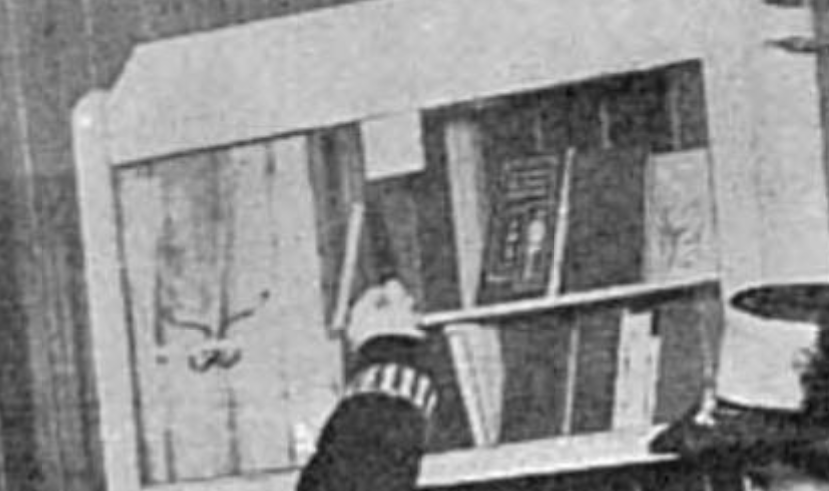
Notably, a close-up view of one of the bookshelves reveals that the dojo made copies of Sadakazu Uyenishi’s The Text-Book of Jiujitsu and W. H. Collingridge’s Tricks of Self-Defence available to their students.

Uyenishi was, of course, one of the young Japanese instructors who had taught jiujitsu at the Bartitsu School of Arms.  He later followed his colleague Yukio Tani onto the boards of the London music halls as a challenge wrestler, but the impression is that he was happier as an instructor. Uyenishi taught his art to members of the British armed services as well as establishing the successful Golden Square dojo, which William and Edith Garrud later took over when Uyenishi returned to Japan.

Like the Garruds, W. H. Collingridge was a “second generation” instructor who had learned Japanese unarmed combat from Yukio Tani and his associate, Taro Miyake. His book was still being published, in an edition revised by their mutual colleague, Percy Longhurst, as late as 1958.

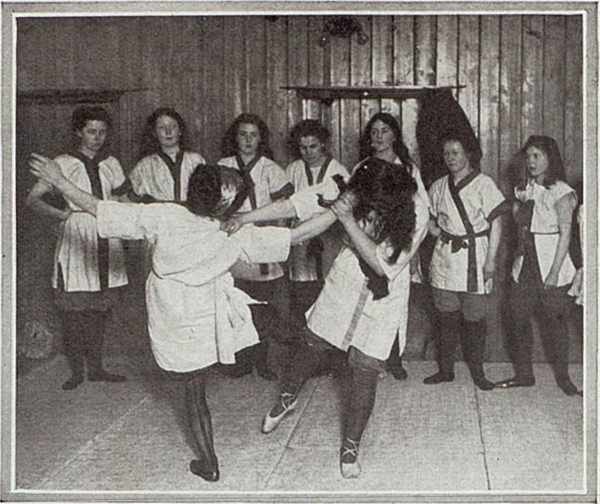
This photograph, originally published in The Sphere of Feb. 11, 1911, offers a very rare glimpse of one of Edith Garrud’s jiujitsu classes for girls, which also took place at the Golden Square dojo.  The unusual gi jacket designs, featuring dark ribbons along the hem-lines, may have been unique to these classes.

Perhaps some of the young ladies shown in this photo went on to join the clandestine “Bodyguard” unit of the radical suffragette movement, for which Edith Garrud also served as a trainer …

Posted in Edwardiana, Jiujitsu, Suffrajitsu | Comments Off on Inside Edith Garrud’s dojo (1910-11)

The “Great Anglo-Japanese Tournament” at the Adelphi Theatre in Liverpool

  • Originally published on the Bartitsu.org site on November 6th, 2018

The “last hurrah” of the Bartitsu Club as a corporate entity was the ambitious and largely successful “Great Anglo-Japanese Tournament” tour during early-mid 1902.   We’ve previously detailed these provincial Bartitsu exhibitions at the Oxford Town Hall, the Shorncliffe Army Camp base in Kent and the Mechanics Institute Hall in Nottingham; the Club is also known to have exhibited at Cambridge University during this period.

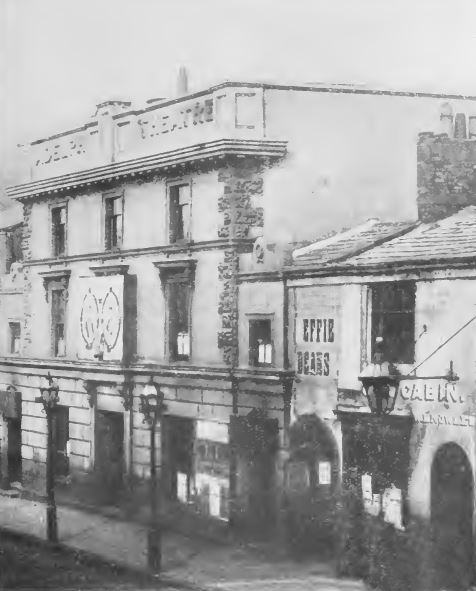
Recent research has confirmed that the 1902 tour extended as far North as Liverpool, where Edward Barton-Wright et al performed a week-long series of tournament contests and displays at the famed Adelphi Theatre in Christian Street.

As usual, the first notice Liverpudlians had of Barton-Wright’s impending visit came in the form of challenge notices printed in their local newspaper.  Lancashire was, of course, the birthplace of the renowned catch-as-catch-can style of wrestling, and a Liverpool Echo journalist picked the story up, commenting that although they had heard great things about the “New Art of Self Defence” from London, Lancastrians knew a thing or two about the grappling game and would adopt a “wait and see” approach:


Anglo-Japanese wrestling in Liverpool

The Bartitsu Self-Defence System

An orchid fancier, when he makes an important find or successfully hybridizes, generally perpetuates himself in the nomenclature of the plant. In the field of athletics Mr. Barton Wright seems to have done both, and, applying the first syllable of his own name to the Japanese phrase which is equivalent to our “to the finish”, gives to the world “Bartitsu” as the appropriate name of the system of self-defence for which he claims results that, to those ignorant of anatomy, might seem almost incredible.

Bartitsu in its fullness is described as consisting of a means of self-preservation against hooliganism, which enables a man a very slight build to hold his own against a giant. With the Japanese system of wrestling and its wonderful knowledge of anatomy as a basis, Mr. Barton-Wright has set himself to add to it by calling from other systems of wrestling as well as boxing, singlestick, etc., all that is most applicable to a perfect system of self-defense under all possible circumstances.

We of Liverpool, who in the past decade have seen more of championship wrestling than the rest of the world taken together, aren’t actually inclined to accepting anything regarding matters agonistic on the ipse dixit of any other place. If, however, all that is reported of Bartitsu from the Metropolis is such as we are likely to find it, Liverpool will not be behindhand in its acclamation.

Mr. Barton-Wright’s combination, including two celebrated Japanese wrestlers, who are credited with doing some wonderful things in resistance as well as attack, opens this evening a week’s performance at the Adelphi Theater, Christian Street, which has been very much brightened up for the occasion. These events, which seem to pit the Japanese system of wrestling against our own Lancashire style and to involve other equally interesting considerations, will be awaited with great expectancy.

– Liverpool Echo, 31 March, 1902 


It may be worth noting that “combination”, in this context, implies a team of professional athletes, and that the Echo journalist confused Pierre Vigny’s art of walking stick defence with the sport of singlestick fencing.

Another story appeared in the Echo a few days later (noting, as usual, that the term “Jap” was not pejorative during this period, being rather a simple abbreviation like “Brit” for “British” or “Aussie” for Australian):


Japanese wrestling in Liverpool

 Forthcoming visit of the Japanese exponents

If the “Japs”, in their enterprising and praiseworthy search after scientific knowledge, have had to borrow extensively from Britain and other Western nationalities, it appears that they are in a position to return the compliment by showing us some valuable “pins” and how best to take care of ourselves when threatened as individuals with personal hostility.

For quite a decade, Liverpool people have had the advantage over other centers, not excluding even the mighty Metropolis, and seeing by far the larger share of the championship Greco-Roman and catch-as-catch-can wrestling matches. On the other hand, in regards to the Bartitsu method of self-defence , regarding which such wonderful reports have for months been appearing in print, London has had the better of us.

At last, however, Mr. Barton-Wright is coming with his lightweight Japanese wrestlers to show what it what extraordinary results man of slight build, but armed with easily learned scientific knowledge, can obtain against heavyweight hooliganism. Mr. Barton-Wright is to open a week’s entertainment of a varied and attractive program on Monday next, in the Adelphi Theater.


The first exhibition, on the evening of March 31st, was received with great acclaim (although later reports suggested that the attendance on that night was low):


The Wonderful Japanese Wrestlers in Liverpool

 The Bartitsu Method of Self-Defence

Last evening, Mr. Barton-Wright and his athletic combination, who have for several months been creating such a furore among sporting circles in London, entered upon a week’s entertainment in the Adelphi Theater, Christian Street. In anticipation of the event, Liverpool people have seen so much of championship wrestling during several years, and are naturally rather chary in giving credence to the wonderful things related of Mr. Barton-Wright’s Japanese wrestlers and his combination generally.

Now that they have had an opportunity of witnessing it for themselves, there is no doubt about the superlative degree with which the verdict would be given. The neatness and lightning quickness with which falls occur in the Japanese practice is something that must be seen to be believed. Their performance consists of three classes of display, commencing with the foiling of sudden attacks by dextrous movement and sudden assumptions of the best wrestling positions with strength momentarily applied in the nick of time.

Following that are several wrestling bouts, in which the falls are obtained with equal dexterity, the feet, which are bare, playing an important and a wonderfully clever part in the struggle. Balance, or rather the sudden deprivation of it, obviously plays a very prominent part in these bouts, which can hardly be called “struggles”, so quickly is the controlling force brought into operation.

They also illustrate how effectually a man lying on his back may defend himself against an aggressor on foot, while giving far more than he receives. Several new counter checks for the cross buttock are also in evidence to the great admiration of the onlooking, and one artiste lying on his back, and held down by a pole across his throat, and kept in the position by the weight of two men on each side, releases himself by sudden exertion, the operation being so deftly performed that the eye can scarcely follow it.

That part of the display would of itself be a very fine entertainment for lovers of really scientific athletics, but several additional turns bear out both the novelty and the excellence of the whole display. The combination comprises a most remarkable exhibition of ball punching by Mr. D. Meier, described as the champion of the world and certainly the best we have seen in Liverpool.

La Savate is a style of boxing very much in evidence in France, but absent from Liverpool for very many years. A very able display of that art of self-defense is given by Pierre Vigny opposed to Wolfe (sic – should read “Woolf”) Bendoff, a well-known heavyweight boxer of decided ability.  Monsieur Vigny also gives an able exposition of the most comfortable and effective use of the walking stick in self-defence.

Not the least important item in the program is the catch-as-catch-can wrestling competition contended for each night with Armand Cherpillod, the celebrated Swiss wrestler. Last night the contest was between him and Charles Green, of Wigan, a well-known heavyweight who was pinned down upon his shoulders after fully 40 minutes industrious wrestling, in which the Swiss put in a kind of leg roll which was new to many of the spectators.

Tonight Cherpillod’s opponent will be the famous Joe Caroll, whose long and exciting struggles with the renowned American, Jack Carkeek, two years ago, are still well remembered. Mr. Sam Nixon officiated as referee last evening, and Mr. T. Walsh as timekeeper.


The Cherpillod/Carroll contest on Tuesday night was effectively a rematch of their famous catch-as-catch-can contest at London’s St. James’s Hall a few months prior.    After training with Tani and Uyenishi, Cherpillod had won the St. James’s Hall challenge match, and so his struggle with Joe Carroll at the Adelphi was the highlight of that evening’s action:


Japanese and European wrestling in Liverpool

Mr. Barton-Wright’s Wonderful Combination
Cherpillod and Joe Caroll in Catch-as-catch Can

 Mr. Barton-Wright’s remarkably clever combination of experts in Japanese and European wrestling, Bartitsu self-defence with a walking stick, boxing, savant, ball punching, etc. was again presented last evening to a highly appreciative Liverpool audience.

The Japanese secret art of wrestling by the two lightweights Japanese champions elicited tokens of unbounded admiration, and occasionally a good deal of laughter, on account of the apparently magical style in which falls were achieved. So suddenly and unexpectedly were they brought about as to elicit the general comment that they were far too quick for the eye to follow them. One noticeable point in regards to either contestant who scored a particular fall was that, however negligently he appears to be standing at the commencement, his attitude at the close of the movement was always the strongest and the most rigid which science could devise for the purpose.

A remarkably interesting item was a catch-as-catch-can contest between Cherpillod, the Swiss champion, and the celebrated Joe Caroll, who, in prospect of a match a month hence with Carkeek, the American heavyweight, found the event a good opportunity for training practice. Seldom have two men apparently more equally matched in skill and the other qualities essential to success been pitted together. Joe Carroll, as candidate for the 10 pounds offered on behalf of the Swiss, was in the position of defender, but he undertook a large share of the attack, and by his phenomenal bridge-making capacity repeatedly escaped from tight corners occurring through Cherpillod’s strong body rolls, half-Nelsons, etc.

Having succeeded in out-staying the 15 minutes, he was hailed as the winner of the 10 pounds offered as a forfeit. As he has accepted a second challenge for this evening, patrons of agonistic prowess may expect to see something in the nature of the object lesson in regard to clever points. Apart from this event, the general program is one which no lover of excellence in athletics should miss the opportunity of seeing them.


The Wednesday night programme ran much the same:


Mr. Barton-Wright’s Japanese Wrestlers

A Local Catch-as-Catch-Can Champion’s Acceptance
A Britisher and a Japanese Wrestler

Last evening’s program in the Liverpool Adelphi Theatre was highly intensified by a second contest between those redoubtable catch-as-catch-can celebrities Joe Carroll of Hindley and Cherpillod, instructor of the Bartitsu School of Arms. The time limit was set at 15 minutes.

Carroll, as the acceptor of the challenge, being nominally on the defensive, was really doing a full share of the aggressive work . In regard to Cherpillod’s body rolls and Carroll’s splendid defense on the bridge, the ballot was pretty much a repetition of that of the previous evening, but with intensified impetuosity and some very fine additional points put in on both sides.

Carroll successfully outstayed the 15 minutes, and, as he is considered a good man to take on upon a similar terms again, the limit for him will be extended to half an hour, with Carroll having the opportunity of earning double forfeit if he can’t obtain a fall within the time.

Mr. Barton-Wright’s general program is one which must really be seen more than once for an intelligent appreciation of Pierre Vigny’s remarkably fine walking stick defence, which leaves no part of the body unprotected for the 10th part of the second; Mr. D. Meier’s magnificent ball punching; M. Vigny’s display of the French savate against an English boxer, and the wonderful exploits of the Japanese wrestlers.

This evening’s bill is fare will not only include a bout between Cherpillod and Charles Green, of Lincoln, but the fulfillment of an acceptance by a local man of a challenge on behalf of one of the Japanese wrestlers. As the opponent in question is Roger Parker, winner of the 11 stone championship and Mr. Cannon’s catch-as-catch-can tournament of two years ago, the event will be of very great interest, as affording the first opportunity we of Liverpool have had of seeing a Britisher opposed to a Jap.


Barton-Wright’s ongoing difficulty in persuading English wrestlers to take on his Japanese grapplers under their own rules seems to have followed the troupe around the country.   Kenneth Duffield’s 1945 memoir Savages and Kings includes an amusingly exaggerated account of his own set-to with Yukio Tani at Cambridge University, in which the diminutive Tani was described and illustrated as if he’d been a sumo wrestler. 

The Liverpudlian catch wrestler Roger Parker was unusually courageous in accepting Barton-Wright’s challenge, though the subsequent match only lasted 90 seconds before Parker tapped out.


The Japanese Wrestlers in Liverpool

The attendance at the Adelphi theater last evening he gave unequivocal testimony to the remarkably rapid progress which Mr. Barton-Wright’s scientific and attractive entertainment has made in the favor of Liverpool patrons of athletics.

A house filled to repletion presented a remarkable contrast to the miserable gathering of the opening evening, which would probably have caused a less enterprising manager to shake the dust of Liverpool from his feet, but which did not deter Mr. Barton-Wright from persevering, knowing that his entertainment was one deserving well a very important section of the public to delight in patronizing athletics conducted with dignity and respectability, and carried on with the idea of selecting the fittest on their merits, and apart from individual or national considerations.

The customary items of ball punching by Meier, boxing and the Savate by Wolf Bendoff and Pierre Vigny, the wonderful defensive manipulation of the walking stick by M. Vigny and the magical science of the Japanese wrestlers were all applauded to the echo.

The piece de resistance of the evening proved to be a half-hour bout between Cherpillod, the wonderfully strong and clever Swiss catch-as-catch-can wrestler, and the celebrated Joe Carroll. It proved to be one of the nimblest and best conducted struggles as seen in Liverpool for many a day. The Swiss was, as usual, remarkably quick and strong in securing body rolls, but Carol was equally effective in his splendid bridge-making defence, and exceedingly quick and nimble in counteractive moves. Neither secured a fall, so that, according to the agreement, Carroll received 5 pounds for having outlasted the time, though he failed in earning a similar sum offered if he could throw the other man.

Cherpillod afterwards tried conclusions with Leo, the South African giant, who made a good defence in resistance of hammer locks and other moves for 13 minutes, but who was eventually disposed of before his allotted 15 minutes.

The Jap wrestler, who had got the better of Roger Parker on the previous evening in a minute and a half, Japanese-style, appeared on the stage in readiness to wrestle him (Parker) in the catch-as-catch-can style on the undertaking to put him down in 15 minutes. Parker failed to appear, but it was announced on his behalf that he would come forward this evening. It is also expected that Tom McInerney will appear as an opponent of Cherpillod on a half hour time limit, and that Ted Reece will also try for a forfeit against the Swiss in the ordinary quarter of an hour.

There is, therefore, every prospect of a very fine program of wrestling events added to the other admirable structures. Mr. Sam Nixon officiates as referee, and Mr. W. Walker as timekeeper. Mr. Barton-Wright announced that he was willing to back Cherpillod for 25 pounds or upwards in his own style against any man in England.


Unfortunately, although the Echo noted again on Saturday afternoon that Cherpillod was scheduled to take on two local opponents, namely Tom McInerney and Ted Reece, and that Roger Parker intended to compete again with either Yukio Tani or Sadakazu Uyenishi, there seem to be no detailed records of the final night’s exhibitions. Research is ongoing …

By March the troupe had arrived in Liverpool, where local journalists evinced a hard-nosed “wait and see” attitude regarding the announced highlight of the tournament, which would pit jiujitsuka Yukio Tani and Sadakazu Uyenishi against Lancashire-style wrestling challengers. Reacting to the advance publicity notice, one reporter also uniquely and aptly compared E.W. Barton-Wright’s innovation in naming “Bartitsu” to that of an orchid fancier who incorporates his own name into the nomenclature of a new hybrid flower.

The actual demonstrations and contests played out much as they had during previous engagements, the Japanese athletes acquitting themselves admirably against tough and talented locals (albeit, as usual, under jiujitsu rules) and Armand Cherpillod defeating a heavyweight Liverpool hopeful.

Posted in Academia, Bartitsu School of Arms, Canonical Bartitsu, E. W. Barton-Wright, Edwardiana, Jiujitsu, Wrestling | Comments Off on The “Great Anglo-Japanese Tournament” at the Adelphi Theatre in Liverpool

The “Dwarf of Blood” on Bartitsu (June-October, 1900)

The following accounts were written for the Sporting Times by a journalist styling himself as “The Dwarf of Blood”.  Many Sporting Times columnists used similarly colourful pseudonyms – “The Pitcher”, “The Shifter”, “The Master”, et al.

The author of these articles was actually Colonel Nathaniel Newnham-Davis, a gourmet and bon vivant who was best known as a London restaurant critic.  Newnham-Davis had received his nickname during the preparations for an impromptu pantomime, performed as an after-dinner entertainment under the direction of famed music hall chanteuse, Miss Bessie Bellwood.  The principal parts having been cast, Miss Bellwood assigned to the Colonel the role of the Dwarf of Blood, tasked with emerging from beneath the dinner table and groaning “at the appropriate time”.  The nickname stuck with him for life.

Colonel Newnham-Davis, who was also a founding member of the mysterious “Order of the Black Heart”, took an ongoing interest in Bartitsu and produced a series of entries on that subject for “the Dwarf of Blood’s” regular Sporting Times column, “Around the Town”, between 1899 and 1901.

Sporting Times –Saturday, 09 June, 1900

If Mr. Barton-Wright wants advertisement for Bartitsu, he has got it very thoroughly through Otojiro Kawakami and his company, who have been playing at the Coronet Theatre. To see the gallant Samurai in the second act of the little play, by twists, catches, and kicks, dispose of four assailants at once is a lesson in the art of using skill against brute strength. Nor is the gentle Madame Soda Yacco behind him in this art. She, as a Geisha, sends four Buddhist priests sprawling to earth. Theatrical criticism is in Bill of the Play’s department, otherwise I should like to rave for half column over the quaint intensity of the principal players. If the company revisits London after the Paris Exhibition I should advise all and sundry to and see them.

https://youtu.be/7BBtBYq0UgM?t=237
Above: film footage of the “Samurai” fight scene described by Colonel Newnham-Davis.

Sporting Times – Saturday, 20 October, 1900

(N.B. that the term “Jap” had no pejorative meaning in Edwardian English, being more in the nature of a simple abbreviation like “Aussie” for Australian or “Brit” for British.)

There was private show of “Jujitsu,” the new Japanese art of self-defence, at the Alhambra on Wednesday last. Mr. Barton-Wright was in the place of showman, and his usual bad luck on these occasions stuck to him, for he had to begin the proceedings with an explanation and an apology. The Japanese professors of Jujitsu — which Mr. Barton-Wright says means “fighting to the last,” but which I had always understood to mean “the gentle art”—who have come to this country are three in number; but, when they understood that they were to appear place where money is taken, they made difficulties in the matter, and Mr. Barton-Wright was looking forward to an interview with them before the consul of their country to try and have matters put square.

The reluctance of the professors to do anything that they consider might be disparaging to their position or their art comes from the curious origin of Jujitsu. At one time it was secret art, and to those to whom it was taught an oath was administered that its principles should not be communicated except under conditions that would render its abuse almost impossible, and the recipients of the knowledge had to be men of perfect self-command and of good moral character.

Mr. Kano Jigoro, however, the principal of the higher normal school in Tokio, who is himself splendid athlete, established throughout Japan schools of the art, in order that, by learning it, the Japanese gentleman, in spite his small size, might be at no disadvantage in rough and tumble fight. He also invented Judo, form of fighting in which the falls are given standing. Therefore the art has a particular status of its own, and the semi-sacred mystery which surrounded it at one time has scarcely yet worn off.

Mr. Kano, the inventor of Judo, is splendid exponent of the two arts, men who have seen him give exposition of them tell me. Part of the training for Jujitsu—and it takes three years to make a perfectly trained man, they say in Japan, and seven to make professors – is to harden the muscles of the neck so thoroughly, that strangulation is impossible. To show how hard his muscles are, Mr. Kano puts a pine wood pole across his throat and lets two 14st men sit on the ends, releasing himself by jerk given with the throat muscles. A parallel feat, though not so effective, was performed by one the professors at the Alhambra.

Above: Yukio Tani’s version of the pole trick.

The other bit of bad news that Mr. Wright had to tell on Wednesday was that the bout with canes promised between two of his professors was off, for one of the two Bartitsu gentlemen had been having a bout with a Jap the day before, and had been thrown so violently that his shoulder was badly hurt.

A large square of matting had been nailed down on the floor, and the two Japanese professors, one a powerful man, who looked as if be weighed somewhere between 12st and 14st, and the other an 8st man, came on the stage. They were dressed in the orthodox costume of a wadded cotton coat with short broad sleeves, cotton belt, and wide silken trousers; but they omitted the orthodox salutes of touching the mat with their foreheads.

bartitsu-club-demo
Above: Bartitsu Club instructors demonstrate jiujitsu.

The first exhibition of series of grips and throws was difficult to follow, so quickly were they done. Then the two men wrestled and fought couple of bouts at Jujitsu, a form of fight in which there is no such thing foul play, and the smaller man was, in the first one, held in such grip that his arm would be broken if did not declare him self vanquished. Then followed the tour de force of supporting the weighted pole on the throat; but the rod used was too lissom for the feat to convincing. Next the smaller man, taking as his subject the biggest man in the audience, showed how easy it was to give him a fall by using his adversary’s weight against him.

pole-tricks
Above: Tani demonstrates two pole tricks.

The bigger man of the two then put the end of the pole against muscles his throat, and allowed one of the audience to push against him with one hand.

Then the talking began, for a gentleman of ripe years, alluded to affectionately by most of the audience as “Charley,” was not quite satisfied with the pushing experiment of arm against throat, and had something to say as to leverage and the Georgia Magnet. Whether he wanted make a match between the little American lady and the big Jap, we in the stalls could not quite catch; but when the discussion was at its height, Mr. Barton Wright appeared from behind the scenes with a message from the big Jap. He (the big Jap) would stand against the wall, and let the doubting gentleman push with the pole as hard as be could against his throat, if afterwards the doubler would wrestle a fall with him.

There was general feeling amongst the pressmen present that the weather was too cold to attend funerals, so the champion of the Georgia Magnet was dissuaded from accepting the offer.

Whether Mr. Barton Wright will persuade the Japanese to appear in public, and whether, if they do, it will be show that an ordinary British audience will understand, I cannot tell; but that has no bearing the value of Jujitsu and Bartitsu, into which the catches, grips and throws of Jujitsu have been absorbed. It is a training by which a light but athletic gentleman can overcome the brutal and heavy rough, and I should like to see in all the great public schools when there are gymnasiums, the art made part of the physical training. Every boy is taught how to put up his hands so that he can give account of himself in a fair fight; he should be trained in Jujitsu, or Bartitsu, so that he can make good struggle of it if beset upon by Hooligans.

Posted in Canonical Bartitsu, E. W. Barton-Wright, Edwardiana | Comments Off on The “Dwarf of Blood” on Bartitsu (June-October, 1900)

“What To Do When A Thug Attacks You”: Still More on the Latson Method of Self-Defense

  • Originally published on the Bartitsu.org site on Monday, 21st November 2016

The following article dated July 16, 1911 serves as a further explication of the curious “Latson Method of Self Defence”.  Aside from its clear parallels with Bartitsu, as a combination of jiujitsu with savate and umbrella self defence, the Latson method is notable for the bizarre tragedy and scandal that enveloped its only two known practitioners – Dr. William Latson and his apprentice, secretary and lover Ida Rosenthal, also known as Alta Marhevka.

Dr. Latson died, under very mysterious circumstances, about two months before this anonymous article was published.

_______________

Last week several methods of self-defense by which any woman may protect yourself against footpads and rowdies were given in this paper. Today we are able to present some further suggestions along the same line.

It was pointed out last week, but the caution may well be repeated, that in these days of rowdy–infested streets, minding one’s “own business” is by no means a guarantee against insult or attack. Nothing short of the power to take the law into one’s own hands and administer summary punishment to the offender really meets the situation.

Every woman of average physical strength, courage and self-control owes it to herself and to her weaker sisters to acquire a few of these serviceable tricks, by the help of which she can put the boldest thug at a disadvantage and discourage others of his calling.

The art of striking a blow with the utmost force and efficiency is to be gained only by years of careful study and training. To describe, however, how a blow should be struck, can be done in a few words.

The first step is to gain thorough ease and freedom by the practice of the simple physical exercises described below. This once gained, all that is needed is to practice the same exercises, increasing the amount of swing used in moving the arms forward and backward in a circular direction. Then, as the arms are moved forward, clench the fist and strike, not forcibly, but easily and lightly at an imagined antagonist. A punching bag will prove of great assistance in practice.

It must always be remembered that the power of the blow depends not upon the strength of the individual scratching it, but on the rapidity with which the fist is moving forward, and upon the weight which is thrown behind it.

The following tricks of defense can be acquired by almost any woman who is willing to devote a little bit of her time to the task. There is no telling when one may be called to put them in to practice:

In defending oneself with the naked hands, as well as in self-defense with walking stick or umbrella, the most important point is the position of the body. As has been said, to stand correctly with arms extended and stick in the hand, will of itself put the body into a position in which it is not easy to be attacked. It is equally true that to take a position, even approximately correct, with the arm outstretched in front, is to put the untrained adversary at a most striking disadvantage.

To one who has gained this simple art of placing the body in the method best adapted for self-defense with the naked hands, it will be very easy matter to learn to strike a blow which will posses many of the characteristics distinguishing the attacks of the trained pugilist. Of course, the average woman will be unable to strike with a force at all comparable to that of the skilled prize fighter, but the ease, freedom and rapidity which are most valuable in fist fighting she can easily acquire.

The illustration above shows how effectively a blow delivered by a footpad either with the bare fist or a weapon may be blocked with an umbrella skillfully handled.

A simple exercise to develop skill in the use of the umbrella as a weapon of defense is as follows:

Hold the umbrella extended straight out in front of you, grasping it about two-thirds from the end. Swing body and umbrella making a wide circle. Then, approaching a pad or pillow placed upon a table or mantelpiece, strike it a hard blow, making this part of the general swing of the body from left to right.

latson-2
The position which would naturally be taken by a woman in delivering a telling blow is well illustrated in the above photograph, the effectiveness of a blow depends largely upon the manner in which the body is controlled.

Adeptness in this respect will be developed by practicing the following exercise:

Stand with feet about fifteen inches apart, left foot in advance. Head is lowered and turned toward left. Rise upon the balls of the feet; swing easily up and down without touching heels. Swing weight easily back and forth.  Extend arms straight up in front of the body, left hand on a level with face, right a little lower and nearer to body.  Move slowly up and down the room swinging the arms and body with the utmost freedom possible but always return to about the same position.

Kicking as a means of defense is demonstrated most perfectly in the French system known as savate. Skill in kicking may be obtained by any woman by practicing the following exercises.

Exercise one – stand easily. Take weight upon left foot. Swing right easily back and forth, gradually increasing movement.

Exercise two – same as preceding, save that the weight is taken upon right foot and the left leg is swung.

Exercise three – stand easily, take weight upon left foot and swing the right in a circle as far upward, outward and backward as possible. Circles should be made both forward and back.

latson-3
How to deliver the rapid and effective kick is shown in the illustration directly above.

The French system of kicking is most complex. It consists of various kicks, guards and counters made with both feet.

The system as taught by leading French exponents is one of the most superb methods of exercise known. It provides attacks which are absolutely indefensible even to its own experts.

As a means of defense, it is, of course, most valuable when used against those who are not versed in its tactics.

The Japanese art of jiujitsu in its entirety is far too intricate for the average woman to master.

latson-4

There are several little tricks in the system, however, which may be readily acquired. The illustration above shows one of them.

The man in the picture advanced towards the woman with his right foot forward and his right arm extended either to strike or grasp her. Grasping the man’s extended hand and wrist, the woman steps forward so that her right foot is behind his right and twists his hand upward and backward.

This trick, effectively executed, will place the assailant at the woman’s mercy.

In the advanced jujitsu there are many tricks by which a woman might render her assailant unconscious or even cause his death.

Such knowledge, and its justifiable use, will be invaluable to women when attacked under atrocious circumstances. Even then it is not necessary to kill, as jujitsu provides many ways in which an assailant may be rendered in sensible, and kept so until help arrives.

But, for ordinary purposes, the simpler tricks will suffice to protect the woman who is obliged to face the perils of city streets unescorted at night.

Posted in Antagonistics | Comments Off on “What To Do When A Thug Attacks You”: Still More on the Latson Method of Self-Defense

“Should an Assailant Strike at Your Wind or Heart with His Right Fist”: an Anomalous Canonical Bartitsu Technique Illustrated

  • Originally published on the Bartitsu.org site on Saturday, 26th November 2016
new-art-header-2

In April of 2010 the Bartitsu Society discovered a “new” entry into canonical Bartitsu unarmed combat.  This self defence kata or sequence appeared as part of a reprint of E.W. Barton-Wright’s “New Art of Self Defence” article series in the June, 1899 American edition of Pearson’s Magazine.  Curiously, the sequence had not appeared in the original and better-known English edition and, also curiously, it was the only sequence in the American edition to be described in text but not illustrated with photographs.

Compounding the mystery is the fact that the sequence is titled “One of Many Means of Defence when a Man Strikes at You Low or Below the Belt”, which does not actually match Barton-Wright’s subsequent description of the techniques.  This may imply that the American Pearson’s editor confused two separate titles and descriptions, in which case there may be at least one more, as yet undiscovered, entry into the Bartitsu canon.

Here follows the sequence in question, as written by Barton-Wright and now illustrated for (possibly) the first time.  Note that the camera perspective reverses between numbers 2) and 3), to afford the viewer a better look at the techniques.

No. 1.—One of many Means of Defence when a Man Strikes at You Low or Below the Belt.

american-1

Should an assailant strike at your wind or heart with his right fist, step backward with your right foot, and in doing so place your right hand over your heart, with the palm outward, and grasp his wrist by placing your left hand over his wrist (the placing of the right hand over the heart is only a precautionary measure in case you miss catching his wrist when he leads off at your body).

american-2

As soon as you feel you have hold of his wrist, pull it towards you with a slight outward motion leftways, take a step forward with your right foot, placing it behind his right leg, and seize him by the throat, pressing your thumb into his tonsil or just under the back of the ear, which is extremely painful.

american-3

Then with a sharp leftward pull with the left hand, and a thrust or a push leftward with the right hand (keeping your right calf or the side of your knee tightly behind his right knee), you throw him on his back.

american-5
The photograph of this technique is modified from an essay on self defence in The Universal Book of Hobbies and Handicrafts (1935).

Retain your hold on his throat and ear, and dropping upon the right knee you pull his arm towards you so that his elbow is just across your thigh. With the slightest pressure you could break his arm. At the same time you extend your right arm vigorously and press your thumb well into the cavity under the ear, which will cause great pain, preventing him from getting up.

Posted in Antagonistics, Canonical Bartitsu, Instruction, Jiujitsu | Comments Off on “Should an Assailant Strike at Your Wind or Heart with His Right Fist”: an Anomalous Canonical Bartitsu Technique Illustrated

“Proof of Great Strength”: Grappling with the Kibbo Kift Kindred

  • Originally published on the Bartitsu.org site on Friday, 9th June 2017

Exemplifying the virtues and limitations of the early 20th century “self-taught man”, John Hargrave (1894-1982) was accomplished in a variety of fields.  A senior scoutmaster possessing great powers of imagination, energy and charisma, Hargrave’s experience of war during the Battle of Gallipoli caused him to become bitterly disillusioned with the nationalism and militarism of Sir Robert Baden-Powell’s Scouting movement.

When the Great War ended, Hargrave broke from the Scouts and created a pacifistic, progressive and universalist alternative youth movement, which became known as the Kindred of the Kibbo Kift.  “Kibbo Kift”, Hargrave maintained, meant “proof of great strength” in an archaic and obscure Cheshire dialect.

Although never very great in numbers, the Kindred were highly active and influential throughout the 1920s, attracting support from writer H.G. Wells and former suffragette Emmeline Pethick-Lawrence among other socially progressive thinkers.  Indeed, Wells’ 1905 novel A Modern Utopia, with its vision of a “New Samurai” class of creative, disciplined and self-actualised individuals leading the world towards a future free of war and poverty, was a clear model for Hargraves’ counter-cultural movement.

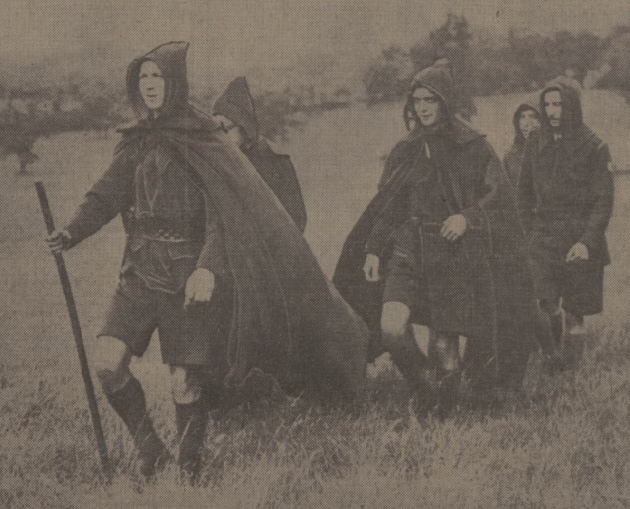
The Kibbo Kift adopted a romanticised Anglo-Saxon motif, including a uniform of green jerkins, hoods and cloaks. Thus attired, they set out on strenuous camping and hiking expeditions, staged elaborately theatrical rituals and mystical plays, produced strikingly original handcrafts and costume art, all according to Hargrave’s comprehensive philosophy for the betterment of each individual Kin member and the wider society.

Above: echoes of Robin Hood as young members of the Kibbo Kift embark on a bracing cross-country hike.

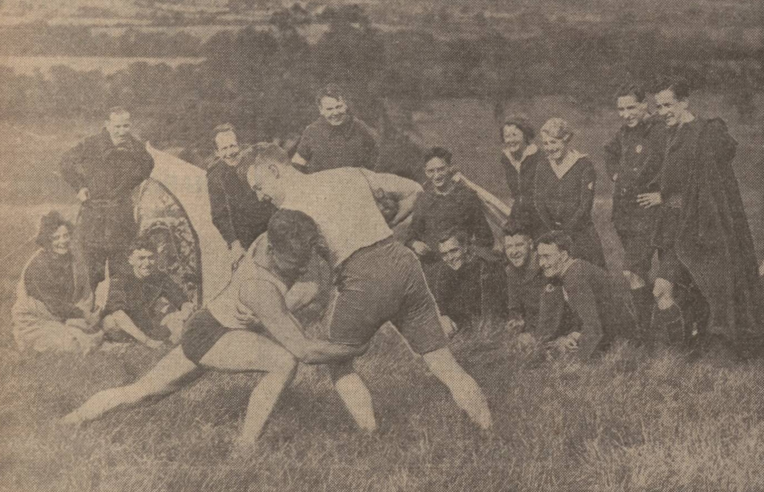
Although the Order of the Kibbo Kift was an avowedly pacifistic organisation, it also promoted physical fitness and the ethic of self-reliance, which included self-defence if necessary.  Therefore, along with archery and “fleetfoot” (running races), Hargrave – whose name within the Order was “White Fox” – instituted a type of wrestling sport called “thewstrang”.  This word was taken to mean “muscular strength”.

Above: Thewstrang as demonstrated by two stalwart Kibbo Kift Kinsmen.

Unlike most English folk-styles of wrestling, Thewstrang did not mandate any particular opening grip, nor insist that a specific grip should be held throughout the match.  In common with the Lancashire catch-as-catch-can style, it allowed holds to be taken below the belt-line.  The object appears to have been to throw one’s opponent to the turf, although it’s possible that – like the roughly contemporaneous “standing catch” style – one could also win by simply hoisting an opponent helplessly off his feet.

Thewstrang matches were mainstays of Kindred meetings, including a tournament held at their main annual camping gathering which was known, after the Icelandic custom, as the “Althing”.

During the economic and social turmoil of the 1930s Hargrave attempted to transform the Kindred of the Kibbo Kift into a political movement, agitating for the institution of a radical, Social Credit-based economic reform.  Members of his quasi-militaristic Green Shirt Brigade frequently exerted their “thewstrang” in clashes with Sir Oswald Mosely’s fascist Black Shirts during political rallies and marches through the streets of London.

A Hargrave supporter, Hubert Cornish-Bowden, recalled the wrestling technique he’d used during a brawl at a Mosely meeting:

We were carrying a banner and a chap tried to pull it down. I gave him a biff and then I found myself on the floor with about four people kicking me. Unfortunately, it was very dark and when one is lying in the gutter being kicked it is rather difficult to distinguish one person’s legs from another’s. And I caught hold of a policeman’s foot. Got hold of his toe in one hand and his heel in the other, and twisted it. Of course he fell down. Next thing I knew, either three or four policemen were carrying me out of the meeting, one on each arm like that and with one or two holding my feet. What they call the frog march. They fined me £3 at the London Magistrate’s Court.

Another Green Shirt (appropriately named Ralph Green) made the news when, inspired by Robin Hood, he shot an arrow through the window of No. 10 Downing Street, proclaiming that “Social Credit is coming!”

The activities of the Green Shirt Brigade and similar paramilitary movements were curtailed by the Public Order Act of 1936, which banned the wearing of uniforms by political groups, and then the membership was scattered by the outbreak of war in 1939.  Thereafter, John Hargrave gradually withdrew from the public spotlight.  Although his notably creative efforts at progressive social reform had been largely forgotten by the time he died in 1982, it could be argued that some of them were simply decades ahead of their time.

Posted in Academia, Wrestling | Comments Off on “Proof of Great Strength”: Grappling with the Kibbo Kift Kindred

The King’s Man Movie Offers More Cane and Umbrella Fight Action

After an enjoyable original outing and a disappointing sequel, the Kingsman movie series shifts temporal gears to offer a prequel set during the early 20th century. The King’s Man trailer below confirms that Bartitsu aficionados can look forward to some more deft cane and umbrella play, alongside that of the sword and the bayonet:

Fun fact: actor Ralph Fiennes has some prior experience playing a debonair secret agent with a penchant for deadly brollies, having also portrayed John Steed in the otherwise ill-fated Avengers movie (1998). Here’s a short and sweet training scene from that film, with fights choreographed by the late, great William Hobbs:

Originally scheduled for release in February of 2020, The King’s Man has been pushed back due to the COVID-19 crisis. Fingers crossed that this movie will represent a return to form for the franchise.

Posted in Pop-culture, Video | Comments Off on The King’s Man Movie Offers More Cane and Umbrella Fight Action